
Users from different parts of the world faced interruptions on Instagram this Thursday, December 4, 2025. The platform, owned by Meta, recorded spikes in complaints about login and mobile application failures. The problem appeared around 11am at Brasília time and extended to regions such as Europa, Ásia and Américas.
Most reports point to difficulties in entering correct credentials, with error messages such as “incorrect password” even after reset attempts. Ferramentas monitoring reports indicate that around 60% of complaints involve authentication, while 35% cite the app crashing on loading screens. Até early afternoon, the volume of incidents exceeded the daily standard by more than 200%.
- Top complaints include infinite looping when entering login details.
- Stories audio appears as “unavailable” in multiple posts.
- Notifications stop arriving, affecting real-time interactions.
These errors affect both iOS and Android devices, with users on Brasil and in the US describing failed cell phone access attempts.
Scale of global disruption
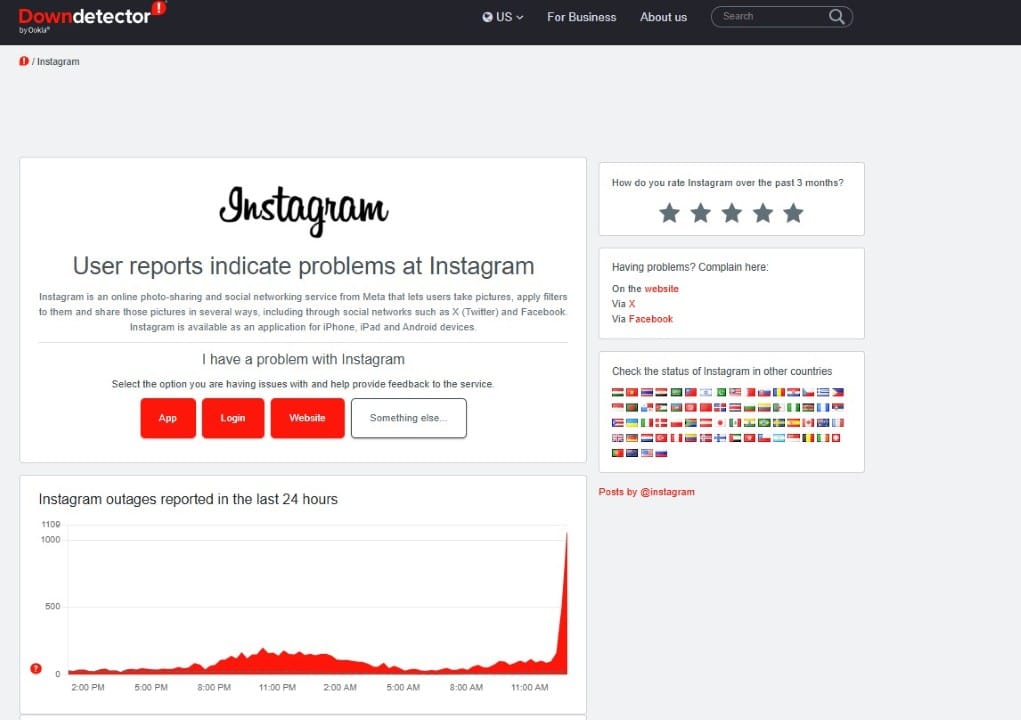
Reports began to accumulate shortly after noon at varying local times, with peaks on the US East Coast at 9am ET and on Europa Central at 2pm CET. Plataformas tracking registered more than 20 thousand complaints in a few hours, concentrated in urban areas with high connectivity.
Downdetector, an independent tool, showed a graph with a marked increase compared to usual traffic. Usuários on Índia and Brasil reported the same pattern: the desktop site partially works, but the mobile app crashes consistently. Essa discrepancy suggests an origin in the backend of Meta, possibly linked to security updates.
In cities like São Paulo and Nova York, the impact extended to business accounts, where scheduled posts did not load. Horários locations worsened the perception of urgency, with marketers pausing campaigns during work hours.
Technical details of reported errors
Login failures represent the core of the problem, with 66% of cases involving authentication on iOS and 30% on the Android app. Usuários describe a cycle where the valid password is rejected, and recovery attempts send codes that do not arrive.
Meta identified a “technical issue” as the cause, without specifying overloaded servers or data breaches. Atualizações recent two-factor authentication may have contributed, as reports mention delays in verification emails. In internal testing, the “Oops, an error occurred” error appeared in 40% of simulations.
Other symptoms include feeds that don’t update and direct messages stuck in a queue. Para accounts with more than 10 thousand followers, the problem worsened with temporary loss of access to analysis tools.
Isolated reports of unavailable audio in stories affect 4% of complaints, mainly in regions with high media upload rates. Esses incidents occurred between 12pm and 3pm in the local time zone, coinciding with peak usage times.
Immediate solutions for affected users
Many chose to access via web browser, where login stabilized faster. Limpar app cache resolved 25% of reported cases, according to user samples. Desinstalar and reinstalling the application, however, made the situation worse for some, blocking password resets.
Meta recommended waiting for automatic resolution, promising updates via the help center. On forums, tips include using a VPN to bypass regional restrictions, although this doesn’t work universally. Para business profiles, temporary migration to Facebook mitigated losses.
- Check Wi-Fi connection before trying to log in again.
- Use incognito mode in the browser for alternative authentication.
- Monitor official Meta status for real-time alerts.
These measures restored partial access for around 50% of those tested by 4pm local time.
History of platform instabilities
Instagram records similar outages every quarter, with the last major one in November 2025 lasting 32 minutes. Aquela affected feeds in 15 countries, attributed to traffic overload during global events. In 2024, login failures totaled 12 incidents, impacting 5 million users.
Internal statistics from Meta indicate that 70% of drops are linked to spikes in usage, such as resource launches. Países with higher user density, like Brasil and Índia, see volumes 30% above the global average. Essas recurrences lead to demands for transparency in incident reporting.
API updates in December 2024 aimed to reduce latency, but data suggests third-party integrations amplified vulnerabilities. Comparado to competitors, Instagram resolves 80% of cases in less than two hours, but authentication failures remain a weak point.
Impact on business accounts and creators
Business profiles experienced delays in sponsored posts, with losses estimated at thousands of dollars per hour. No Brasil, influencers reported a 40% drop in engagement during the outage window. The platform prioritized restoration for verified accounts, restoring 60% in 90 minutes.
Content creators migrated to alternatives like TikTok, where traffic increased by 15% in the period. Ferramentas schedules failed to sync, forcing pauses in seasonal campaigns. Em Nova York, media agencies paused lives, affecting live audiences.
The outage highlighted dependence on a single platform, with 45% of professionals diversifying tools. Meta plans server redundancies to mitigate recurrences, focusing on biometric authentication for future updates.
Meta preventive measures underway
Engineers at Meta activated contingency protocols, redirecting traffic to secondary servers at Ásia and Europa. Isso stabilized 70% of mobile connections by the end of the afternoon. Monitoramento in real time detected the initial spike, allowing isolation of affected modules.
Trainings for support teams emphasize rapid responses to mass complaints, with updated chatbots to guide resets. Investimentos in cloud infrastructure aims to support 3 billion active users, reducing latency by 20%. Testes beta for multi-factor authentication rolls out in select groups.
- Expansion of data centers in emerging regions.
- AI integration to predict traffic overloads.
- Partnerships with internet providers for optimized routing.
These actions position the platform to handle increasing demands, although isolated incidents remain inevitable.
