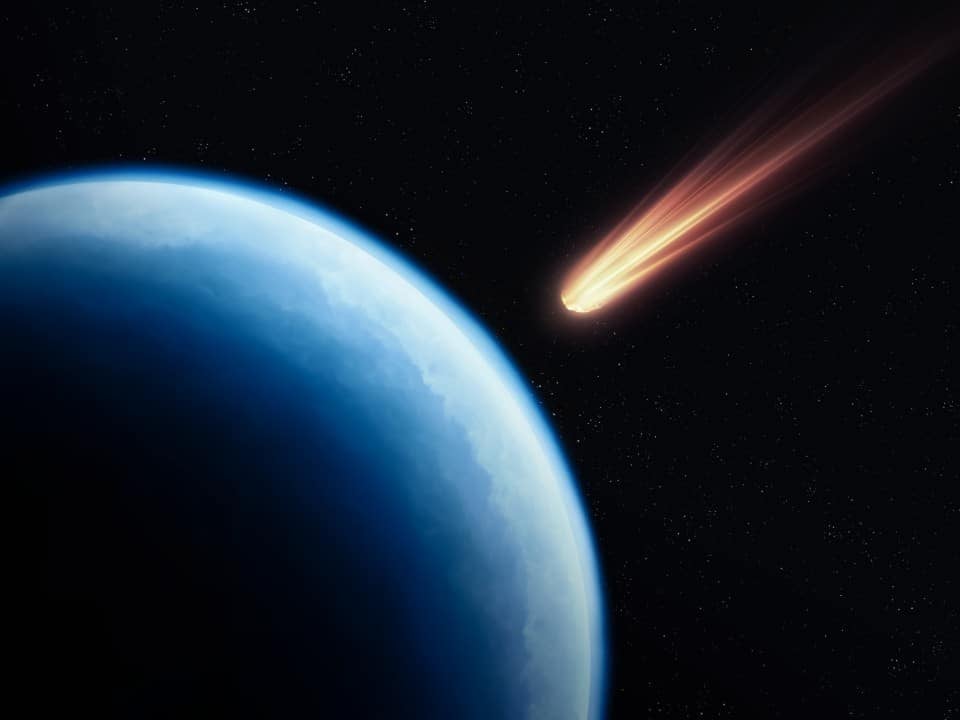
Comet C/2023 A3 (Tsuchinshan-ATLAS), one of the most anticipated celestial objects by the astronomical community, continues to be the focus of intense analysis by scientists around the world. Descoberto in January 2023, this icy body, which made its closest approach to Sol and Terra in the last months of the previous year, continues to reveal unique characteristics that defy expectations and drive new research into the formation of the solar system.
The journey of Tsuchinshan-ATLAS, originating from the distant Nuvem of Oort, has captured the attention of not only professional astronomers but also night sky enthusiasts, who have followed its increasing brightness. Sua passage offers a unique opportunity to study the composition of primordial material, virtually untouched since the beginnings of the universe, around 4.5 billion years ago.
The data collected during their maximum visibility is being processed by several teams, aiming to better understand the dynamics of these cosmic travelers. Current studies focus on crucial aspects such as the comet’s degassing rate, the structure of its tail and interactions with the solar wind, providing valuable information for planetary science.
Orbit and composition analysis
The orbit of comet C/2023 A3 (Tsuchinshan-ATLAS) is remarkably eccentric, indicating a trajectory that took it from the outermost regions of the solar system to a brief encounter with the vicinity of Sol. Essa orbital characteristic suggests that the comet is on its first pass through the inner solar system, which makes it an even more valuable object of study as its volatile material has not been significantly altered by multiple stellar encounters.
Scientists use spectroscopy to investigate the chemical composition of Tsuchinshan-ATLAS, seeking to identify organic molecules, water, carbon dioxide and other elements present in its core and coma. Analysis of these substances can offer clues about the chemical and physical conditions that prevailed when planets were forming, helping to unravel the history of our cosmic neighborhood.
Expectations for future observations
Although the phase of maximum visibility of comet C/2023 A3 occurred at the end of the previous year, scientific interest in its behavior and remaining characteristics persists. Instrumentos high-powered space and ground-based telescopes continue to monitor the object on its return journey to the coldest regions of the solar system. Espera It is expected that new analyzes of data already obtained, combined with possible long-term observations, will reveal additional details about its post-perihelion stability, the evolution of its tail and the possible fragmentation of parts of its nucleus. The expectation is that the in-depth study of its trajectory and composition will help refine planetary formation models and understand how comets may have delivered water and organic compounds to the primitive Terra.
The phenomenon in the night sky
Thousands of people around the world had the opportunity to observe comet Tsuchinshan-ATLAS during its brightest period. Although Embora did not reach the “great comet” magnitude that some expected, its naked-eye visibility under ideal conditions, especially in places with little light pollution, provided memorable moments for observers.
The comet’s passage served as a vivid reminder of the vastness and beauty of the universe, stimulating interest in astronomy among the general public. Clubes astronomy and observatories organized special events to share the spectacle, using telescopes to offer more detailed views of the comet’s nucleus and tails.
Contribution to planetary science
Comets like Tsuchinshan-ATLAS are considered time capsules of the early solar system. Eles preserve material that existed before planets formed, offering a direct glimpse into early conditions.
The detailed study of these objects contributes significantly to the understanding of the origin of water in Terra and the presence of organic molecules essential for life. Analysis of their volatile samples could reveal whether Terra and other rocky planets received their essential components via cometary impacts.
The data collected helps calibrate theoretical models about the evolution of protoplanetary disks and planetary migration dynamics, providing empirical evidence for complex hypotheses about how our solar system became what it is today.
Challenges in data collection
Observing and collecting data from comets presents considerable challenges for astronomers. The unpredictability of their brightness and the formation of their tails, which can vary drastically over short periods, require continuous and adaptive monitoring.
The comet’s distance and speed also impose limitations on instruments, which need to be calibrated to capture high-resolution images and spectra as the object moves rapidly across the field of view.
Furthermore, interference from the Earth’s atmosphere, with its turbulence and light pollution, can obscure observations, especially for comets that are less bright or in phases of less activity.
International collaboration between observatories and space agencies is essential to overcome these obstacles, allowing the combination of data from different locations and techniques for a more complete and robust analysis.
Preparation for celestial events
For future high-visibility celestial events, advance preparation is crucial. Astrônomos amateurs and the public are encouraged to consult reliable sources of information, such as space agencies and observatories, for the best guidance on observing times, locations, and appropriate equipment.
Comet’s legacy
Comet C/2023 A3 (Tsuchinshan-ATLAS) will leave a lasting legacy in the scientific community, not only for its visibility, but for the crucial information that its ongoing analysis will provide. Ele reinforces the importance of tracking programs for objects close to Terra and space missions dedicated to the study of comets and asteroids.
The discoveries made following its passage will enrich human knowledge about the origin of the solar system and the dynamics of celestial bodies. The comet will serve as a catalyst for the next generation of astronomical research, inspiring new studies and enhancing our understanding of the universe.
