Scientists across the globe are keenly observing a newly identified interstellar comet, designated 3I Atlas, as it continues its unprecedented journey through our solar system in 2025. This celestial visitor, believed to be the third confirmed interstellar object, has captured the attention of astronomers and the public alike, promising invaluable insights into the composition of matter from beyond our sun’s gravitational influence. Its unique trajectory and characteristics make it a prime target for extensive study by NASA and its international partners, utilizing the most advanced telescopic arrays and data analysis techniques available today.
The discovery of 3I Atlas has ignited a new wave of excitement within the astronomical community, offering a rare opportunity to examine pristine material from another star system. Unlike objects originating from the Oort Cloud, interstellar comets carry traces of their birth environment, providing direct samples of extrasolar chemistry and physics. This makes 3I Atlas a cosmic messenger, delivering clues about planetary formation processes in distant stellar nurseries.
Initial observations suggest 3I Atlas exhibits a remarkably stable coma and tail, indicating a composition that has remained largely intact despite its long voyage through interstellar space. Researchers are particularly interested in its volatile content, which could differ significantly from comets native to our solar system.
Unprecedented interstellar visitor
The initial detection of 3I Atlas in late 2024 by automated sky surveys quickly triggered a global alert, leading to a coordinated effort to track its path and characterize its properties. Confirmation of its hyperbolic orbit in early 2025 solidified its status as a bona fide interstellar object, marking a monumental occasion for planetary science.
This confirmation places 3I Atlas in an exclusive category alongside ‘Oumuamua and Borisov, the only other interstellar objects definitively identified to date. Its cometary nature, however, distinguishes it from ‘Oumuamua, offering a more direct comparison to 2I/Borisov and allowing scientists to study the activity of volatiles in a truly alien environment.
NASA’s observational strategy for 2025
NASA has mobilized an extensive array of resources to monitor 3I Atlas throughout 2025, deploying both ground-based telescopes and space-borne observatories. The James Webb Space Telescope (JWST) is playing a crucial role, providing high-resolution spectroscopic data that reveals the comet’s chemical makeup, including trace elements and complex organic molecules.
Additionally, the Hubble Space Telescope (HST) is delivering vital optical and ultraviolet images, helping astronomers to map the comet’s morphology, monitor its outgassing activity, and precisely track its trajectory. Complementary data from large ground-based observatories, such as the Keck Telescopes and the Very Large Telescope (VLT), are enhancing these observations, offering continuous coverage and detailed analyses of its light curve and spectroscopic signatures.
The agency’s long-term observational plan for 3I Atlas includes continuous monitoring as it approaches its closest point to the Sun and then recedes, allowing scientists to witness changes in its activity under varying thermal conditions. This comprehensive approach aims to maximize the scientific return from this rare interstellar encounter.
Unlocking cosmic origins
Studying 3I Atlas offers a unique window into the processes that govern star and planet formation beyond our solar system. The chemical and isotopic ratios within its coma and nucleus can provide direct evidence of the conditions prevalent in its home stellar nursery, potentially revealing details about the metallicity and temperature of its parent star.
By comparing its composition to comets formed within our own solar system, scientists hope to identify universal principles of planetesimal formation and uncover unique characteristics of extrasolar systems. This comparative analysis is fundamental to understanding the diversity of planetary systems throughout the galaxy.
The presence of complex organic molecules within 3I Atlas would be particularly significant, as it could imply that the building blocks of life are widely distributed across the cosmos. Such findings would bolster theories about the astrobiological potential of interstellar objects in seeding early planetary environments.
Furthermore, the dynamics of its interaction with the solar wind and radiation environment as it traverses our system provide a natural laboratory for studying how interstellar material behaves under typical stellar conditions. This helps refine models of interstellar object evolution and survival.
Trajectory and visibility predictions
Current projections indicate that 3I Atlas will make its closest approach to the Sun in mid-2025, offering optimal viewing opportunities for both professional astronomers and the public. While its brightness will depend heavily on its outgassing rates, experts anticipate it could become visible with powerful binoculars or small telescopes from dark sky locations, particularly in the Northern Hemisphere.
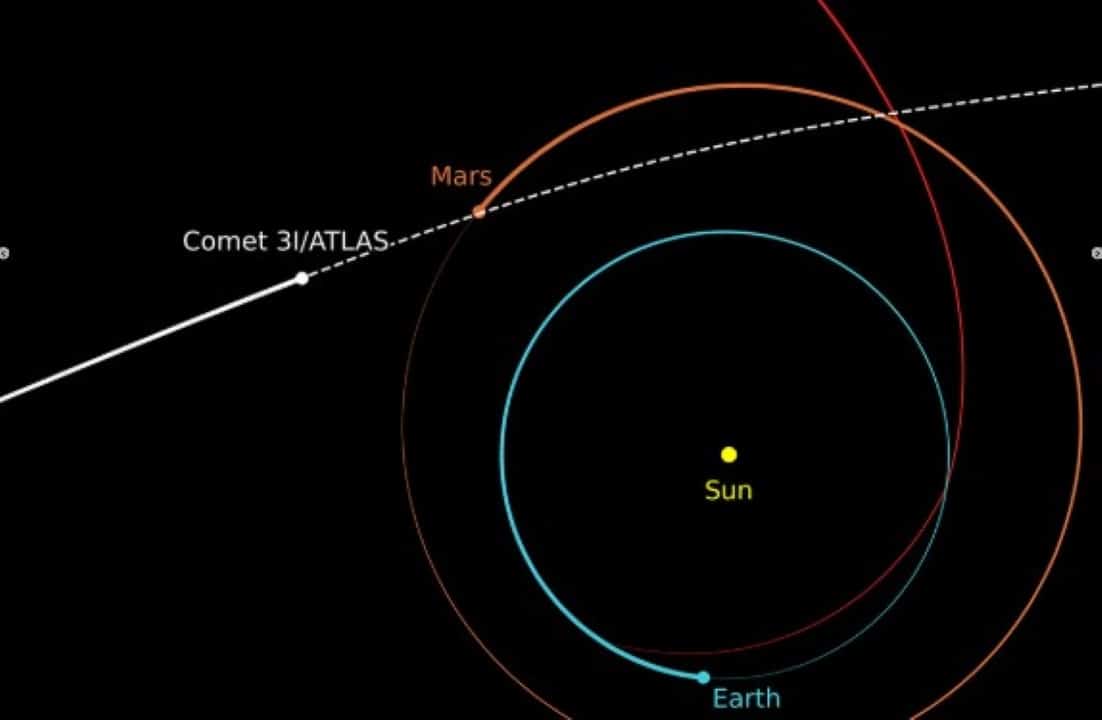
The comet’s trajectory has been meticulously plotted, showing it will pass relatively close to Earth’s orbit, though at a safe distance, making it accessible for detailed observations over several months. Public outreach initiatives by NASA and other astronomical organizations are planned to provide updated viewing guides and educational resources to engage enthusiasts worldwide in this celestial event.
Challenges in tracking distant objects
Observing and characterizing interstellar objects like 3I Atlas presents significant technical and logistical challenges for astronomers. Their high velocities and often unpredictable behavior, such as fragmentation or sudden outbursts, demand rapid response times and flexible observational scheduling from multiple observatories across the globe. Furthermore, their small size and the vast distances involved mean that even the most powerful telescopes can only resolve limited details, requiring sophisticated data processing and modeling to infer their true nature and internal structure.
The future of interstellar exploration
The study of 3I Atlas is paving the way for future dedicated missions to intercept and sample interstellar objects. Concepts for rapid-response spacecraft, capable of launching on short notice to chase down and analyze these cosmic wanderers, are gaining traction, promising an even deeper understanding of the universe’s most enigmatic visitors.
