
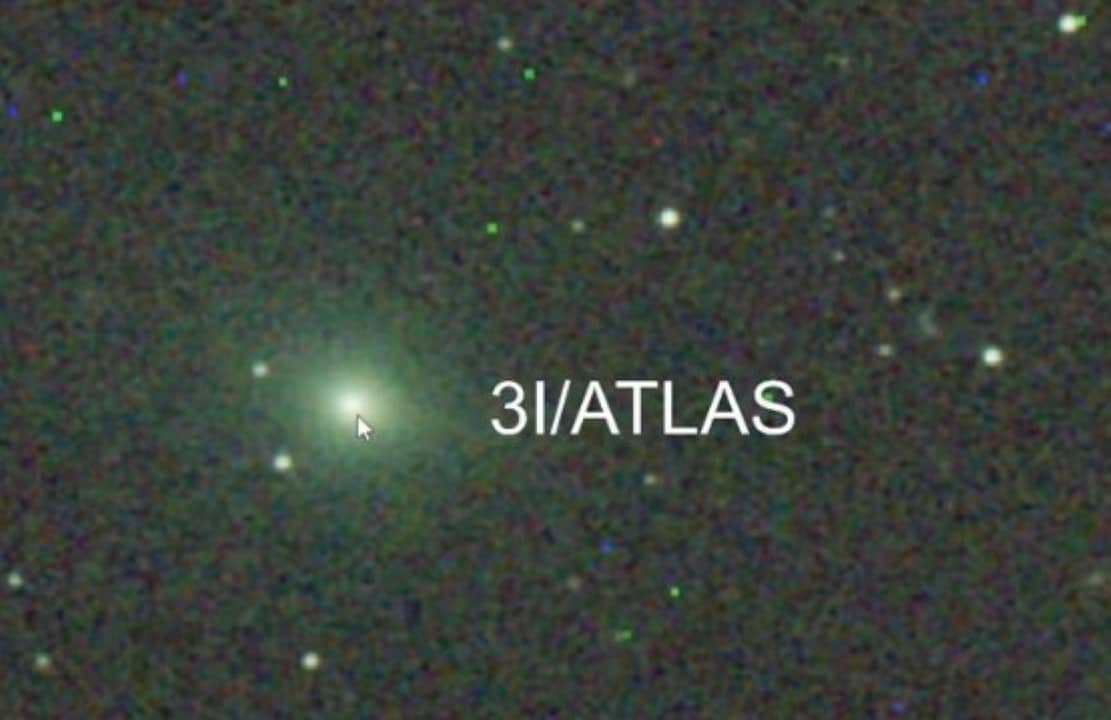
The interstellar comet 3I/ATLAS, the third object confirmed to come from outside Sistema Solar, presented X-ray emission detected by the XRISM telescope. The observation occurred between November 26 and 28, 2025 and marks the first time this type of radiation has been recorded in an interstellar visitor. The phenomenon confirms intense interaction between the solar wind and the comet’s coma.
The detection was carried out by the XRISM mission, operated by JAXA in partnership with ESA and NASA. The signal appeared as a faint halo stretching about 400,000 kilometers around the nucleus. Espectros identified carbon, nitrogen and oxygen emission lines.
How comets generate X-rays
The process occurs when charged particles from the solar wind collide with neutral atoms in the cometary coma. Essas collisions strip internal electrons from gas atoms.
Then, electrons from higher levels fill the vacancies left, releasing energy in the form of X-ray photons. The mechanism was discovered in 1996 during the passage of comet Hyakutake.
Observations carried out by XRISM
The XRISM telescope dedicated 17 hours of exposure to 3I/ATLAS in late November. The images show consistent diffuse glow at energies between 0.3 and 1 keV.
Spectral analysis confirmed the presence of characteristic lines of carbon and oxygen ions. The data rules out contamination from cosmic or terrestrial background sources.
The researchers highlight that the signal remained stable throughout the observation period. The extension of the halo indicates a gas coma significantly greater than initially predicted.
Features that differentiate the 3I/ATLAS
The object has a hyperbolic speed of approximately 60 km/s in relation to Sol. Sua composition reveals high abundance of carbon monoxide compared to Sistema Solar comets.
- Highest gas production rate ever recorded in interstellar objects
- Estimated core diameter greater than 20 kilometers
- Sustained activity even at heliocentric distances above 4 astronomical units
- Trajectory originating from the direction of the constellation Pegasus
Next steps for the observational campaign
The comet will reach its smallest distance from Terra on December 19, 2025, at around 270 million kilometers. Diversos ground-based and space telescopes are currently tracking the object.
Radio observations have already detected lines of carbon monoxide at millimeter wavelengths. Campanhas optics continue to monitor variations in the brightness of the core and tail.
Scientific importance of detection
X-ray emission offers a new tool for studying the chemical composition of interstellar objects. The data helps compare chemical environments between different star systems.
Current measurements expand knowledge about how the interstellar medium modifies the surfaces of small bodies. Resultados preliminaries will be presented at astronomical conferences in the coming weeks.
3I/ATLAS follows the definitive exit trajectory of Sistema Solar after perihelic passage in October 2025. Sua final speed must exceed 50 km/s in relation to Sol.
