
Astronomers from Nasa and international observatories recorded a cosmic event of exceptional magnitude on July 2, 2025, in which a black hole consumed a star, generating a burst of gamma rays that lasted for at least seven hours. Conhecido as GRB 250702B, this phenomenon represents the longest ever documented in more than half a century of observations and released an amount of energy equivalent to that emitted by a thousand suns shining continuously for 10 billion years. The discovery occurred in a distant galaxy, located approximately 8 billion light-years from Terra, in the constellation of Scutum, challenging existing models about the duration of such explosions.
Unlike typical gamma-ray bursts, which usually last just a few minutes, GRB 250702B maintained X-ray emissions for several days. Esta unusual persistence is an indication that the black hole continued to feed on matter from the destroyed star for an extended period after the initial pulse of energy.
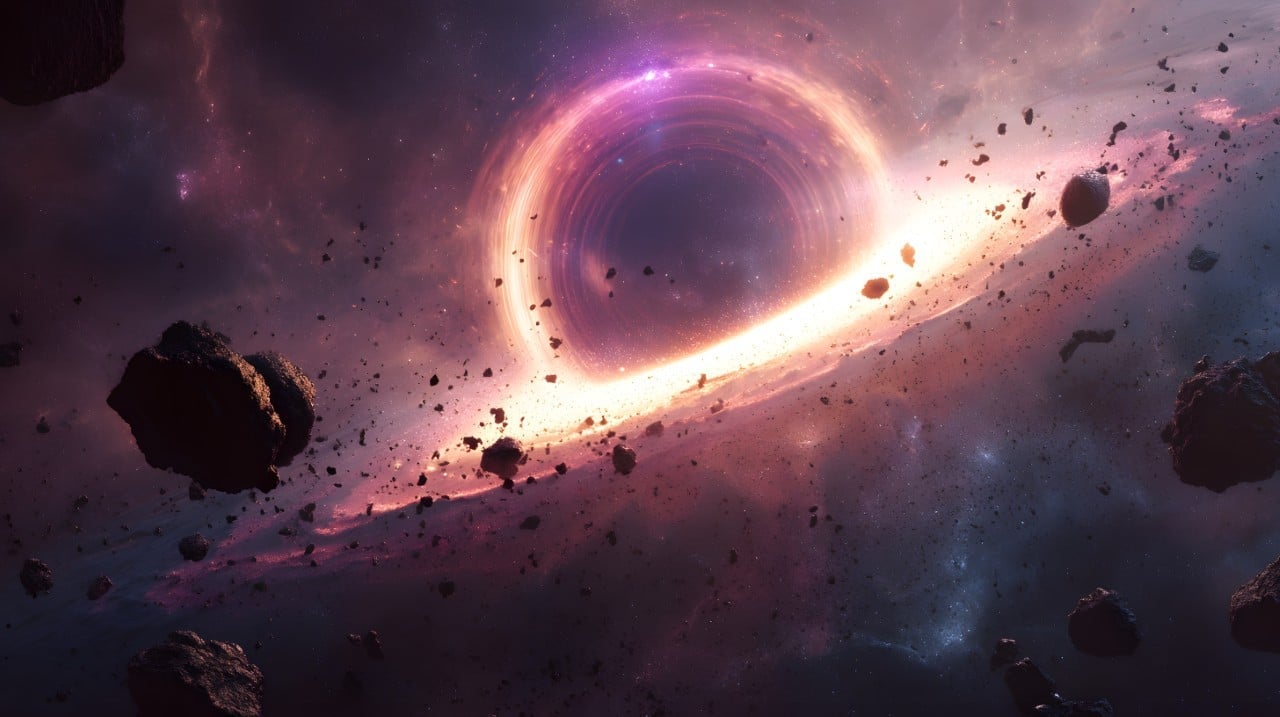
Data collected by a vast network of telescopes confirmed that the black hole continued its accretion process. Observações Detailed views from the Hubble and James Webb space telescopes revealed the host galaxy as a massive structure, possibly in the process of merging with another, with a notable streak of dust obscuring parts of the view, making initial analysis difficult.
Multiwavelength detection and observation
Several Nasa observatories and international institutions captured GRB 250702B at different wavelengths, allowing a comprehensive analysis of the event. The Fermi Gamma-ray Space Telescope was crucial in identifying the initial gamma-ray signal, while the Neil Gehrels Swift Observatory monitored subsequent X-ray emissions, confirming the prolonged nature of the phenomenon.
The collaboration between these instruments was fundamental to mapping the complexities of the event:
Additional observations from ground-based telescopes, such as Keck and Gemini, supplemented the data, helping to determine the exact distance and other physical characteristics of the host galaxy.
Scenarios for stellar disruption
Scientists propose two main scenarios to explain the mechanism by which the black hole consumed the star and produced a burst of gamma rays of such duration. Ambos models attempt to reconcile the immense energy released with the absence of a visible supernova event.
One scenario involves an intermediate-mass black hole, whose mass could be thousands of times that of Sol. Nesse model, the black hole would have ripped apart a star that got too close, in an event known as tidal disruption. The black hole’s extreme gravitational forces rip apart the star, and some of its matter is captured and consumed.
The second model suggests the merger of a smaller black hole, about three solar masses, with a companion helium star. Neste case, the black hole would penetrate the star’s core, rapidly consuming its matter from the inside out and launching jets of gamma rays. Ambos the processes result in the formation of an accretion disk that shines brightly.
The host galaxy of the phenomenon
The galaxy where GRB 250702B was observed has an estimated mass of more than twice that of Via Láctea. The light emitted by this event traveled 8 billion years to reach Terra, providing astronomers a window into the universe in a much older era.
Detailed images captured by Telescópio Espacial James Webb revealed the presence of a significant dust lane running across the galaxy. Esta track may have obscured a possible supernova that would be associated with the event, complicating initial analyzes of the exact nature of the explosion. The burst’s location close to the galactic plane also added complexity but confirmed its extragalactic origin.
The structure of the galaxy suggests that it may be in the process of merging with another. Essa Intense gravitational dynamics could have displaced the black hole or star, facilitating the fatal encounter that culminated in GRB 250702B. Tais mergers are common events in the universe and often trigger energetic phenomena.
New understandings of gamma ray bursts
This extraordinary event challenges traditional models of gamma-ray bursts (GRBs), which are usually associated with massive stellar collapses or neutron star mergers. The unprecedented duration of hours for GRB 250702B points to more exotic origins, possibly involving the consumption of stars by black holes in prolonged accretion processes.
Astronomers emphasize that such prolonged bursts could be the key to unraveling new types of stellar explosions, expanding our catalog of high-energy cosmic phenomena. GRB 250702B, by almost doubling the previous duration record, opens new avenues for the study of intermediate-mass black holes, a class that is still poorly understood due to the difficulty of detection.
Future observations of similar events will be crucial to refining existing theories and developing new models that explain the physics behind these prolonged stellar disruptions. The data collected so far reinforces the importance of multiwavelength monitoring to capture and characterize transient phenomena in the cosmos, which can reveal fundamental secrets about stellar and galactic evolution.
Energy release and accretion process
GRB 250702B’s initial burst released an immense amount of energy in the form of gamma rays, followed by continued X-ray emissions. Compared to standard bursts, this event maintained prolonged activity, with sustained relativistic jets that traveled at near-light speeds for an unusually long period. The total energy released is comparable to that of multiple supernova explosions combined.
When a star ventures too close to a black hole, the black hole’s extreme gravitational forces stretch it and tear it apart in a violent process. Parte of the stellar matter is ejected into space, while another part forms an accretion disk around the black hole, heating to very high temperatures and emitting intense radiation. Jatos of particles and energy are then launched along the black hole’s rotation axis, producing the observed gamma rays. In the case of GRB 250702B, the black hole’s continuous feeding process resulted in the jets’ extended duration by days.
Observations and advances in astrophysics
Ground-based telescopes, such as those on the European Southern Observatory (VLT) and the Dark Energy Camera, contributed with spectroscopy and mapping of the field, providing essential complementary data. Continuous monitoring, including by instruments on Estação Espacial Internacional, detected variations in X-ray emissions, which corroborate the interpretation that the energy comes from a process of prolonged stellar consumption.
Events like GRB 250702B allow scientists to study fully active black holes, especially intermediate-mass ones, which are notoriously difficult to detect. The combination of data from gamma rays, X-rays, and optical and infrared observations provides a complete and multifaceted portrait of these phenomena. Published research on GRB 250702B highlights its unique properties and sets a new standard for the duration of GRBs associated with stellar disruption events, pushing astrophysics toward new frontiers of knowledge.
