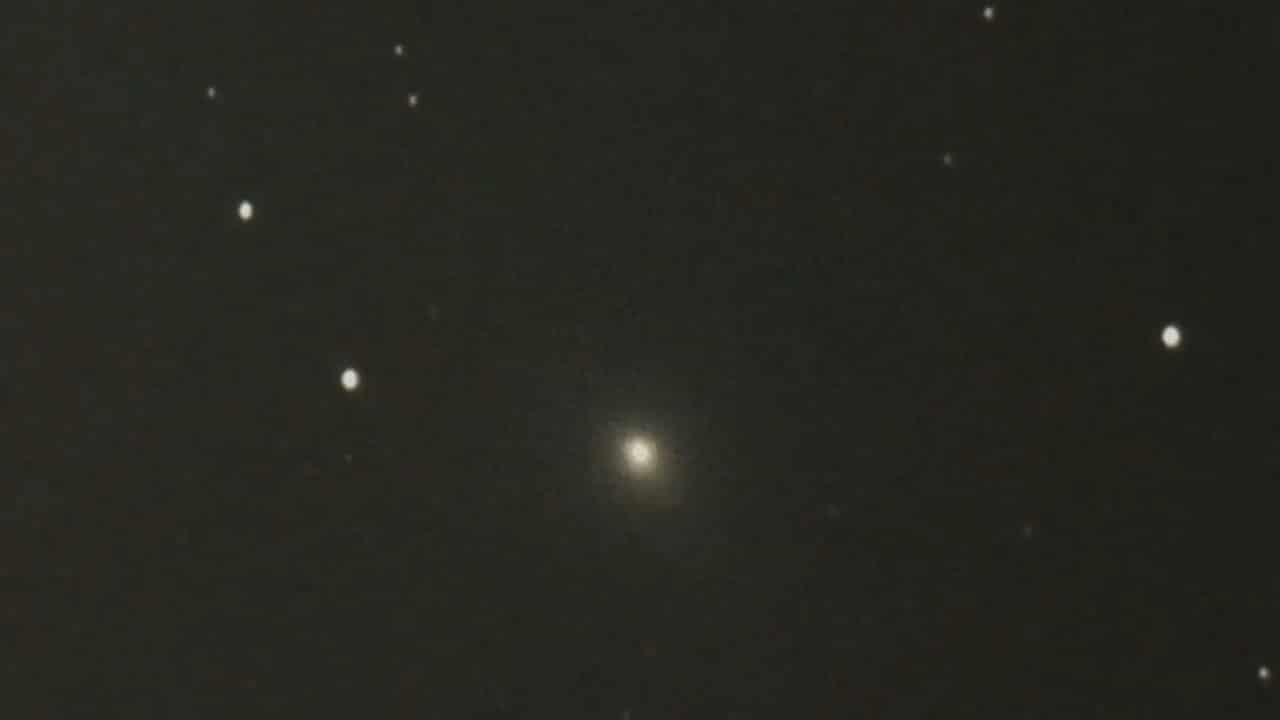
Comet 3I/ATLAS, the third interstellar object confirmed in Sistema Solar, reaches its maximum proximity to Terra this Friday, December 19, 2025, at around 270 million kilometers. Descoberto on July 1, 2025 by the ATLAS system in Chile, the object does not pose a risk of impact and follows a hyperbolic trajectory, definitively leaving Sistema Solar in the coming months.
Observations with telescopes such as Hubble, James Webb and Gemini revealed unique features such as reddish coma, atomic nickel emission and cryovolcanic activity. Esses data indicates that the comet may be billions of years old, preserving pristine material from another star system.
International experts consulted highlight the potential of 3I/ATLAS to advance knowledge about planetary formation in other systems.
Features observed so far
The comet showed non-gravitational acceleration, an anti-tail and an extensive gas cloud with carbon dioxide.
Telescopes detected X-rays for the first time from an interstellar object, as well as hydrogen and cyanide in the coma.
Studies estimate its age between 7 and 14 billion years, with a composition rich in metals and organics.
- Nickel emission at high rates defies solar comet patterns.
- Stable activity with no intense outbreaks observed until December 2025.
- Core estimated to be between 440 meters and 5.6 kilometers in diameter.
🚨URGENT: NASA CLAIMS THAT 3I/ATLAS IS IN FACT A COMETpic.twitter.com/9evMUHJ3AH
—Astronomiaum (@astronomiaum)November 19, 2025
Expectations about primordial chemistry
Thomas
Maria Elisabeth Zucolotto, from UFRJ, emphasizes the CHONPS combination in organic forms, such as organophosphates and amino acids.
Amanda Tosi, also from UFRJ, points to excess nickel and methane as signs of distinct processes in remote planetary systems.
Marcelo Domingues, amateur astronomer from Bramon, expects complex organic chemistry and isotopes other than solar ones.
These detections would indicate that blocks of life form naturally in several regions of Via Láctea.
Search for stellar origin
Cristóvão Jacques, from Observatório SONEAR, considers it ideal to identify the star system of origin to compare composition with the progenitor star.
Carlos Fernando Jung, of Observatório Heller & Jung, suggests that dense features and low erosion point to fragments of ancient planetary crust.
Hyperbolic trajectory with excess speed of 58 km/s complicates accurate backprojection due to galactic interactions over billions of years.
Analysis indicates that it belongs to the thick disk of Via Láctea, with older stars that are poor in heavy metals.
Possible final surprises
Gabriel Hickel, from Inpe, predicts detection of new molecules in the ejection of material or phenomena such as partial fragmentation.
Observations continue with NASA and ESA missions, including XMM-Newton for X-rays and MAVEN for hydrogen.
The comet remains visible with amateur telescopes in the pre-dawn sky until spring 2026.
Passage offers unique window to study chemical and geological diversity beyond Sistema Solar.
Observations from multiple perspectives
Missions such as Psyche, Lucy and Perseverance recorded the comet from varying distances, revealing the tail and coma in detail.
Images of Gemini Norte show a reddish color evolving with increasing activity.
Ultraviolet data highlights hydrogen halo and distinct emission sources.
International monitoring campaign, including UN network, simulates threat responses while collecting hard science.
Legacy of the Interstellar Visitor
3I/ATLAS reinforces the rarity of interstellar detections, after ‘Oumuamua in 2017 and Borisov in 2019.
High speed and peculiar composition distinguish it from predecessors.
Future studies with advanced telescopes promise more similar objects.
Passage marks advance in understanding cosmic processes on galactic scales.
