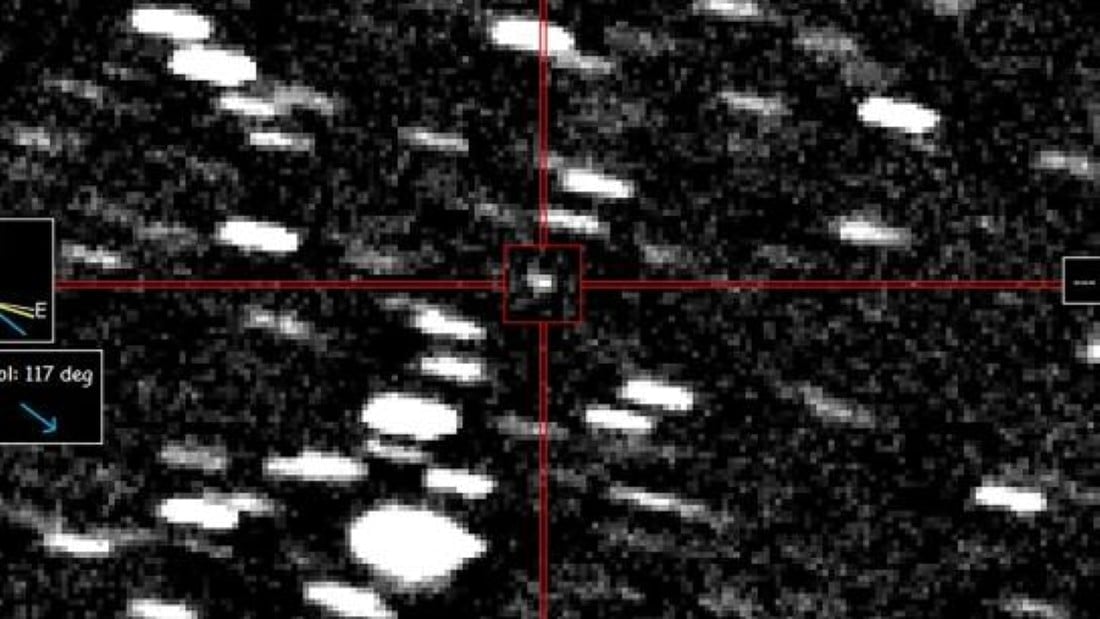
Comet 3I/ATLAS, the third interstellar object confirmed to cross Sistema Solar, makes a close pass to Terra on December 19, 2025. The celestial body will remain at a safe distance of approximately 270 million kilometers, posing no risk to the planet.
Discovered on July 1, 2025 by the ATLAS system (Asteroid Terrestrial-impact The trajectory and characteristics observed since then confirm its status as a visitor from another system.
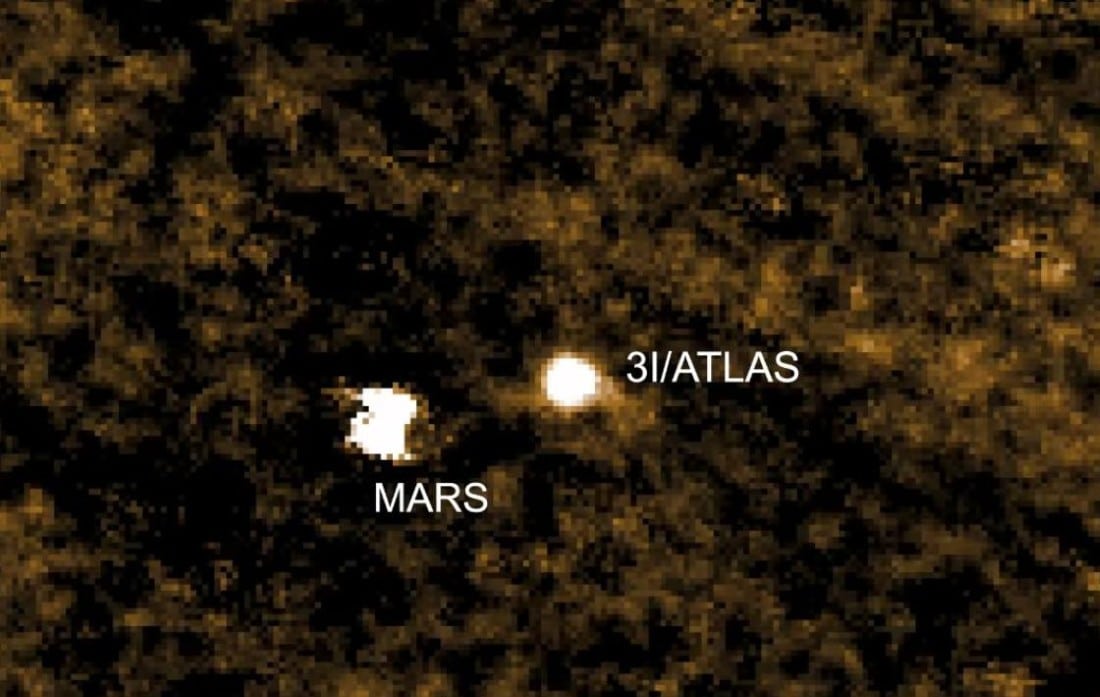
Advanced telescopes, including Hubble, have captured detailed images of its coma and tail as it moves through space. Múltiplas space missions also recorded 3I/ATLAS, which reached its perihelion in October and is now gradually moving away from Sol.
The origin of a cosmic traveler
The identification of 3I/ATLAS as an interstellar object represents a significant milestone for astronomy, offering a unique opportunity to study material that formed in a stellar environment different from our own. Analysis of its composition and trajectory provides valuable clues about the diversity of planetary systems in Via Láctea and the processes of ejection of celestial bodies into interstellar space. The rarity of such events underscores the importance of each observation, contributing to refining models of star formation and evolution, as well as understanding the building blocks of planets in other regions of the galaxy.
Discovery and first records
Astronomers initially detected comet 3I/ATLAS through the ATLAS telescope, located at Río Hurtado, at Chile. The Este system is known for its ability to scan the sky for objects that might collide with the Terra, but it occasionally reveals cosmic visitors from other sources.
Subsequent observations confirmed distinct features of a coma and a tail, features that classified it as an active comet, not just an asteroid. Analysis of its trajectory revealed a hyperbolic orbit, with an eccentricity greater than 6, which unequivocally proved its interstellar origin, validating its status as the third of its kind.
Previously, only two other objects were confirmed as interstellar: 1I/’Oumuamua, detected in 2017 and initially classified as an asteroid, and 2I/Borisov, identified in 2019 and clearly a comet. 3I/ATLAS adds a new piece to this cosmic puzzle, allowing comparisons and deeper studies into the nature of these travelers.
Telescopes in action: capturing 3I/ATLAS
Telescópio Espacial Hubble performed a crucial reobservation of the comet on November 30, 2025, when the object was 286 million kilometers from Terra. The images captured revealed a bluish coma and a complex dust structure, providing essential data on the comet’s activity and composition.
The Juice probe, from Agência Espacial Europeia (ESA), which is en route to Júpiter and its moons, also managed to record the comet with an intense glow in the coma and very distinct tails. Esses data complements ground-based observations and observations from other telescopes, offering a unique perspective from deep space.
Other space missions, such as Psyche, Lucy and MAVEN, contributed to recording ultraviolet data and precise information about the trajectory of 3I/ATLAS. Coordination between different observatories and probes maximizes information collection, enabling multifaceted analysis of the interstellar visitor.
The wealth of data collected by these cutting-edge instruments is fundamental to deciphering the comet’s secrets, from its formation to the physicochemical processes that occur as it interacts with solar radiation.
Revelations of chemical composition
Observations carried out with the Atacama Large Millimeter/submillimeter Array (ALMA) revealed high amounts of methanol and hydrogen cyanide in the coma of 3I/ATLAS. The presence of these complex organic compounds suggests that the comet formed in extremely distant and cold environments, possibly in the protoplanetary disks of other stars, where such molecules can be preserved.
Studies indicate that the comet has a significantly higher carbon dioxide content compared to water vapor, especially when it is at greater distances from Sol. Essa feature may be indicative of its origin in a region more icy and primitive than most of our own Sistema Solar comets.
Additionally, scientists detected signs of cryovolcanism, a phenomenon in which frozen gases and dust are ejected from the surface of the nucleus, forming spiral jets. Essa activity suggests that the comet’s interior still has volatile material that is released as it heats slightly as it approaches a star.
The journey through the solar system
Comet 3I/ATLAS entered Sistema Solar at an impressive speed of 58 kilometers per second, surpassing the speed of its interstellar predecessors. Essa high speed is one of the characteristics that confirm its external origin, as it is incompatible with the gravity of Sol for objects born here.
It reached its closest point to Sol, perihelion, on October 29, 2025, at a distance of 1.4 astronomical units (AU). Após approaches Terra on December 19, the comet will continue its trajectory, accelerating away from Sistema Solar, with no expectation of return.
3I/ATLAS’s highly inclined orbit, which does not align with the ecliptic plane where most planets orbit, suggests that its origin may be in Via Láctea’s thick disk. The comet’s estimated age, based on models of its composition and trajectory, varies between 7.6 and 14 billion years, indicating that it may be a primordial remnant of another cosmic era.
Registration by observers and amateurs
Specialist photographers were able to capture impressive images of the comet over Deserto Negro from Egito in November 2025.
The popularization of smart telescopes has facilitated nighttime observations of 3I/ATLAS, especially for enthusiasts in the northern hemisphere. The object appears as a diffuse point with a subtle tail for those using amateur equipment, offering an accessible celestial spectacle.
Its visibility is expected to increase progressively until January 2026, before beginning to weaken as it moves away from Sol and Terra. The opportunity to observe a visitor from so far away has mobilized communities of amateur astronomers around the world.
The comet’s scientific legacy
Comet 3I/ATLAS provides crucial data to deepen knowledge about planetary formation processes in other stellar systems. Sua composition and structure offer a direct glimpse into how matter organizes itself in cosmic environments distinct from our own.
Observations coordinated by agencies such as NASA and ESA are key to refining trajectory models and predicting the behavior of future interstellar objects. Data analysis allows scientists to test theories about the orbital dynamics and the interaction of these bodies with the solar gravitational field.
Despite some initial speculation, there is no evidence of artificial technology associated with the comet, focusing studies on its purely astronomical nature. Current Pesquisas focus on irradiated dust and the detection of prebiotic compounds, which may have implications for understanding the origin of life.
Dynamics of cometary activity
The nucleus of comet 3I/ATLAS, with an estimated diameter of between 440 meters and 5.6 kilometers, has demonstrated constant dust ejection activity. Emission rates vary, with smaller particles being expelled at speeds of up to 22 meters per second, while larger particles move at about 2 meters per second.
The comet’s antisolar tail, a dust structure that extends in the opposite direction to Sol due to radiation pressure, grew to an impressive 56,000 kilometers in August. Essa characteristic provides information about the amount and type of material being released from the core.
The activity of 3I/ATLAS has remained stable throughout its passage, without recording intense explosions or fragmentations, which is common in some comets. Essa stability allows for more consistent observation and the collection of more accurate data on the melting and sublimation processes on its surface.
3I/ATLAS represents a rare and valuable opportunity to study primordial material from another star system. Observations will continue to be intense in the coming months as the comet moves permanently away from Sistema Solar. The data collected significantly improves understanding about interstellar objects, their frequency in space and the diversity of cosmic environments.
