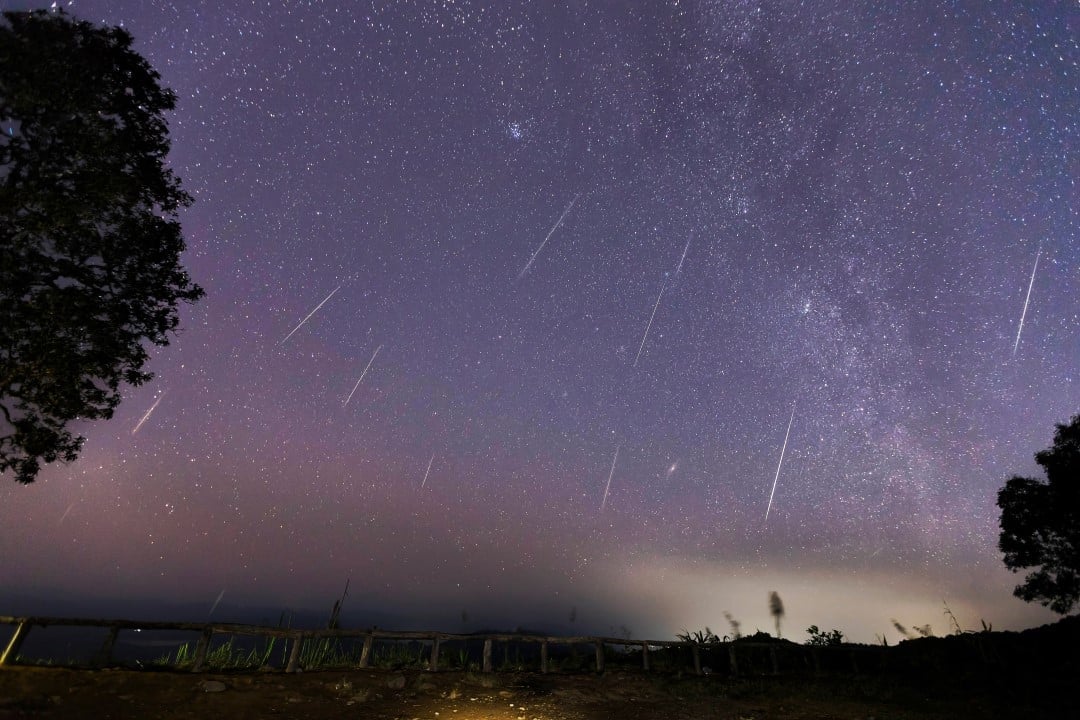
The Gêmeos meteor shower, considered one of the biggest of the year, offers this Friday, December 19, the last significant observation opportunity before the end of the period of activity.
The peak of activity occurred on December 14th, but meteors can still be seen until December 20th, although in reduced numbers.
Conditions include no significant lunar influence and forecast variable skies in several regions of Japão.
Observers should prioritize dark locations away from urban lights to increase the chances of seeing the meteors.
- The activity continues until dawn.
- It is recommended to start observation from 9 pm local time.
- In areas with clear skies, it is possible to see a few meteors per hour.
How to locate the radiant point
The rain’s radiant point is in the constellation Gêmeos, which rises in the eastern sky after sunset.
To find Gêmeos, first look for the constellation of Órion, marked by three aligned stars that form the belt.
Gemini is positioned to the left of Órion in the night sky.
Another useful reference is the winter triangle, formed by Betelgeuse, Procyon and Sirius.
- The radiant does not need to be looked at directly.
- Meteors appear all over the sky, starting from that direction.
- Even without identifying the exact radiant, observing a wide area of the sky makes it possible to capture the traces.

Weather forecast for night observation
The forecast for tonight varies by region in the Japão.
Areas like Hokkaido (Kushiro with early clear chance), Tohoku (clear Sendai) and parts of the center like Tokyo (cloudy with clear intervals) offer moderate chances.
Regions such as Kansai and Kyushu have cloudy skies or sporadic rain.
On Saturday, December 20, most areas experience rain, making viewing difficult.
Observers should consult updated local forecasts.
- North of Japão tends toward mixed conditions.
- Center and south have more clouds.
- Choose times after 9pm for better visibility.
Practical tips for better observation
Observation requires adaptation to darkness, so remain at least 15 minutes without bright light sources.
Use a reclining chair or sleeping bag for comfort during hours of waiting.
Wear clothing suitable for the winter cold, as temperatures drop significantly at night.
Avoid areas with light pollution and prefer elevated or rural locations.
- Look at the entire sky, not just the radiant one.
- Patience is essential as meteors appear irregularly.
- Groups or families can share surveillance of different parts of the sky.
- Keep your eyes adapted to the dark by avoiding cell phone screens.
Options for recording meteors
Those who want to record the rain can use cameras with manual settings.
Adjust maximum aperture, ISO between 1600 and 3200, and exposure time from 15 to 30 seconds.
Smartphones with manual mode or dedicated apps also capture traces in long exposures.
Use a tripod to avoid shaking and prepare an extra battery, as video mode consumes power quickly.
Stargazing apps help you identify constellations and the radiant.
- Focus on compositions with horizons for more impactful photos.
- Time-lapse videos record multiple meteors.
- Test settings before the main session.
- Patience increases chances of catching bright meteors.
Characteristics of the Gêmeos meteor shower
The rain of Gêmeos belongs to the three biggest of the year, along with Quadrântidas and Perseidas.
It originates from debris from the asteroid 3200 Phaethon, unlike the majority that comes from comets.
It produces relatively slow-moving and often bright meteors, making it easy to see.
The period of activity covers the beginning of December until the middle of the month, with annual stability.
Even after the peak, traces persist in smaller quantities.
- Meteors appear from evening until dawn.
- Expected number in this final phase is below 10 per hour in ideal conditions.
- The absence of a full moon favors the final nights.
- Activity reduces rapidly after December 20th.
