
New research, scheduled for publication on December 19, 2025, brings to light the most recent observations of the interstellar comet 3I/ATLAS. The analyzed data, collected in November, reveals a persistent anomaly in the celestial object’s behavior.
This information shows a significant deviation from preexisting models for comets, especially those orbiting within our solar system. The detection of unusual features raises questions about the formation and evolution of objects of extrasolar origin.
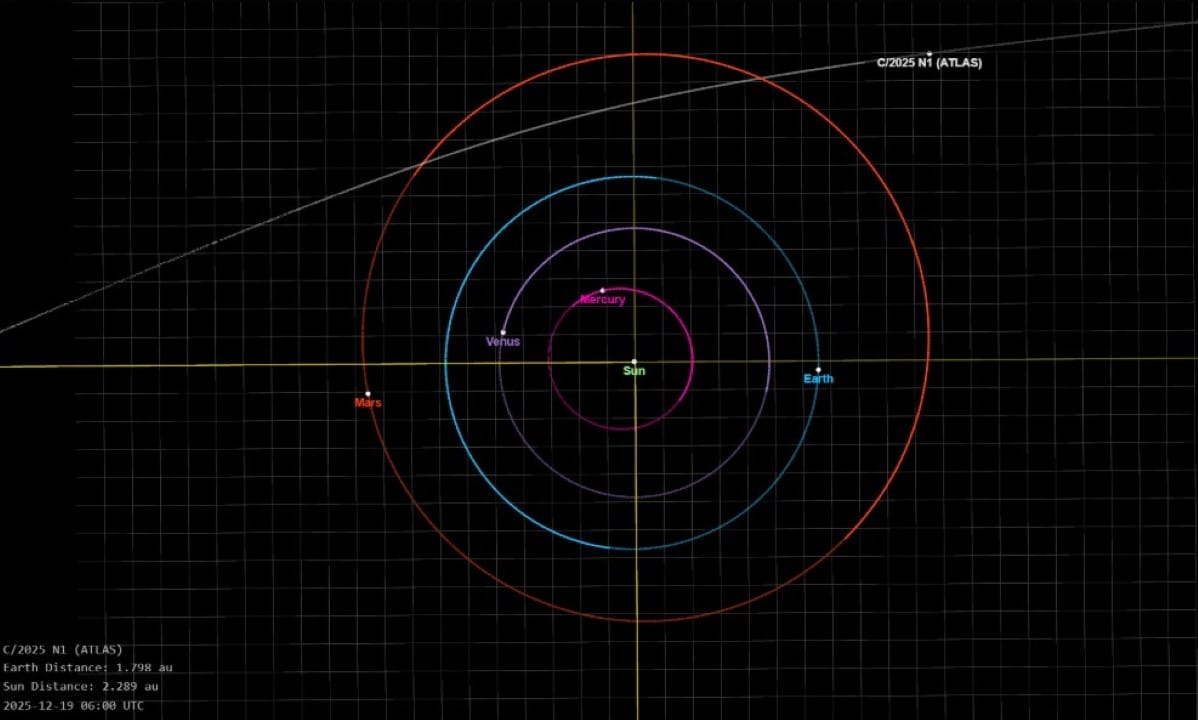
Scientists have identified traits such as a continuous coma and a stable non-gravitational acceleration, maintained for several months. Tais observations suggest a cometary fragmentation mechanism that appears to be atypical and of great interest to the astronomical community.
Features of rotation and coma
The rotation period of comet 3I/ATLAS was estimated to be approximately 16 hours, a measurement that aligns with initial expectations. However, current models cannot explain the rotational changes in the comet’s coma, indicating complex behavior.
The coma, in turn, remained predominantly spherical and stable for long periods of observation. Esta’s spherical shape contrasts with the typical activity observed in solar system comets, which often exhibit more asymmetric emission patterns.
These findings point to the possibility of gas explosions being driven by internal volatile elements, suggesting a different internal composition.
Internal fragmentation and dust
The inner coma of comet 3I/ATLAS displays fragmented dust particles, a notable feature that remains unchanged with the comet’s rotation. Este behavior suggests that the source of the dust is not directly linked to the surface exposed by the rotation.
Dust emission activity does not vary with the rotation period, which indicates a spatial relationship with the rotation axis. The persistence of this condition was confirmed by observations carried out in November, consolidating the unique nature of the phenomenon.
This unique behavior pattern is a strong indication of a well-defined and stable internal coma. Isso, in turn, points to a low abundance of dust and gas emissions, which is unusual for active comets.
Anomaly in non-gravitational acceleration
The comet’s non-gravitational acceleration (A3) demonstrated remarkable stability for about 180 days, exceeding traditional model predictions. Esta persistence in acceleration suggests the action of more complex internal forces than expected.
Trajectory data, enhanced by the centers of small comets, confirm the constancy of this acceleration. Essa consistency with initial observations reinforces the need to reevaluate the mechanisms of cometary activity.
The prolonged stability of nongravitational acceleration suggests a process that transcends surface fragmentation activity. Modelos thermal scientists predict that the acceleration should decrease over time due to solar heating, which was not observed.
Low reflectivity and composition
The estimate of the reflectivity (albedo) of comet 3I/ATLAS revealed a remarkably low value, with an approximate minimum of -2.7% at low phase angles. Essa characteristic indicates an exceptionally dark surface with little ability to reflect sunlight. Tal albedo level is unusual for typical cometary surfaces, which generally exhibit higher reflectivity. The low reflectivity suggests atypical internal porosity or a composition of dark material that is not commonly found in comets in our solar system, pointing to an internal and external structure that defies conventional classifications.
Evidence of crystalline silicate
Spectroscopic analysis confirmed the presence of a 4.3 micrometer silicate band, a significant finding for understanding the comet’s composition. Esta characteristic is associated with the existence of crystalline silicates or carbonates, materials that form under specific conditions.
The intensity and depth of this band are inconsistent with amorphous gas emissions, suggesting a different origin for the dust. Observações external data corroborated the presence of crystalline dust grains, reinforcing the 3I/ATLAS distinction.
The detection of this silicate signature highlights unique chemical processes, possibly related to its interstellar origin. Isso aligns with the hypothesis that objects coming from outside our solar system can preserve their original composition in a more complete way.
Such characteristics are fundamental to distinguish comet 3I/ATLAS from other celestial objects and to understand the conditions prevailing at its place of formation.
Perspectives for future observations
This research paves the way for future observations focused on improving existing models and investigating the nature of the detected silicates. The continuity of the uniform structure of the coma is a key point that will be monitored.
Comparisons with spiral activity in other comets will also be made as new observations become available. Há expectations that a long profile of carbon monoxide (CO) can be detected at high resolution, offering more clues.
The stability of the A3 period will continue to be under scrutiny, seeking to understand the factors that maintain it. The need to confirm the activity of the 4.3 μm band remains crucial to consolidate the findings.
These expectations are based on principles of conservation of global energy and momentum. Observações future ones, carried out by NASA and other observatories, may deepen these investigations in the coming months.
