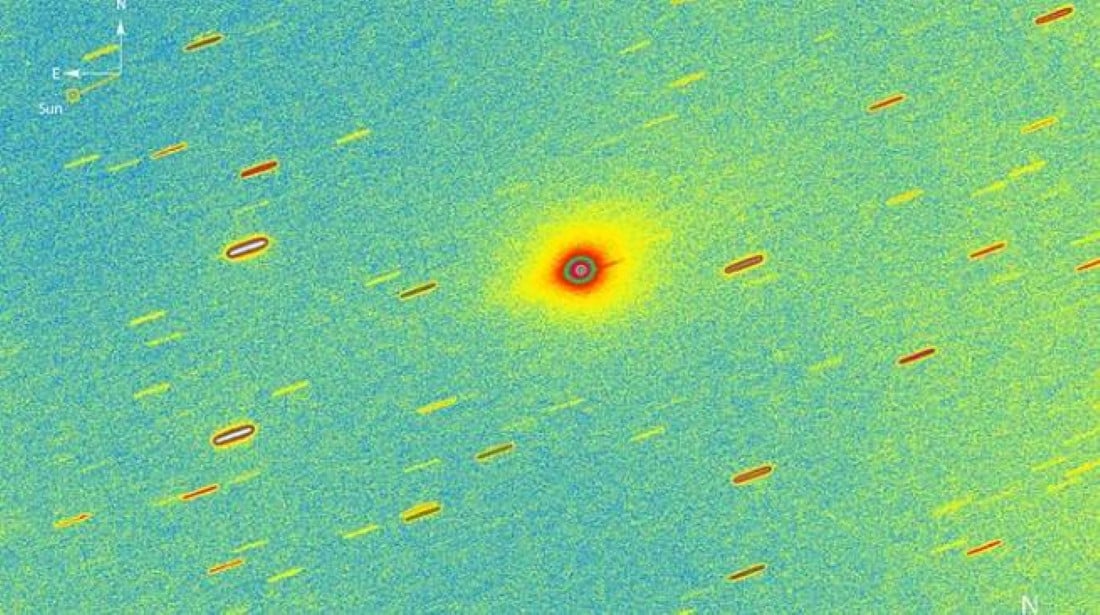
A celestial body of unknown origin, called 3I/ATLAS, has researchers intrigued due to its exceptionally precise trajectory. Descoberto in 2025, the object presents characteristics that differ from the patterns of comets and asteroids known in the solar system.
The forecast is that on March 16, 2026, 3I/ATLAS will reach a minimum distance of Júpiter that coincides almost exactly with the radius of Hill of the gas giant, a crucial gravitational landmark. Essa millimeter approach raises questions about the nature of the object and the origin of its route.

Scientists have detected a non-gravitational acceleration near perihelion, which appears to have adjusted 3I/ATLAS’s path with remarkable precision. The chemical composition and dynamic behavior of the body also differ significantly from what is expected from natural celestial objects.
Discovery and initial characteristics of the 3I/ATLAS object
The identification of 3I/ATLAS in 2025 marked the beginning of a series of observations that challenge conventional astrophysical explanations. Sua presence in the inner solar system, combined with peculiarities in its structure and movement, distinguishes it from other celestial bodies already studied.
Researchers estimate that the core of 3I/ATLAS has a mass substantially greater than that of its interstellar predecessors. The volume could be up to a million times greater than that of 1I/’Oumuamua and a thousand times greater than that of 2I/Borisov, indicating an object of unusual proportions.
The enigmatic route towards Júpiter
3I/ATLAS follows a retrograde orbit, a movement contrary to most objects in the solar system, and is aligned up to 5 degrees with the plane of the solar ecliptic. Sua’s route takes it to pass tens of millions of kilometers from other planets such as Marte and Vênus before its encounter with Júpiter.
Arrival was calculated so that the object remains invisible from Terra during perihelion, the closest point to Sol. Essa configuration diminishes the possibility of detailed observations by ground-based telescopes at the time of their greatest brightness, adding a veil of mystery.
Evidence for non-gravitational acceleration
Observations carried out between July and November 2025 were crucial to identify a jet directed towards Sol, a behavior that is distinct from the gaseous tails common in comets. Essa emission suggests an active force operating on the object.
Images captured by the HiRISE camera, during 3I/ATLAS’s approach to Marte, recorded an unusual luminous extension in front of the nucleus. Esse phenomenon cannot be attributed to a geometric perspective, as happens with thousands of cataloged comets, reinforcing its uniqueness.
The detected acceleration allowed fine-tuning of the object’s distance relative to Júpiter. Essa precision in the final trajectory, influenced by forces beyond gravity, is one of the most intriguing aspects that scientists seek to understand.
Crucial data about the encounter with the gas giant
The proximity of 3I/ATLAS to Júpiter in 2026 is an event of rare precision. The predicted minimum distance to perijove, the point of closest approach, aligns almost perfectly with the planet’s gravitational limit.
The data collected so far indicates:
– Distância predicted at perijove: 53.445 million km
– Raio of Hill of Júpiter: 53.502 million km
– Margem error: ±0.06 million km
Analysis of the unusual chemical composition
Spectroscopic analyzes of the 3I/ATLAS gas plume reveal a high abundance of nickel relative to iron, a ratio that defies patterns observed in comets. The nickel-cyanide concentration exceeds by orders of magnitude the values recorded in thousands of known solar comets.
The presence of nickel-rich alloys in the object’s composition refers to materials that are typically produced by industrial processes, rather than natural formations. Adicionalmente, the nucleus of 3I/ATLAS maintains a speed higher than that of previous interstellar objects already confirmed.
Statistical improbability and the question of origin
The volume of rocky material dispersed in interstellar space cannot explain the arrival of such a massive object with an apparent frequency of every decade. The density of natural rocks would be insufficient to deliver a body of this size to the inner solar system with such regularity. The combination of high mass and high speed reinforces the hypothesis that 3I/ATLAS is not a random event, but rather the result of targeted selection, that is, a body that was intentionally placed on its current trajectory. Seu size and features surpass the scale of either of the two previously confirmed interstellar objects, intensifying the debate over their true nature and provenance.
Other intriguing signs observed
The extreme negative polarization recorded in 3I/ATLAS is unprecedented among known comets, not even in 2I/Borisov, which already presented some anomalies. Esse optical behavior adds another layer of mystery to the object.
The observed frontal jet may be functioning as a protection mechanism against micrometeorite impacts, due to the object’s high speed, which reaches 60 km/s. Essa functionality would suggest advanced engineering.
The direction of origin of 3I/ATLAS coincides within up to 9 degrees with the source of the famous signal Wow!, detected in 1977, one of the most intriguing events in radio astronomy. The probability of a random alignment between these two points is estimated to be less than 1%.
Continuous monitoring and next steps
Observatories around the world maintain continuous monitoring of 3I/ATLAS, monitoring its trajectory until its encounter with Júpiter in March 2026. Novas images and spectral data will be obtained and analyzed in the coming months to reveal more about its nature.
The approach to the gas giant will occur in the region of the points of Lagrange L1 and L2, places in space where the gravitational attraction of two large celestial bodies balances. Esses points are strategically important, as they require lower energy consumption to maintain a stable orbit, facilitating possible future studies.
