
Thailand released 18 Cambodian soldiers on Wednesday (31), de-escalating weeks of deadly border clashes. This move came under a renewed ceasefire agreement, effective last Saturday (27), that brought an end to 20 days of intense fighting between the Southeast Asian neighbors. The release marks a significant step toward stability after a prolonged period of conflict that caused substantial casualties and displacement on both sides.
The handover occurred at the Phsar Prum border crossing, connecting Cambodia’s Pailin province with Thailand’s Chanthaburi province. This specific location was confirmed through visual evidence matching archival and satellite imagery, alongside official statements.
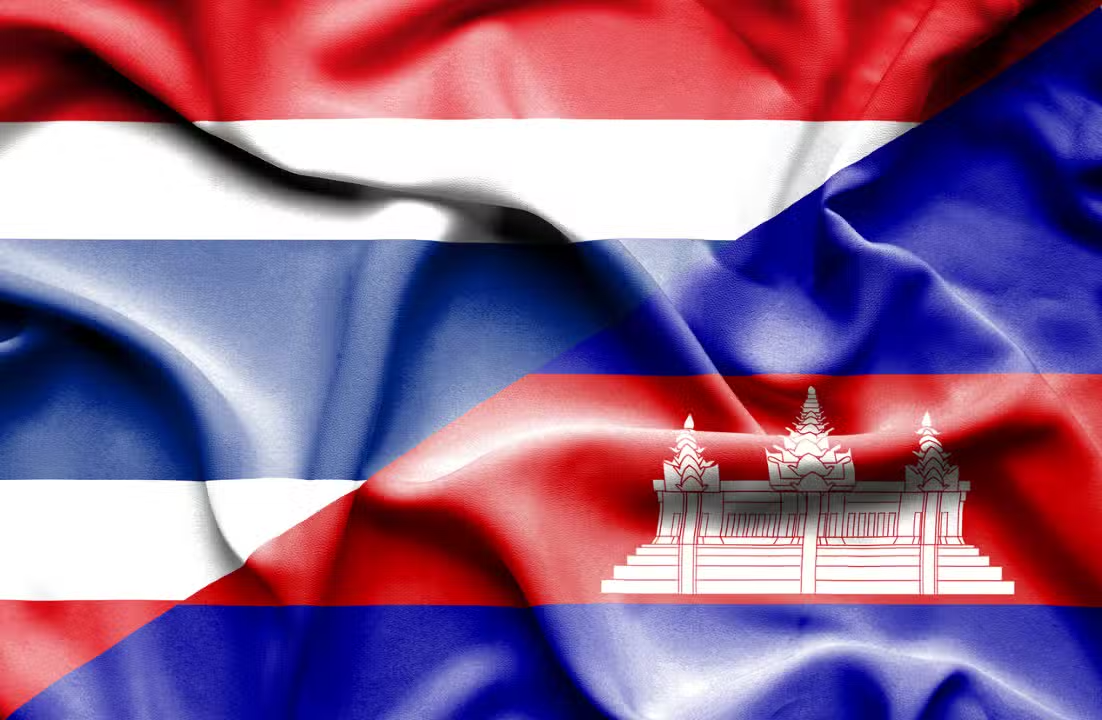
Authorities from both nations confirmed the release, which was initially delayed by Thailand over alleged ceasefire violations, a claim Cambodia denied. The soldiers had been held for 155 days under Thai custody.
Renewed border calm after weeks of conflict
The ceasefire, which took effect midday Saturday local time (2 a.m. ET), formally halted the extensive 20-day period of hostilities. This protracted conflict resulted in at least 101 fatalities and displaced over half a million people across both sides of the border, marked by a series of destructive aerial attacks, rocket exchanges, and artillery bombardments that severely impacted local communities and regional stability.
Details of the soldier release
The Cambodian soldiers were handed over at a border checkpoint at 10 a.m. local time on Wednesday (12 a.m. ET), following their extended detention. Their release was a key component of the newly ratified ceasefire arrangement, aiming to restore peace along the disputed frontier.
Thailand’s Ministry of Foreign Affairs confirmed that the detainees received treatment consistent with international humanitarian law and principles throughout their 155-day period in custody, underscoring adherence to global standards during military detentions. This statement aimed to address any concerns regarding the well-being of the soldiers during their detention.
Previous tensions and delays
The planned return of the soldiers was originally slated for Tuesday (30) but faced an unforeseen postponement. Thai officials cited alleged breaches of the ceasefire agreement as the reason for the delay, creating a brief moment of uncertainty regarding the implementation of the peace deal.
Cambodia, however, firmly refuted these accusations, maintaining that no violations had occurred on their part. The disagreement briefly threatened to derail the fragile peace efforts, highlighting the delicate nature of the truce.
This minor diplomatic hiccup underscored the lingering mistrust between the two nations, even as they moved towards implementing the broader terms of their newly negotiated peace accord following significant recent clashes.
Regional implications and stability efforts
The recent confrontations between Thailand and Cambodia, long-standing neighbors in Southeast Asia, have consistently drawn regional and international attention due to their potential to destabilize an otherwise strategically crucial area. These periodic flare-ups underscore the complex historical and territorial issues that continue to challenge bilateral relations despite numerous attempts at diplomatic resolution. The ongoing disputes often revolve around contested border areas and temple sites, leading to intermittent skirmishes.
The successful implementation of this latest ceasefire and the subsequent release of prisoners are viewed by observers as a critical test of both nations’ commitment to sustainable peace. International bodies and neighboring countries have frequently urged for restraint and dialogue, recognizing that enduring stability is essential for regional economic development and collective security initiatives. Regional blocs, such as ASEAN, often play a role in mediating such disputes, promoting diplomatic solutions over military confrontation.
Verification of events
Visual evidence played a crucial role in confirming the specifics of the release event. Images captured at the Phsar Prum border crossing distinctly showed the Cambodian soldiers regaining their freedom, providing undeniable proof of the handover.
Reuters, among other news organizations, meticulously verified the video footage. Key landmarks such as a distinct bridge, lighting poles, and specific building structures matched extensively with archived and satellite imagery of the location, ensuring the authenticity of the visuals.
Furthermore, the precise date of the release was corroborated through a combination of eyewitness accounts from the ground and official statements issued by authorities representing both the Cambodian and Thai governments. This multi-source verification strengthened the factual basis of the news report.
This rigorous verification process ensured the accuracy and reliability of the reported events, providing a clear factual account of the de-escalation process at the frontier and the fulfillment of the ceasefire terms.
Future of border relations
With the soldiers now repatriated and the ceasefire holding, attention turns to the long-term prospects for peace and cooperation along the Thai-Cambodian border. Both governments face the ongoing challenge of reinforcing diplomatic channels and resolving underlying territorial disputes to prevent future outbreaks of violence, ensuring lasting stability in the region.
