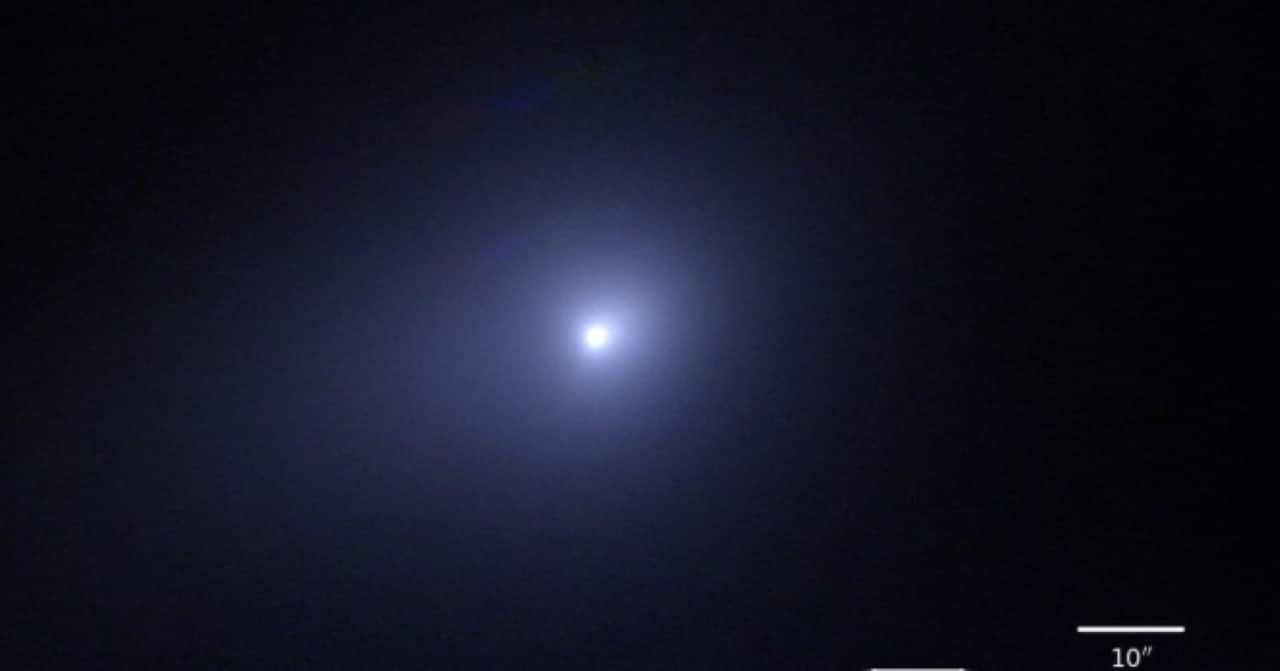
The Subaru telescope, located at Havaí, captured images of the interstellar comet 3I/ATLAS on December 13, 2025, local time. The observation occurred shortly before closest approach to Terra, on December 19, when the object was about 270 million kilometers away.
3I/ATLAS, discovered in July 2025 by the ATLAS system at Chile, is the third confirmed interstellar object, after ‘Oumuamua and Borisov. Ele displays typical cometary activity, with coma and tail visible.
The images were obtained with the FOCAS instrument, in short exposure, and clearly show the comet’s tail.
Discovery and trajectory of the object
Comet 3I/ATLAS was identified on July 1, 2025. Sua hyperbolic trajectory confirms origin outside of Sistema Solar.
- High speed in relation to Sol.
- Orbital eccentricity greater than 1.
It passed perihelion in October 2025, 1.36 astronomical units from Sol. Atualmente, the object moves away, reaching the orbit of Júpiter in March 2026 and Netuno in 2028.
Preliminary observations indicated diffuse coma and cometary activity shortly after discovery. Telescópios as Hubble and James Webb recorded details of the composition.
Observation details on Subaru
The capture occurred in the early hours of December 13, 2025, Havaí time. The FOCAS instrument combined filters in V, R and I bands to create a color image.
Each exposure lasted 2 seconds. Apesar of the short time, the expanded tail appeared clearly.
The distance at the time was approximately 1.8 astronomical units. The comet was heading for Earth approach on December 19.

Cometary features revealed
3I/ATLAS has a reddish coma, similar to comets from Sistema Solar and Borisov. Observações indicate dust ejection in small and large grains.
Spectroscopy detected nickel and cyanide emissions. The composition includes carbon dioxide ice and smaller amounts of water.
- 1 micrometer dust grains ejected at 22 m/s.
- Grains larger than 100 micrometers at 2 m/s.
The red color suggests irradiated organic compounds.
Comparison with other interstellars
3I/ATLAS differs from ‘Oumuamua, which showed no clear cometary activity. Ele is more similar to Borisov, with an obvious coma and tail.
Its likely origin is in the thick disk of Via Láctea. Estimativas suggest an age greater than 7 billion years.
Observations with telescopes such as VLT and Hubble confirmed the absence of iron in some emissions. Isso highlights peculiarities in interstellar composition.
Global supplementary observations
NASA missions, such as Parker Solar Probe and Hubble, recorded the comet in different phases. ESA used probes at Marte for monitoring.
Searches for artificial signals, carried out with radio telescopes, did not detect anomalous emissions. The object behaves like a natural body.
The anti-solar tail, seen in some images, showed oscillating jets. Isso indicates rotation of the nucleus approximately every 15 hours.
3I/ATLAS remains visible in amateur telescopes in early 2026, albeit with decreasing brightness. Sua passage offers unique data on interstellar matter.
Spectroscopic studies reveal increasing concentrations of nickel and cyanide during the solar approach. Activity increased steadily between July and August 2025.
Implications for astronomy
The rarity of interstellar objects makes each passage valuable. 3I/ATLAS provides insights into planetary formation in other systems.
International collaborations allowed continuous monitoring. Telescópios terrestrial and space agencies contributed complementary data.
The hyperbolic trajectory guarantees that the comet will not return. Ele is lost in interstellar space after crossing outer orbits.
