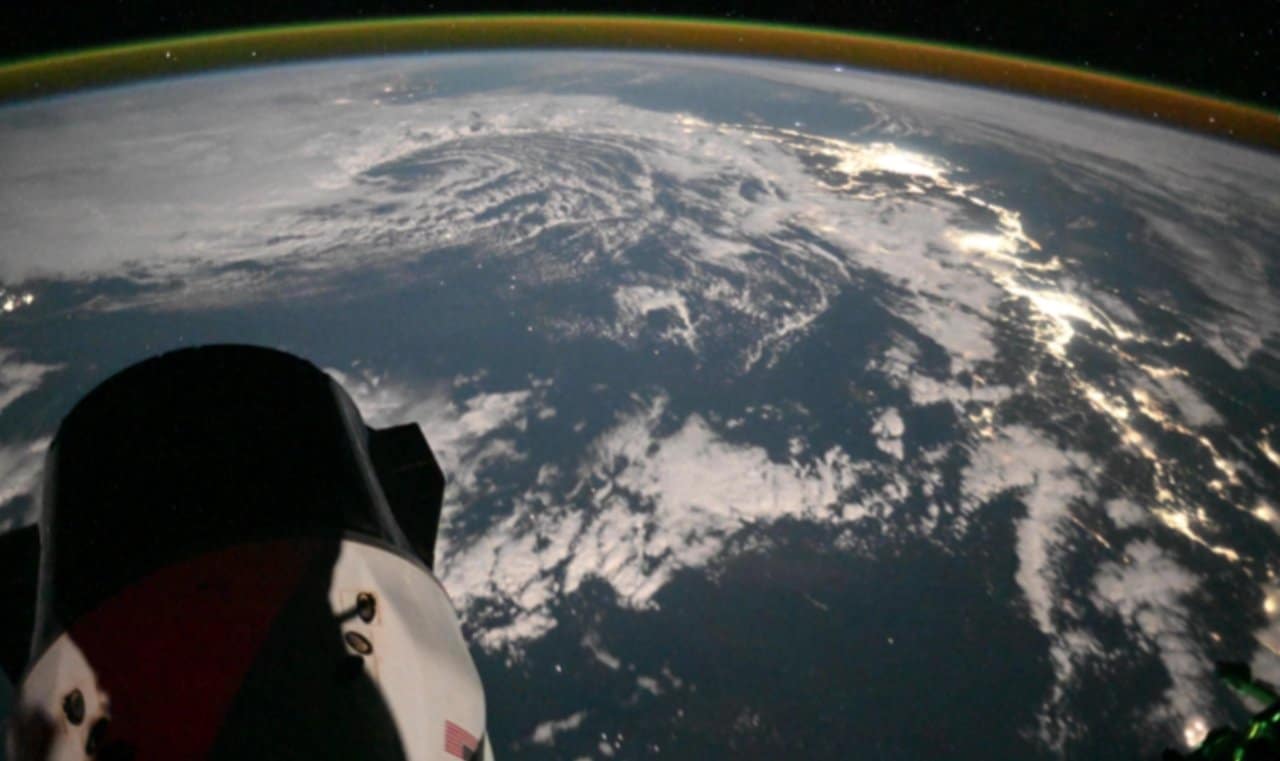
The global space development scenario underwent significant transformations in 2025, marking a record number of satellite launches and revealing complexities in both government programs and private initiatives. The growing activity, driven mainly by the Estados Unidos and The anticipation for 2026 points to crucial missions, political adjustments and the advancement of technology that will redefine the human and robotic presence in the universe, facing budget issues and unexpected accidents that shape the future trajectory of nations in space.
In 2025, the number of satellite launches that reached orbit worldwide surpassed the 300 mark, an increase of more than 50 compared to the previous year. Os Estados Unidos led this increase, with 190 launches, driven by the proliferation of SpaceX’s Starlink satellites and the expansion of private companies like Rocket Lab and Blue Origin. China followed with 86 launches, demonstrating notable progress in its state and private programs, with the goal of exceeding 100 annual launches.
This exponential growth in the number of satellites in orbit generated a total of 16,888 objects, of which 9,349 are exclusively from the Starlink constellation. The dominance of a single operator highlights the changing space landscape, where private infrastructure plays an increasingly central role in global communication and data collection, impacting discussions about regulation and sustainability of the orbital environment.
Advances and setbacks of the Japanese space journey
The Japão consolidated its role in space with four successful launches starting from the Centro Espacial and Tanegashima in 2025, ending the operational era of the H-IIA rocket and introducing the new H3 series into its continuous operations phase. Estes launches were vital to the deployment of strategic satellites and the advancement of Japan’s space transportation capability.
Among the milestones, rocket H3 #5 launched quasi-zenithal satellite Michibiki #6 on February 2, while H3 #7 on October 26 boosted the first HTV-X, an innovative resupply vehicle for Estação Espacial Internacional. The exchange of astronauts on the ISS, with Takuya Onishi being replaced by Kimiya Yui, kept the Japanese presence active in long-term experiments, reinforcing international collaboration.
Despite the successes, the Japanese space program suffered a setback on December 22, 2025, when the launch of the Quasi-Zenith satellite Michibiki #5, aboard the H3 rocket #8, failed. The problem occurred in the second burn of the second stage, preventing the satellite from being placed in orbit.
Initial investigations suggest that the payload fairing, which separated differently than expected, may have triggered the failure. Although the exact cause is still under investigation by JAXA and Ministério of Educação, Cultura, Esportes, Ciência and Tecnologia (MEXT), the incident will delay the completion of the seven-satellite system
Global political and scientific scenario
Internationally, 2025 was a year of political instability with a direct impact on space programs, especially Estados Unidos. The inauguration of a new president resulted in drastic changes at NASA, including the replacement of Administrador and the proposed significant budget cut of 24%, affecting critical areas such as science.
Crucial projects such as the Gateway lunar exploration base and the Marte sample return (MSR) mission were initially canceled, raising concerns about the agency’s competitiveness. Embora o Congresso resisted cuts and sought to restore some funding, partisan impasses led to a government shutdown in October, impacting NASA operations and other government programs.
At China, space development advanced considerably, with a record number of launches and success in civilian rocket reuse experiments, in addition to the stable operation of its Tiangong space station. An incident in September that damaged the Shenzhou 21 spacecraft demonstrated China’s ability to quickly implement contingency programs by transferring astronauts to an unmanned spacecraft.
Rússia also faced challenges with a November accident on Cosmódromo of Baikonur, which damaged a crucial launch pad for the Soyuz spacecraft. Este incident is expected to hamper manned launches for an undetermined period of time, requiring the support of Estados Unidos resupply vehicles and manned spacecraft for Estação Espacial Internacional operations until repairs are completed.
Perspectives for 2026: missions and collaborations
The year 2026 promises to be full of significant space activities for Japão and the world. The first Japanese launch is scheduled for February 4, with H3 rocket No. 9 carrying the Quasi-Zenith Michibiki No. 7 satellite, crucial to the completion of the autonomous positioning system. However, the date may be revised due to the need for inspections following the previous failure.
Rocket Lab, with launches of ultra-compact satellites for JAXA, will continue its operations, highlighting the growing dependence on foreign rockets for certain technological demonstrations. Japanese private Empresas, like Space One, plan microsatellite launches, highlighted by the third attempt of Kairos 3 on February 25, which will be a crucial test for the future of private rocket financing in Japão.
Fiscal year 2026 also sees the debut of configuration 30 of the H3 rocket, a simpler and lower-cost version, after the resolution of a defect detected in tests in 2025.
Featured major space science projects
Among the most anticipated space science missions, JAXA’s Exploração mission of Luas of Marte (MMX) will be launched in 2026. Esta unprecedented probe aims to collect samples from the surface of
The international BepiColombo mission, a JAXA-ESA partnership for the exploration of Mercúrio, will finally reach its destination in November 2026, after an eight-year journey. The Orbitador Magnetosférico of Mercúrio (MMO), developed by JAXA, will analyze the planet’s magnetosphere, seeking to unravel the mysteries of planetary formation.
In the Estados Unidos, the Telescópio Espacial Nancy Grace Roman (WFIRST), scheduled to launch in 2026, will observe the universe in infrared light with a field of view 200 times larger than that of the Hubble. The telescope will seek to investigate dark energy and cold exoplanets, although its schedule has been affected by proposed budget cuts for space science.
Manned mission agenda and global developments
The global agenda for 2026 includes the launch of the Índia demonstration manned spacecraft, Gaganyaan-1, in January, marking a significant step towards the country becoming the fourth nation with technology for human flight.
In February, the Artemis II of the Estados Unidos manned lunar exploration mission will be launched, representing the American return to lunar orbit after 54 years. With a combination of the SLS rocket and the Orion spacecraft, the mission will take three astronauts from the Estados Unidos and one from the Canadá on a journey lasting approximately ten days, boosting the competition for lunar exploration. Japanese space legislation, based on Tratado from Espaço Exterior, is in the process of being revised to cover more diverse launch methods and support the private sector.
[Keywords]
space development, Japão, Estados Unidos, China, JAXA, NASA, H3 rocket, satellites, lunar exploration, Estação Espacial Internacional
space missions 2026
[Researched links and researched posts]
Not applicable, as instructed not to present searched links in the final output.
