Astrophysicist Avi Loeb, from Harvard, updated his position on the interstellar object 3I/ATLAS in a recent article. Ele maintains the ranking at 4 on the Loeb scale, which ranges from 0 for natural rocks to 10 for potentially threatening alien technology. Essa classification reflects the presence of anomalies but emphasizes that the object is likely of natural origin.
Loeb refused to change the ranking until the public release of new data obtained near the closest approach to Terra, in December 2025.
The object, discovered in July 2025, has characteristics that distinguish it from common Sistema Solar comets. Observações indicate a hyperbolic trajectory, confirming its interstellar origin, and gaseous compositions typical of comets, such as CO2, CO and H2O.
Scale Loeb and its application
The Loeb scale classifies interstellar objects based on observable anomalies. Ela has been quantified in peer-reviewed publications and recently expanded to evolve with new data. Para 3I/ATLAS, the initial ranking of 4 considers anomalies such as the anti-tail jet.
Loeb currently lists 15 anomalies in the object. Essas include unusual gas composition and trajectory alignment. However, he highlights that the absence of clear technological signals keeps the probability of natural origin high.
- Trajectory aligned with the ecliptic plane
- Extensive sunward jet
- Anomalous abundances of nickel and other elements
These points require further observations to distinguish between natural ice sublimation and a possible technological propellant.
🚨Discovery: The “3i/Atlas”
— SpaceTracker.space (@Ammar1176708)January 7, 2026
3I/ATLAS Images:https://t.co/00hpNCh9Zx
January 6, 2026 — Astronomers and space enthusiasts are reeling after the release of ultra-high-resolution 8K imagery of the 3iAtlas system, a…pic.twitter.com/tqtgXr4rAN
Anomalies observed in 3I/ATLAS
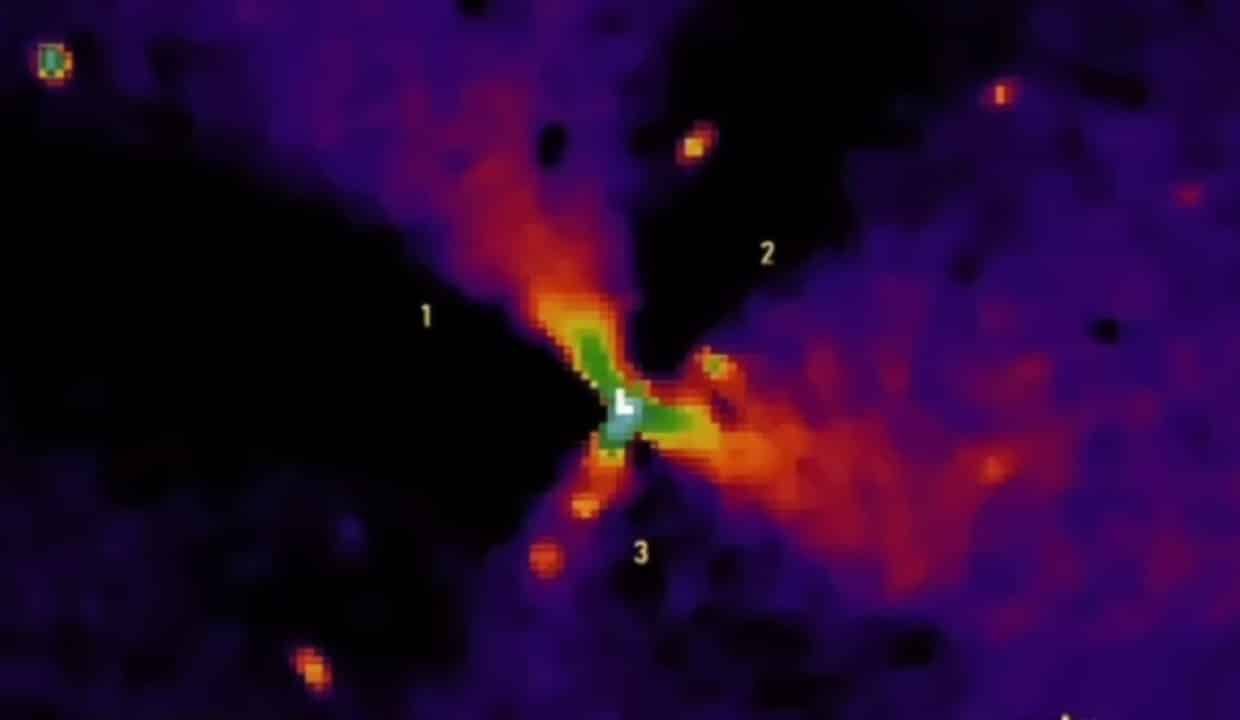
Recent observations reveal an anti-tail jet extending millions of kilometers toward Sol. Esse jet features dust particles larger than those common in comets. Medições of speed and composition could differentiate natural from artificial origins.
The object passed close to Terra on December 19, 2025, about 269 million kilometers away. Não recorded unexpected maneuvers or artificial radio signals during this approach. Buscas by technosignatures, including with the Green Bank Telescope, did not detect anomalous emissions.
Surveys with telescopes such as Hubble and VLT confirm typical cometary activity. Isso includes release of gases and dust, reinforcing the natural interpretation.
Spectral data and composition
Anti-tail jet spectra are crucial for future classification. In a natural case, gases such as CO2, CO and H2O are expected at speeds of hundreds of meters per second. Composições anomalous or higher speeds would suggest technological origin.
Detections include cyanide (CN) and atomic nickel vapor, common in comets. Observações from JWST confirm CO2 and water outgassing. Essas evidence aligned with natural astrophysical processes keeps the ranking stable.
Passage through Júpiter and future perspectives
The approach of Júpiter on March 16, 2026 will occur at about 53.6 million kilometers. Essa distance approximately coincides with the planet’s Hill sphere. Observações of this phase may reveal release of smaller objects or artificial lights.
Without clear technological signals, Loeb plans to reduce the ranking. The Juno probe, orbiting Júpiter, could provide additional data. However, fuel limitations restrict maneuvers.
Recent observations and scientific consensus
Images from December 2025 show the anti-tail jet prominently. The object exhibited brightness and color expected for interstellar comets. The scientific community mostly considers 3I/ATLAS a natural comet with unique characteristics due to its external origin.
Searches for radio signals during the approach to Terra found no evidence of technology. Isso reinforces the view that the object follows known natural processes.
- Absence of radio signals in specific bands
- Gas composition consistent with comets
- Hyperbolic trajectory without anomalous non-gravitational deviations
These observations contribute to the stability of the current ranking.
Classification evolution with new data
The Loeb scale allows for dynamic updates as data arrives. Loeb emphasizes that science advances through rigorous analysis, not reporting. Futuras releases of spectral and proximity data to Júpiter will determine adjustments.
The object remains under global monitoring. Astrônomos await results from ground and space observatories to clarify the remaining anomalies.
