
The rock formation known as Al-Naslaa, located in the Tayma oasis in the northwest of Arábia Saudita, consists of a block of sandstone divided in half by an extremely straight crack. Essa structure, approximately six meters high and nine meters wide, rests on two natural pedestals that give the impression of precarious balance. Especialistas in geology highlight that the division seems so precise that it generates debates about natural processes over thousands of years.
The rock attracts visitors and researchers due to its unique appearance in the arid desert. Imagens and records show that the two parts remain separated without tilting, which reinforces scientific interest in the formation. Petróglifos ancient engravings on the surface add archaeological value to the site.
Formally discovered in the 19th century by the French explorer Charles Huber, Al-Naslaa is part of a region rich in historical remains. The Tayma oasis houses evidence of human occupation since prehistoric periods.
Location and characteristics of training
The Tayma oasis is located in the province of Tabuk, about 50 kilometers south of the Al-Naslaa formation. Essa desert area presents extreme climatic conditions, with constant winds and thermal variations that influence rock erosion. The structure stands out for its symmetry and contrast with the sandy surroundings.
The two halves of the rock remain erected on narrow bases, the result of differential erosion processes. Geólogos observe that sandstone, a porous material, facilitates the action of wind and sand over time. The vertical crack measures a few centimeters wide in some places.
Theories about rock splitting
Experts propose that a subtle geological fault initiated the separation of the parts. Movimentos tectonics in the region could have fractured the original block, creating the straight line observed today. Essa hypothesis gains strength from the presence of natural joints in similar sandstone formations.
Another explanation involves freezing and thawing cycles in wetter periods in the past. Água infiltrated into microcracks would expand upon freezing, gradually widening the crack. Upon return to arid conditions, the crack would remain smooth and defined.
- Wind erosion with grains of sand acting as a natural abrasive over millennia.
- Chemical action that dissolves specific layers of sandstone.
- Combination of internal stresses with external factors such as wind and temperature.
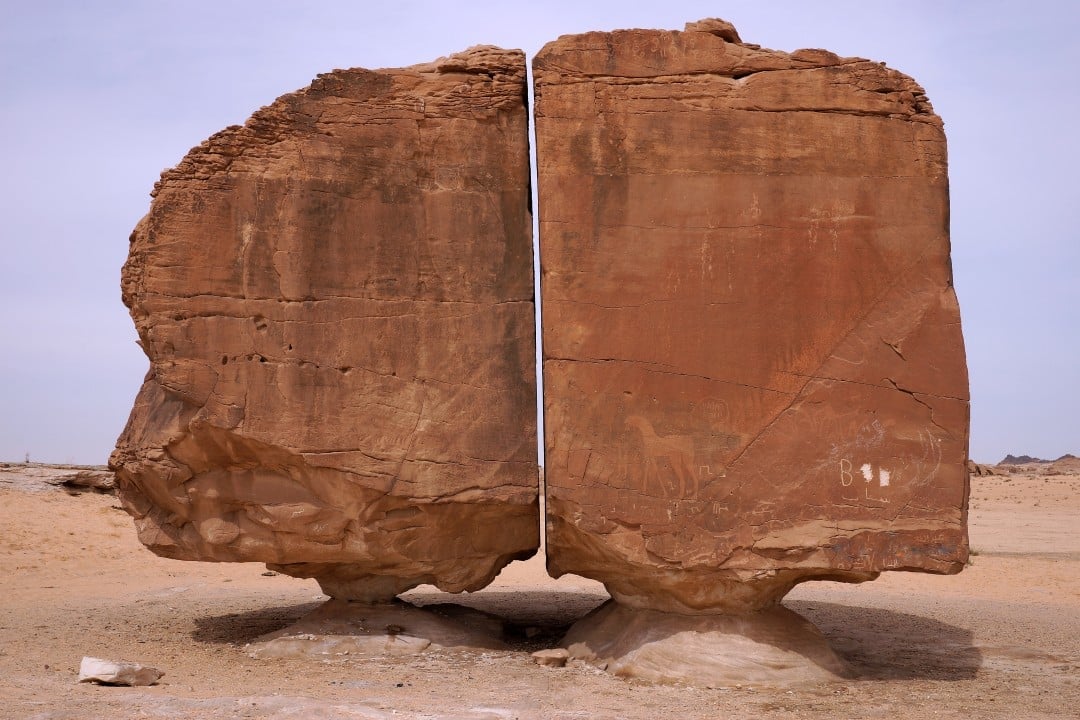
Petroglyphs present on the surface
The faces of Al-Naslaa contain ancient engravings depicting human and animal figures. Entre The drawings identified are Arabian horses, ibexes and hunting scenes. Essas images indicate cultural use of the site by ancient populations.
Archaeologists estimate that the petroglyphs date back at least four thousand years. The preservation of the recordings benefits from the natural protection offered by the position of the rock. Estudos recent documents document dozens of motifs on one of the main faces.
Research in the Tayma region reveals similar patterns in other nearby rocks. The carvings suggest trade routes or ritual practices associated with the oasis.
Erosion processes in the desert environment
Strong winds carry sand particles that wear exposed surfaces unevenly. Nas bases of Al-Naslaa, erosion creates pedestals by removing material more quickly in the lower parts. Esse phenomenon occurs in several desert formations around the world.
The relative protection of the inner faces of the crack preserves smoother surfaces. Areia accumulated over time acts as a natural polish on the edges of the division.
Other similar formations in the region
Arábia Saudita houses several balanced rocks due to characteristic wind erosion. In areas near Tayma, sandstone blocks exhibit comparable weathering patterns. Recent Descobertas include cave paintings of camels estimated to be 12,000 years old.
These monumental representations possibly served as indicators of water sources. The Nafud region reveals archaeological sites that contextualize ancient human occupation.
Preservation and access to the site
Saudi authorities include Al-Naslaa in tourist itineraries open to the public. Visitantes access the site using vehicles adapted to the desert terrain. Medidas conservation agencies limit direct contact with the rock to protect the petroglyphs.
Local guides offer information about the geology and history of the area. The training integrates efforts to enhance the country’s natural heritage.
Al-Naslaa remains the subject of ongoing geological studies. Pesquisadores collect data on current erosion to compare with past processes. The site combines natural phenomena with evidence of ancient human occupation in the desert.
Photographic records and detailed analyzes contribute to understanding the formation. Straight division continues to generate hypotheses based on field observations.
