
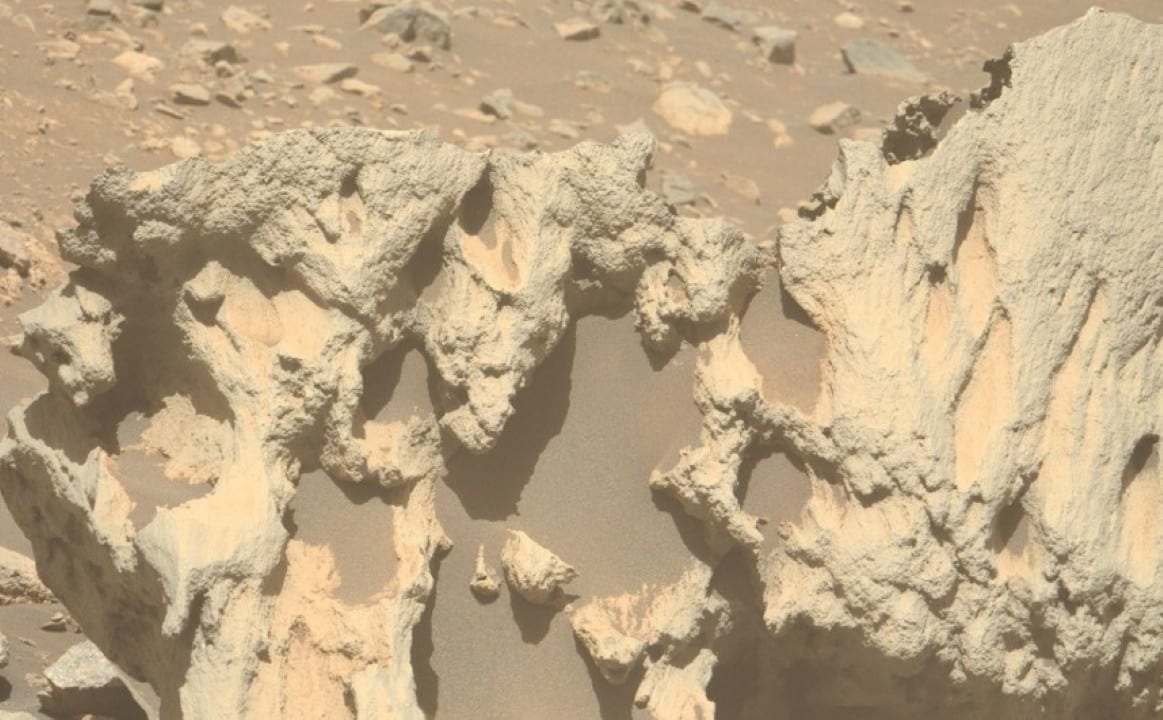
The Nasa rover Perseverance made a remarkable discovery on the surface of Marte by identifying an unusual-looking rock approximately 80 centimeters in diameter. Batizada of Phippsaksla, the rock formation is located outside the crater
The identification took place in September 2025, and confirmation of its peculiar composition came through analyzes carried out by the SuperCam instrument, one of the most advanced on board the rover. The images and spectral data were released by the space agency in November 2025, after a period of processing and verification by the scientific team. Este find potentially represents the first ferronickel meteorite found by Perseverance, expanding the scope of its geological discoveries in Marte.
The rock stands out visually in the flat, fragmented terrain of the Vernodden site, an area adjacent to the Jezero crater. Sua’s sculpted shape and elevation relative to the surrounding land contrast with local Martian rocks, which tend to be lower and more eroded. Fotografias detailed images, captured at different times, allowed scientists to observe its cavernous texture and plan more in-depth analyzes to unravel its history and cosmic origin.
Detailed analysis of rock composition
The Phippsaksla investigation was conducted using a suite of high-tech instruments. The main one, SuperCam, located on the rover’s mast, used a laser to vaporize small portions of the rock’s surface. The light emitted by the resulting plasma was captured and analyzed by a spectrometer, a technique that allows the chemical elements present to be identified. The spectra revealed significant peaks of iron and nickel, a classic signature of metallic meteorites, which are fragments of the cores of ancient asteroids. SuperCam’s Além, the Mastcam-Z, a system of panoramic and stereoscopic cameras, recorded high-resolution images that documented the rock’s morphology, including its cavities and contours that suggest a violent passage through the Martian atmosphere. Combining this data enabled accurate remote characterization, providing the team at Terra with crucial information without the need for direct contact or immediate sample collection. Visual analysis also showed that the rock has a dark patina, possibly the result of the interaction of its metallic surface with the Martian environment over millennia.
Characteristics that differentiate Phippsaksla
What makes Phippsaksla particularly interesting is its physical prominence in the environment. The rock towers over neighboring formations, suggesting much greater resistance to the erosion processes that shape the Martian landscape, such as dust-laden winds and drastic temperature variations.
This durability is a common feature in iron and nickel meteorites, which are much denser and more cohesive than the sedimentary and volcanic rocks native to Marte. Enquanto the surrounding bedrock fragments and erodes over time, Phippsaksla appears to have remained relatively intact, serving as a silent monument to an ancient impact event.
The importance of exploration outside of Jezero
Initially, the Perseverance mission focused on the interior of the Jezero crater, a site chosen because it was home to a lake and river delta billions of years ago, making it a prime target in the search for signs of past microbial life. Collecting samples of sedimentary and igneous rocks within the crater has already provided robust evidence of interaction with ancient water.
However, the decision to extend exploration to peripheral areas, such as site Vernodden, was strategic. Essas regions allow scientists to study the oldest bedrock on the planet, which has not been covered by lake sediments. Mapear these areas help build a more complete picture of the geological history of Marte.
The presence of a meteorite like Phippsaksla in this region reinforces the idea that cosmic impacts were a fundamental process in the formation of the Martian surface, distributing materials from different parts of the solar system across the planet. Analysis of these “visitors” offers a direct window into the composition of asteroids, without the need for a sample return mission from one of these celestial bodies.
A history of meteorites in Marte
The Perseverance rover is not the first to find objects of extraterrestrial origin in Marte. The discovery of meteorites has been a scientific bonus on several Nasa surface missions, providing valuable data on the bombardment of smaller bodies in the inner solar system.
The Spirit and Opportunity rovers, which explored the planet in the 2000s, were pioneers in this area. In 2005, Opportunity found “Heat Shield Rock”, the first meteorite formally identified on another planet, a piece of iron and nickel about 30 centimeters in diameter.
More recently, the Curiosity rover, which has been operating in the Gale crater since 2012, has also made several discoveries. Entre they are the “Lebanon” meteorite in 2014, a large block of iron, and the “Cacao” in 2023, a small metallic meteorite that stood out against the reddish soil.
These previous finds establish a pattern of preservation and occurrence that makes the discovery of Phippsaksla expected but no less exciting. The absence of ferronickel meteorites in the Jezero crater has until now been a question that has puzzled scientists, and this new evidence begins to fill that gap.
The Martian environment as a cosmic preserver
Mars is an exceptionally good environment for preserving metallic meteorites, much better than Terra. Nosso planet has a dense atmosphere that burns most incoming objects and a humid, oxygen-rich climate that quickly corrodes and decomposes iron meteorites through oxidation, or rust. In a few thousand years, an iron meteorite can completely disintegrate into Earth’s soil.
In contrast, Marte’s thin atmosphere offers less protection from impacts, allowing more fragments to reach the surface. Once in the soil, the absence of rain and the low concentration of atmospheric oxygen drastically slow down the chemical degradation processes. Isso allows meteorites like Phippsaksla to remain exposed and recognizable for millions, perhaps billions, of years. Essa exceptional preservation transforms the surface of Marte into a true museum of the history of the solar system, with asteroid samples scattered around and ready to be studied.
Next steps of the mission
With the preliminary identification of Phippsaksla as a ferronickel meteorite, the Perseverance team plans to continue remote analysis to extract as much information as possible. Additional Estudos could include more laser shots at different points of the rock to check the homogeneity of its composition and observations with other instruments to better understand its physical properties.
This finding also reinforces the importance of the Mars Sample Return mission, an ambitious project in collaboration with Agência Espacial Europeia (ESA). Perseverance has already collected and sealed dozens of samples of rocks, soil and Martian atmosphere in titanium tubes, which will be left on the surface for a future mission to search for and bring to Terra. Embora Phippsaksla is too large to collect, its study informs the type of material scientists hope to analyze in terrestrial laboratories.
Scientific potential of the find
Continued analysis of Phippsaksla can refine models on the frequency and distribution of meteorite impacts on Marte. Cada discovery adds a piece to the puzzle of the planet’s and solar system’s history, helping scientists understand the composition of bodies that roamed space billions of years ago and contributed to the formation of rocky planets.
