
Venezuela embraces US recovery phase with prisoner releases and oil investment push
Venezuela is actively moving into what the United States government terms the “second phase” of its post-Nicolás Maduro plan, focusing on two pivotal areas: the release of political prisoners and the vital need to attract foreign investment. This strategic shift comes as Delcy Rodríguez has served as interim president for nearly two weeks in early 2025, solidifying U.S. oversight of the nation’s oil industry.
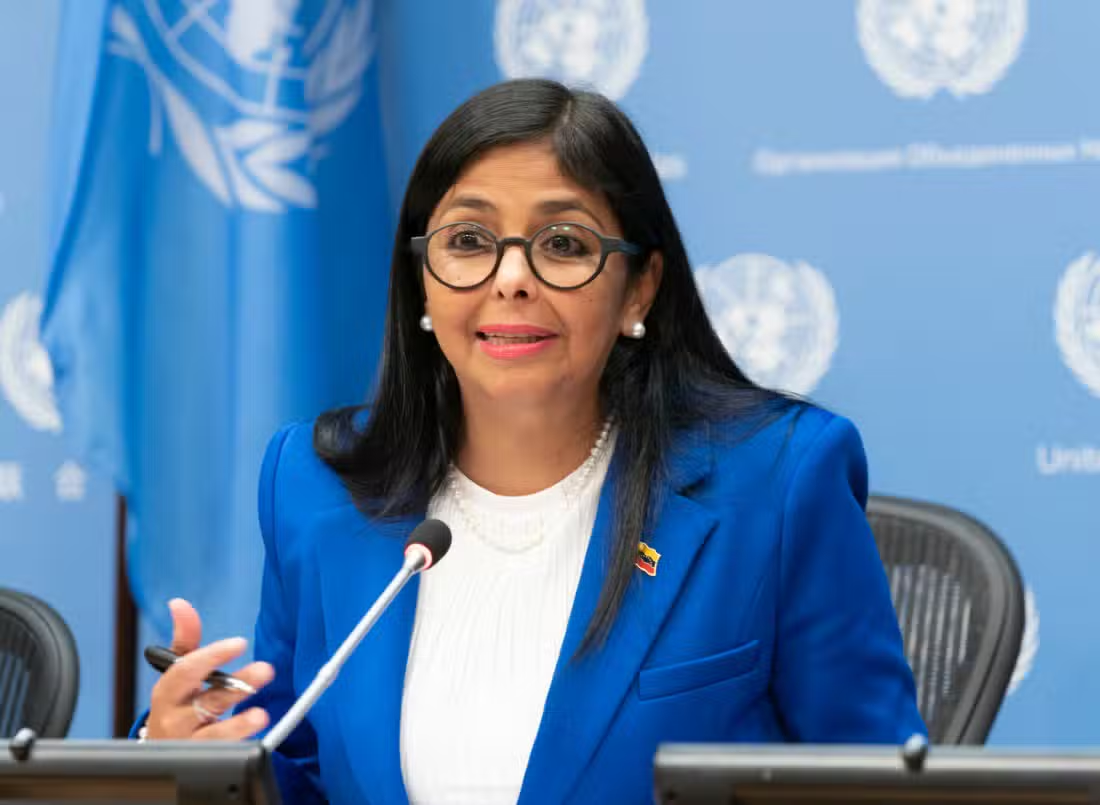
This “recovery” stage, as outlined by U.S. Secretary of State Marco Rubio, is designed to rebuild the nation after Maduro’s capture and trial in the U.S. It specifically calls for granting amnesty and liberating individuals detained for political reasons, alongside facilitating the entry of international companies into Venezuela’s economy. The initial “stabilization” phase aimed to prevent chaos, while the final “transition” phase envisions Venezuelans determining their future through presidential elections.
Venezuela enters U.S. recovery phase
The strategic roadmap laid out by U.S. officials highlights a phased approach to reshaping Venezuela’s political and economic landscape. The current emphasis on “recovery” signifies a shift from immediate crisis management to laying groundwork for long-term stability and growth. This phase explicitly connects humanitarian concerns with economic reconstruction.
Washington’s framework prioritizes both political reconciliation and economic liberalization as intertwined components for the nation’s future. By addressing issues of political detention and foreign investment simultaneously, the plan aims to foster an environment conducive to broader international engagement and internal reconciliation, essential steps after a period of intense geopolitical pressure and internal strife.
Oil sector reform seeks foreign capital
President Delcy Rodríguez announced on Thursday, January 15, 2025, that her administration would submit a bill to the National Assembly to reform the Hydrocarbons Law. This legislation, historically strengthening state control over the entire oil production chain under former President Hugo Chávez, is now poised for significant changes to allow greater private sector involvement.
The proposed reform seeks to integrate emergency mechanisms from the 2020 Anti-Blockade Law, which previously enabled the Venezuelan state to flexibly partner with private oil companies to circumvent sanctions. This move is a direct response to foreign oil companies, influenced by pressure from the United States, which demand guarantees against losses similar to those experienced during the nationalization of the Venezuelan oil industry before committing new capital.
Political prisoner releases advance
As part of the ongoing reconciliation efforts, Delcy Rodríguez confirmed on Wednesday, January 14, 2025, that the country would continue releasing political prisoners. Her statement indicated that up to 406 individuals were expected to be freed by the end of that day, signaling a tangible step toward fulfilling a key aspect of the U.S.-backed recovery plan.
This initiative is particularly significant given the statistics from human rights organizations. The Foro Penal, a prominent group monitoring human rights in Venezuela, had reported 806 political prisoners in the country as of January 5, 2025. The continued releases demonstrate a commitment to reducing this number and addressing long-standing human rights concerns.
Rodríguez emphasized that these actions mark “a Venezuela that opens up to a new political moment.” She articulated a vision of a nation embracing “understanding from divergence and political-ideological diversity, but which must be done with respect for others and human rights.”
Machado meets Trump, pushes for democracy
While Rodríguez announced these domestic reforms in Caracas, María Corina Machado, a leading opposition figure to the Chávez regime, met with former U.S. President Donald Trump in Washington. This marked their first encounter since the operation that led to Maduro’s capture and subsequent trial in the U.S. for drug trafficking. Machado presented Trump with her 2025 Nobel Peace Prize medal, engaging in calm discussions about “the expectations and dreams of Venezuelans.” She expressed being “very impressed” by Trump’s “clarity” regarding Venezuela’s complex situation. Machado affirmed that Venezuelan society is unified, with over 90% seeking freedom, dignity, justice, and the return of their children, all contingent on establishing a true democracy. She confidently stated that President Trump is committed to the freedom of all political prisoners and all Venezuelans, underscoring the ongoing process in the country.
Expert analysis on the Venezuelan transition
Professor Eduardo Viola of the University of São Paulo and Fundação Getúlio Vargas noted that Venezuela’s repressive structure extends beyond state institutions to include armed paramilitary groups known as “colectivos.” He highlighted these factions as a primary reason the U.S. opted for a transition under an interim Chavista leadership, rather than immediately installing an opposition figure like María Corina Machado or Edmundo González.
Viola remarked, “A transition with María Corina and Edmundo González would never have been possible; that is opposition naivety.” This perspective suggests that the pragmatic choice aimed to navigate the complex web of power dynamics within Venezuela, which includes formidable non-state actors. The presence and influence of these armed groups make a sudden, radical shift in power particularly challenging and potentially destabilizing for the nation, guiding the U.S. strategy towards a more gradual and controlled transition.
Geopolitical stakes for US elections
Thiago de Aragão, CEO of Arko Advice Internacional, emphasized that in the year preceding significant U.S. legislative elections, the Trump administration would likely leverage American involvement in Venezuela. This engagement aims to secure crucial Latino votes for Republican candidates, particularly by demonstrating foreign policy successes and strong stances abroad.
Venezuela recovery, US plan Venezuela, political prisoners Venezuela, Venezuela oil investment, Delcy Rodríguez
