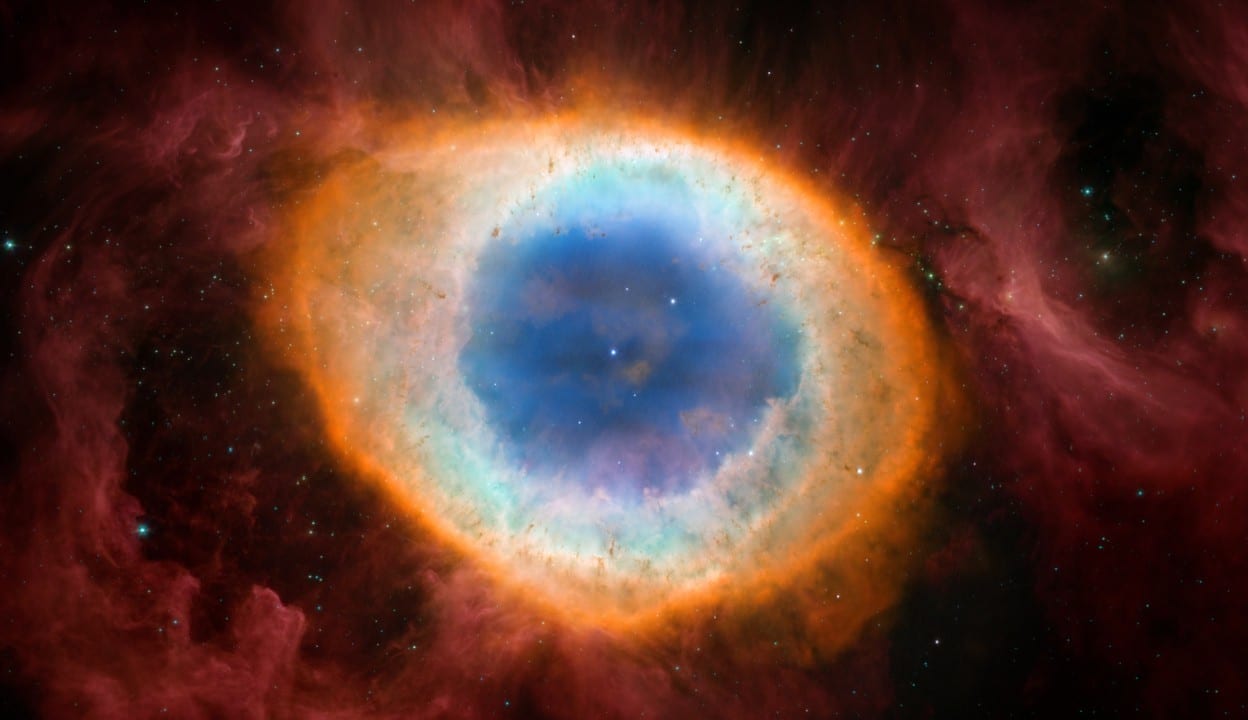
Astronomers announced the identification of a linear structure composed of highly ionized iron within Nebulosa of Anel, located approximately 2,600 light-years from Terra in the constellation of Lira. The discovery occurred during observations carried out with the new WEAVE instrument on Telescópio William Herschel, on Ilhas Canárias. Essa structure, described as a narrow bar, crosses the central region of the nebula and represents a previously unknown component.
The research involved an international team of more than 20 scientists and resulted in a recent publication in the journal Monthly Notices of the Royal Astronomical Society. The observations were conducted in 2023, during the equipment’s scientific verification phase. Nebulosa of Anel, also known as M57 or NGC 6720, is one of the most studied and photographed planetary nebulae in the night sky.
The detected structure emits specific lines of ionized iron, with no correspondence in morphology or speed with other elements present in the nebula. Essa characteristic distinguishes the bar from common phenomena such as gas jets.
Observations carried out with the WEAVE instrument
The Telescópio William Herschel, with a 4.2-meter mirror, received the WEAVE spectrograph as part of a significant upgrade. Esse instrument enables wide-area full-field spectroscopy, capturing data from thousands of points simultaneously.
The Nebulosa observations of Anel took place in May and June 2023. The data revealed the iron bar in composite images of specific emission lines. The spectral resolution allowed detailed analysis of ionization velocities and states.
Properties of the detected iron structure
The bar presents emission confined to iron in high ionization states, such as [Fe V] and [Fe VI]. Essa emission forms a narrow line that crosses the central cavity of the nebula.
Kinematic analyzes indicate that the structure does not exhibit movements typical of bipolar jets, common in planetary nebulae. The radial velocity of the rod differs from other gaseous components in the region.
Comparisons with dust data obtained by other telescopes suggest possible interaction between iron and dust grains. Não there is evidence of high-velocity shocks or extremely hot gas in the area.
The extent of the bar along the line of sight remains uncertain. Sua exact position within the three-dimensional structure of the nebula requires additional studies.
Typical formation of planetary nebulae
Planetary nebulae arise at the end of the life of stars with a mass similar to that of Sol. Essas stars run out of hydrogen in their cores and expand into red giants.
During this phase, the star expels outer layers of material, forming a gaseous envelope. The remaining core, a hot white dwarf, emits ultraviolet radiation that ionizes the ejected gas.
The ionized gas glows in emission lines characteristic of elements such as hydrogen, helium, oxygen and nitrogen. The Nebulosa of the Anel exemplifies this process, with its apparent ring resulting from the projection of a toroidal structure.
Many nebulae exhibit asymmetries, such as lobes or jets, arising from magnetic fields or binary companions. The presence of heavy metals, such as iron, generally occurs in depleted forms in dust.

History of Nebulosa observations of Anel
The object was discovered independently in 1779 by astronomers Antoine Darquier of Pellepoix and Charles Messier. Messier included it in his catalog as the 57th item.
William Herschel observed the nebula years later and coined the term “planetary nebula” due to the planet-like disk-like appearance. Modern Observações, including images of Telescópio Espacial Hubble, revealed fine details of filaments and knots.
Data from Telescópio Espacial James Webb added information about molecules and dust in the outer halo. Nebulosa of Anel serves as a laboratory for understanding low-mass stellar evolution.
- Initial discovery: 1779 by Darquier and Messier
- Appointment as planetary: early 19th century by Herschel
- Detailed images: 1990s and 2000s with Hubble
- Recent Infrared Observations: JWST Identifying Hydrocarbons and Dust
Hypotheses about the origin of the iron bar
The formation of the linear iron structure still has no definitive explanation. Inicialmente, researchers considered the possibility of a jet, but velocity data ruled out that idea.
Another possibility involves selective destruction of iron-containing dust grains, releasing the element in ionized gaseous form. Essa hypothesis requires specific radiation conditions or moderate shocks.
The bar could represent material ejected at a specific stage in the evolution of the central star. Interações with an invisible companion also comes into consideration.
The amount of iron detected suggests significant mass, comparable to small rocky bodies. Additional Observações will help refine these models.
Details of the central star and environment
The star at the center of Nebulosa is a white dwarf with a high surface temperature. Essa star illuminates surrounding material with intense radiation.
The environment includes an empty central cavity, surrounded by a torus of dense gas that forms the visible ring. External Regiões contain molecular halo with neutral hydrogen.
The inclination of the nebula in relation to Terra allows an almost frontal view of the ring. Essa geometry facilitates internal structure studies.
Estimated distance varies between 2,000 and 2,600 light years based on different methods. Recent Medições tend towards values close to 2,600 light years.
Implications for studies of metals in nebulae
The detection of highly ionized iron in an organized structure challenges current models of elemental depletion. In planetary nebulae, heavy metals often become incorporated into dust, reducing their gaseous presence.
This discovery highlights the need for high-resolution spectroscopy on multiple objects. Comparações with other nebulae will help determine whether similar bars occur in other cases.
Future research could explore connections between chemical composition and stellar mass loss history. The case of Nebulosa of Anel offers a unique opportunity due to its proximity and brightness.
Planned next research steps
The responsible team plans further analysis of existing data. Novos articles will detail three-dimensional modeling of the structure.
Additional observations with other instruments aim to clarify the position of the bar in the line of sight. Integração of multi-wavelength data will improve understanding.
Theoretical studies will simulate conditions necessary for the formation of such structures. Esses efforts will contribute to general knowledge about stellar end-of-life.
Nebulosa of Anel continues to reveal surprises despite centuries of study. Descobertas like this demonstrate the value of new instruments in observational astronomy.
