The National Aeronautics and Space Administration (Nasa) released a video this Wednesday, January 21, showcasing a powerful solar eruption that generated a worldwide alert earlier in the week. The visually striking footage highlights the immense forces at play on our star, drawing attention to critical space weather events.
This significant event has prompted global agencies to issue severe warnings regarding potential impacts on technological infrastructure. The detailed observation and subsequent alert underscore the increasing importance of monitoring solar activity for Earth’s preparedness.
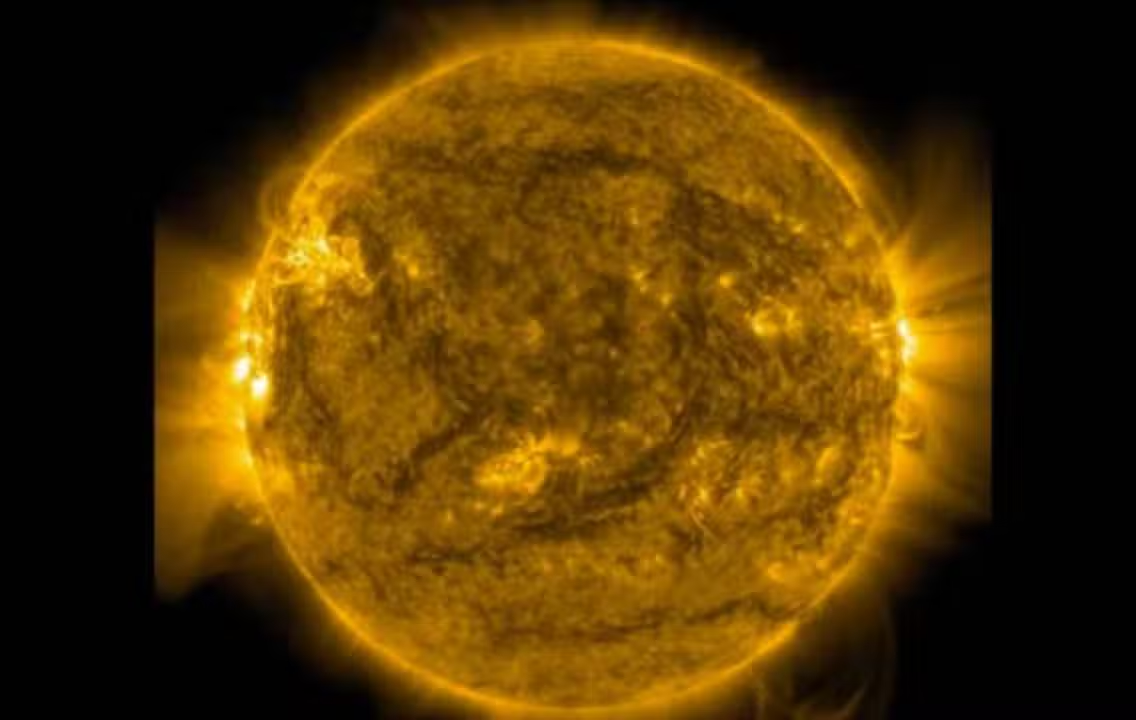
The eruption, classified as an X1.9 flare, represents one of the most intense categories of solar outbursts, carrying substantial implications for Earth’s magnetic field and orbiting assets. Such powerful events necessitate immediate evaluation by space weather experts to assess their global reach.
Observing the solar event
The newly released video from Nasa’s Solar Dynamics Observatory (SDO) captures a bright flash near the Sun’s center-left limb. This particular segment of the footage is processed to highlight extreme ultraviolet light, which emanates from the extremely hot material expelled during the eruption.
The image, intentionally colored in blue-green for clearer visualization, offers scientists and the public an unparalleled view of the flare’s initial stages. A subsequent part of the video further illustrates the eruption simultaneously across three distinct wavelengths, providing a comprehensive spectral analysis of the event.
Classifying the eruption
Solar flares are categorized by their intensity, with X-class flares denoting the most powerful eruptions capable of causing widespread radio blackouts and significant radiation storms. The specific X1.9 classification for this event indicates a high level of strength within this most intense category.
Understanding these classifications is crucial for predicting the potential severity of subsequent space weather phenomena. The numerical modifier, in this case, 1.9, provides a finer detail on the flare’s overall magnitude, helping scientists pinpoint its destructive potential.
The energy released during such an X-class flare can travel across the solar system, influencing planetary environments. While a direct impact on Earth’s surface is shielded by its atmosphere and magnetic field, the upper atmosphere and space-based technologies remain vulnerable.
Severity of the geomagnetic storm
Following the X1.9 flare, the National Oceanic and Atmospheric Administration’s (NOAA) Space Weather Prediction Center (SWPC) issued a severe geomagnetic storm alert, categorized as Grade 4 on a scale of 1 to 5. This alert signifies a substantial threat to various systems.
A severe S4 category solar radiation storm is currently underway, marking the largest such event observed in over two decades. The last instance of an S4 level storm occurred in October 2003, highlighting the rarity and significance of the present conditions.
This intense radiation can pose risks to astronauts, high-altitude aircraft, and sensitive satellite electronics. Operators of critical infrastructure in space and on Earth’s polar regions are typically advised to take precautionary measures during such events.
The SWPC’s alert provides crucial information for stakeholders to mitigate potential disruptions. Continuous monitoring ensures that updated advisories can be disseminated promptly, allowing for responsive actions to safeguard technology and personnel.
Global alert and potential impacts
The global alert issued by space weather authorities emphasizes the interconnectedness of solar activity and Earth’s technological infrastructure. Powerful solar eruptions can eject vast clouds of charged particles, known as coronal mass ejections (CMEs), which, if directed towards Earth, can trigger geomagnetic storms. These storms occur when the CME’s magnetic fields interact with Earth’s magnetosphere, causing disturbances that can lead to various effects. Potential impacts are primarily limited to critical sectors such as space launches, the operation of satellites, and aviation, particularly for flights traversing polar routes where the Earth’s magnetic field offers less protection. Such disturbances can disrupt radio communications, degrade GPS signals, and induce electrical currents in power grids, although the latter is more common with higher-grade storms. Organizations managing these systems are on heightened alert, implementing protocols to minimize service interruptions and ensure safety.
Historic context and future monitoring
The current S4 radiation storm’s intensity, unprecedented in over 20 years, places it in a historical context that underscores the dynamic and unpredictable nature of solar activity. Previous events of this magnitude have offered valuable lessons regarding the resilience and vulnerability of space-based and ground-based technologies. Continuous advancements in solar observation, such as those provided by Nasa’s SDO, are vital for enhancing our predictive capabilities. International cooperation in space weather forecasting ensures a comprehensive understanding of these phenomena, allowing for more accurate alerts and better-informed decisions globally. The ongoing vigilance is essential for protecting a world increasingly reliant on technology susceptible to the Sun’s powerful emissions.
Understanding space weather
Space weather encompasses the conditions in space that can affect Earth and its technological systems, largely driven by events originating from the Sun. Monitoring these phenomena is a continuous effort, involving a network of observatories and scientific models to forecast solar flares, radiation storms, and geomagnetic disturbances.
