Nex Computer, known for its peripherals that expand the functionality of mobile devices, officially entered a new segment with the launch of NexPhone. The smartphone stands out in the market for an innovative feature: the ability to natively run three different operating systems, including Windows 11, Linux Debian and Android. Apresentado as a definitive solution for productivity and versatility, the device aims to serve an audience of technology enthusiasts and professionals who seek convergence between desktop computing and the mobility of a cell phone.
Starting at US$549, the device challenges the conventions of closed ecosystems, offering unprecedented freedom of choice. The project, which according to the company took 14 years to come to fruition, represents the culmination of an engineering effort to enable desktop operating systems in a compact and efficient hardware architecture, without resorting to emulators or virtualization solutions that compromise performance.
The initial launch strategy focuses on direct-to-consumer sales, with global distribution planned to reach key markets. The NexPhone is not just a phone, but positions itself as a true pocket computer, promising to transform the way users interact with their work and entertainment software in different contexts, whether in the office, at home or on the go.
The convergence of three systems into a single device
NexPhone’s main innovation lies in its multi-boot architecture, which allows the user to choose between Android, Linux Debian or Windows 11 at each system boot. Diferente of software-based solutions, this approach ensures that all hardware resources are dedicated exclusively to the operating system in use, resulting in greater stability and performance. Para switch between environments, a complete restart of the device is required, a process that ensures the integrity and security of each platform.
This flexibility allows the user to adapt the device to the task at hand. Android can be used for media consumption, social networks and mainstream mobile applications, while Linux Debian provides a robust and secure environment for developers, system administrators and open source enthusiasts. Já o Windows 11 in its ARM version transforms the smartphone into a portable workstation, capable of running productivity software that was previously restricted to notebooks and desktops.
Hardware designed for maximum versatility
To support the complex operation of three distinct systems, Nex Computer equipped the NexPhone with hardware components carefully selected to balance performance and energy efficiency. The brains of the device are the Qualcomm QCM6490 chipset, a robust platform that shares similarities with the high-performance Snapdragon line and was chosen for its long-term support and ability to process instructions from desktop systems. Complementando processor, the device has 12 GB of RAM memory, ensuring fluid multitasking and the execution of more demanding applications, especially in the Windows environment. The internal storage is 256 GB, enough space for the partitions of the three systems and user files, with the possibility of expansion via microSD card of up to 512 GB, an essential resource for those who work with large volumes of data.
Visual experience and functional design
The NexPhone’s visual interface is presented on a 6.58-inch LCD screen, which offers balanced colors and good sharpness for different types of content.
One of the highlights of the panel is the variable refresh rate, which dynamically adjusts between 60 Hz and 120 Hz. Essa technology provides smoothness in animations and games, while saving energy in static tasks, such as reading texts.
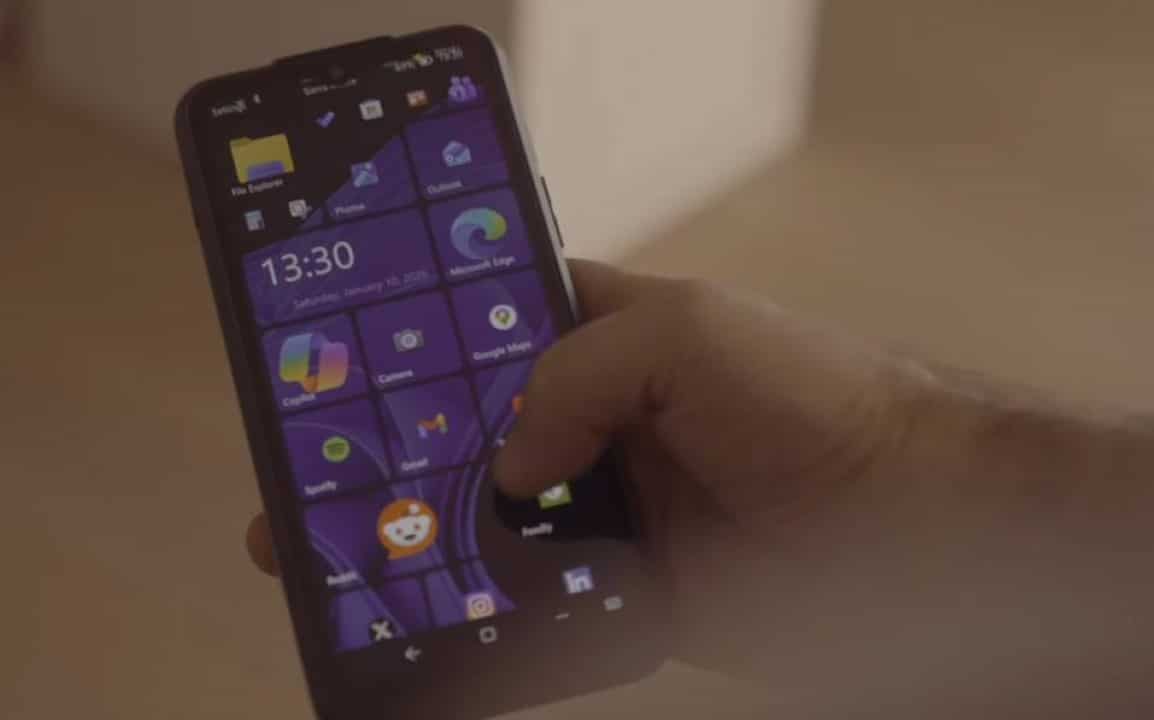
Nex Computer also developed a tile interface for the Windows 11, optimizing usability on a touch screen and making navigation more intuitive without the need for a mouse.
The smartphone that transforms into a complete desktop
The NexPhone’s USB-C port is the heart of its expandability and productivity, offering much more than just charging and data transfer.
With native support for video output, the connector allows the smartphone to be connected directly to an external monitor, projector or HDMI hub.
When Windows 11 is active, this connection instantly transforms the cell phone into a functional desktop computer, allowing the use of multiple applications in full screen.
Support for peripherals such as keyboards and mice, both via Bluetooth and wired connections, completes the desktop experience, making the NexPhone a viable alternative to a notebook for professionals on the go.
Market strategy and initial availability
The NexPhone is priced at US$549, positioning itself competitively in the niche segment it seeks to explore. The company opted for a direct sales strategy to consumers in its initial phase, focusing on markets with a high affinity for technology and mobile productivity.
In addition to the device, a line of optional accessories is available to further expand the experience, reinforcing the idea that the device’s maximum potential is unlocked when integrated into a larger productivity ecosystem.
The vision behind years of development
Emre Kosmaz, CEO of Nex Computer, highlighted that the launch of NexPhone is the realization of a long-term vision. The executive stated that it took 14 years of research to overcome the technical challenges of integrating the Windows into a smartphone format in a stable and functional way. Essa perseverance reflects the company’s philosophy of empowering the user, offering open and flexible hardware, free from the restrictions imposed by large software ecosystems.
Security and privacy with support for Linux
The inclusion of Linux Debian as an official operating system meets a growing demand for security, privacy and control. Desenvolvedores and IT professionals can count on a familiar and powerful environment to perform tasks such as server administration, security testing and software development directly from their cell phone.
The Nex Computer guarantees that the system kernel has been optimized for the NexPhone hardware, ensuring full compatibility with its components and sensors. Essa approach reinforces the device’s positioning as a reliable and robust technical tool for the corporate market and for advanced users who value digital freedom.
