Researchers at Universidade Texas A&M have identified an ongoing merger involving at least five galaxies that occurred about 800 million years after Big Bang. The observation, carried out with Telescópio Espacial James Webb, shows a compact system called Quinteto from JWST, located at redshift 6.7. Essa discovery indicates that complex interactions between galaxies and enrichment of heavy elements were happening earlier than astronomical models predicted.
The system features multiple galaxies interacting in a small region of space, surrounded by a halo of oxygen-rich gas. Antes from this observation, mergers involving multiple galaxies were expected to be common only billions of years after Big Bang. The data suggest that processes of intense star formation and redistribution of metals were already shaping the cosmic environment at this early stage.
JWST’s Quinteto was detected during the telescope’s Advanced Deep Extragalactic Survey program. Galaxies occupy a compact area, separated by tens of thousands of light years from each other.
- Star formation occurs at a rate of about 250 solar masses per year.
- This rate is significantly higher than the average for galaxies at this time.
These elements indicate intense activity in a period when the universe was still young and galactic structures were considered more isolated and simple.
Characteristics of the observed system
The system reveals more than 17 galaxy-sized clusters, with a total stellar mass estimated at 10¹⁰ solar masses. Galaxies form stars at a high rate, positioning themselves above the main star formation sequence for the corresponding redshift.
An extensive halo of ionized gas connects several of the component galaxies. Esse gas emits light from ionized oxygen and hydrogen, extending beyond the boundaries of individual galaxies. The presence of heavy elements outside the main structures points to early enrichment mechanisms.
Gravitational interactions during fusion drive the redistribution of these elements. Diferentemente of isolated galactic winds, tidal collisions appear to be the main driver in this case. Essa direct evidence reinforces the role of mergers in the evolution of the inner circumgalactic medium.
🚨ATTENTION: Telescópio Espacial James Webb finds two of the most distant galaxies ever seen, when Universo was around 330 million years old and traveled around 13.4 billion light years to reach Scientists say these galaxies are currently more…pic.twitter.com/FBicttpmdc
— KTX (@KTX_Official)November 14, 2023
Implications for models of galactic evolution
The discovery challenges previous predictions about the rate of assembly of massive galaxies. Modelos indicated that complex mergers would become common only in later times.
Observations of James Webb have revealed massive, inactive galaxies at lower redshifts. Sistemas like JWST’s Quinteto may represent precursors that rapidly depleted gas after intense mergers. Essa connection helps explain the existence of quiescent galaxies observed billions of years later.
The researchers highlight the need to update theories about galaxy formation and enrichment. Processos of merger appears to accelerate the cycle of evolution in early stages of the cosmos. Futuras observations plan to map movements of gas and stars within the system.
Details of the research conducted
Weida Hu, postdoctoral researcher, led the study published in Nature Astronomy. Casey Papovich, professor of physics and astronomy, coordinated the team that analyzed the data.
Other contributors include Lu Shen, Justin Spilker and Justin Cole, all associated with Texas A&M. The work received support from institutions such as Kavli Institute and space agencies.
The analysis combined deep images from the GOODS-South field. Instrumentos and James Webb made it possible to detect infrared emissions that previous telescopes did not capture. Essa ability reveals structures hidden by cosmic dust.
Early metallic enrichment
The gaseous halo detected presents ionized oxygen in regions external to the galaxies. Heavy Elementos are produced inside stars and expelled during violent events.
In JWST’s Quinteto, gravitational interactions remove stellar material from galaxies. Esse process enriches the circumgalactic medium with metals just 800 million years after Big Bang. The observation provides observational evidence of melt-induced metal pollution.
Contributions of James Webb to cosmology
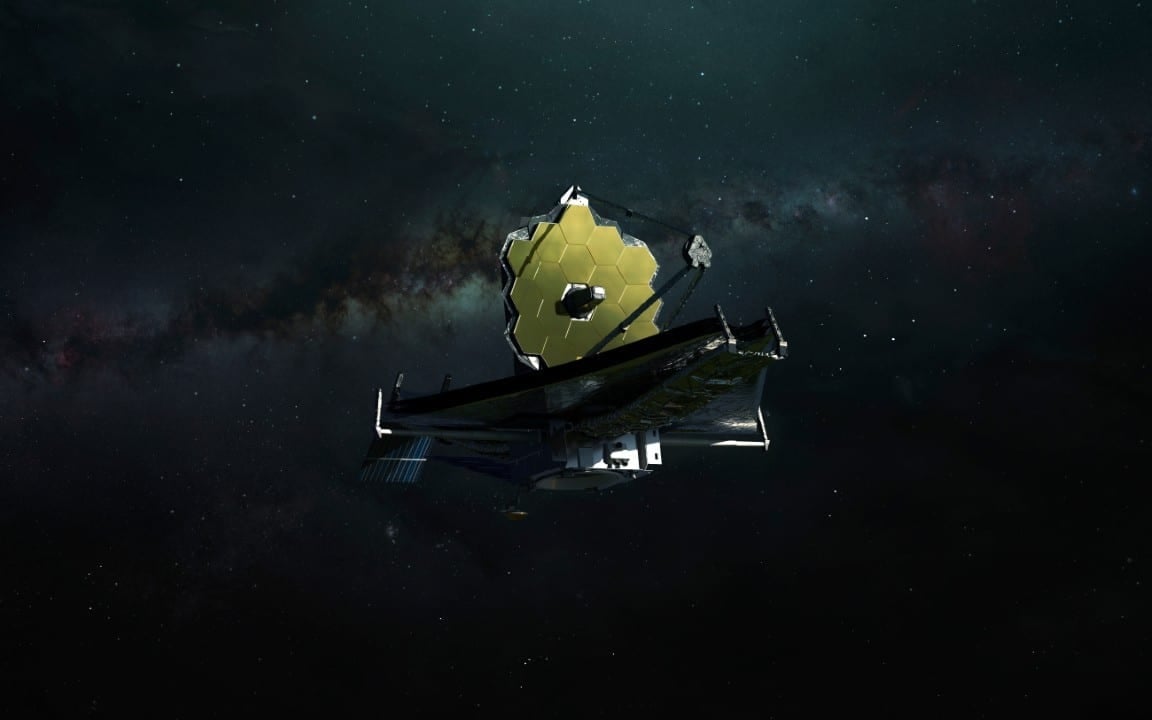
The telescope has been operating since 2021, positioned close to the L2 Terra-Sol point. Seu 6.5 meter mirror captures infrared light from distant objects.
Observations at long wavelengths penetrate dust clouds that block visible light. Isso allows you to study the formation of stars and galaxies in the early universe.
Programs like JADES expand knowledge about cosmic reionization. Descobertas recent adjust chronologies of structural evolution.
Planned future observations
Teams plan new exhibits to track internal dynamics of Quinteto. Medições of gas and star velocities will clarify fusion mechanisms.
This data will refine models of massive structure formation. Integração with other high redshift observations will expand understanding.
James Webb continues to collect information about remote times. Cada discovery contributes to reconstructing the complete cosmic history.
Technical aspects of detection
Pseudo-color images highlight the five main emission line galaxies. Orange Círculos mark the positions of ELG1 to ELG5 in the observed field.
The spatial compactness of the system facilitates intense gravitational interactions. Separações reduced speeds up merger processes.
High star formation rates support observed infrared brightness. The Essa feature differentiates the Quinteto from typical galaxies of the era.
Connection with quiescent galaxies
Rapid fusion systems can deplete fuel gas reserves. Galáxias results become massive and inactive at subsequent redshifts.
JWST observations identify candidates for these evolved structures. The Quinteto represents a critical transient phase.
This link resolves discrepancies between predictions and recent detections. Updated Modelos incorporate early mergers as a key factor.
