An international scientific collaboration, utilizing the unprecedented capabilities of Telescópio Espacial James Webb (JWST), has managed to create the highest resolution dark matter map ever achieved. The research, whose results have been released, offers the most robust visual proof to date of the crucial role of this mysterious substance in organizing large-scale cosmic structure, functioning as the invisible skeleton that allowed the formation of galaxies, stars and, consequently, life.
Dark matter, which makes up approximately 26% of the universe, cannot be observed directly as it does not emit, absorb or reflect any type of light. Sua existence is inferred only through its gravitational effects on visible matter. Este new mapping details how this invisible force has shaped the distribution of galaxies over billions of years, confirming fundamental theories about the evolution of the cosmos.
The project was led by a team of researchers from renowned institutions, including Universidade of Durham in Reino Unido, Escola Politécnica Federal of Lausanne in Suíça and NASA. The work represents a milestone in the human capacity to investigate the fundamental components of the universe and understand its evolution since its origins.
The gravitational lensing technique to map the invisible
To visualize something that, by definition, is invisible, scientists turned to a phenomenon predicted by the Albert Einstein theory of general relativity: gravitational lensing. Dark matter, like ordinary matter, has mass and therefore curves the fabric of spacetime around it. Essa curvature acts like a giant cosmic lens, distorting light from distant galaxies as it travels toward Terra. By meticulously analyzing these subtle distortions in the appearance of thousands of galaxies, the team was able to calculate the amount of intermediate mass and, consequently, map the distribution of dark matter. The Telescópio James Webb, with its extraordinary sensitivity and infrared resolution, was the ideal instrument for detecting these small changes in the light of extremely distant objects, allowing the construction of a detailed and in-depth map of this cosmic “skeleton” that supports the universe.
A technological leap in cosmic observation
The study was based on a 255-hour observation period, during which JWST focused on a specific area of the sky toward the constellation Sextans. Nesse time, the telescope was able to identify and catalog almost 800,000 galaxies, many of which had never been seen before. Webb’s ability to operate in the infrared spectrum allows it to penetrate cosmic dust clouds and observe light from galaxies that formed in the early universe, offering a window into the deep past and the beginnings of structural formation.
The density and quality of data collected represents a monumental advance. The new map contains approximately ten times more background galaxies than maps produced by ground-based observatories and twice the number of galaxies compared to previous mappings carried out by Telescópio Espacial Hubble. Essa wealth of information not only increases the accuracy of the dark matter map, but also opens up new possibilities for studying the evolution of galaxies and the nature of dark energy, another mysterious component of the cosmos that drives the accelerating expansion of the universe.
What is dark matter and its primordial function
Dark matter is a hypothetical form of matter that does not interact with electromagnetic radiation, making it completely transparent and undetectable by traditional means. Sua presence is confirmed only indirectly, by the force of gravity it exerts on visible matter, influencing the rotation speed of galaxies and the cohesion of galactic clusters.
Scientists believe that in the early universe, small fluctuations in the density of dark matter acted as gravitational “seeds.” Essas areas of greater concentration attracted cosmic gas and dust, the common baryonic matter, starting the agglutination process.
Over billions of years, this process gave rise to the first stars and galaxies. Sem this invisible organizing force, ordinary matter would be dispersed much more evenly throughout space, and the formation of complex structures like Via Láctea would be unlikely.
The cosmic architect and the web of the universe
Researchers describe dark matter not as a passive component, but as the active force that sculpted the cosmos. The high-resolution map generated by Webb illustrates with unprecedented clarity how this invisible substance formed a vast network of filaments and halos, known as the cosmic web.
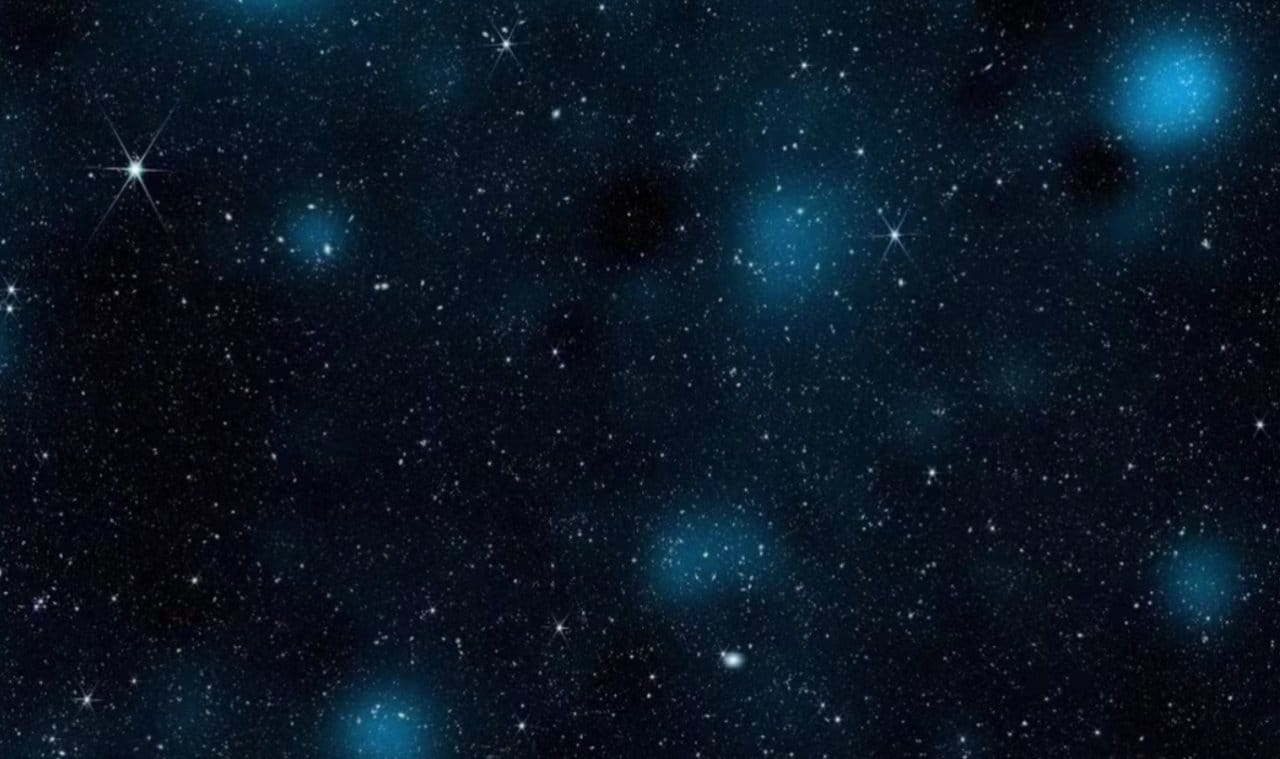
In the released images, the brighter areas indicate a greater density of dark matter. Essas regions overlap a galaxy-rich section of the universe, visually showing how visible matter is concentrated along this invisible skeleton.
This cosmic web isn’t just a visual curiosity; it represents the fundamental infrastructure of the universe. Galaxies are not randomly distributed in space, but rather along these filaments of dark matter.
Large clusters form at intersections, the nodes of the network. Compreender the architecture of this web is essential for deciphering the complete history of the formation and evolution of the universe, from Big Bang to today, and for predicting its ultimate fate.
The direct connection with the existence of life
The research establishes a fascinating link between this mysterious component and our own existence. Scientists argue that the formation and stability of Via Láctea depend on the presence of a vast halo of dark matter that surrounds it. Sem the additional gravitational pull provided by this halo, our galaxy would not have been able to agglomerate enough gas and dust to form the billions of stars that make it up, including our Sol.
“By revealing dark matter with unprecedented precision, our map shows how an invisible component of the universe structured visible matter to the point of allowing the emergence of galaxies, stars and, ultimately, life itself,” highlighted one of the study’s authors. The statement reinforces that our existence is intrinsically linked to this invisible and dominant force.
The ghost that sustains the galaxy
Despite its gravitational importance, dark matter behaves like a cosmic “ghost”. Ela passes through normal matter without interacting, which means that billions of its particles pass through our bodies every second. However, the collective effect of these particles is colossal, with the invisible mass being the reason why stars at the edges of galaxies spin much faster than expected without being hurled into intergalactic space.
Future of research and remaining mysteries
This detailed map represents a milestone, but the journey to fully understand dark matter is just beginning. Although we know where it is and how it acts on a large scale, its fundamental composition remains a complete mystery. The exact nature of the particle or particles that compose it is one of the biggest unresolved questions in modern physics.
Scientists will continue to use the JWST and other instruments to investigate this substance, looking for clues that could lead to its identification. Cada new observation brings us closer to unveiling one of the deepest secrets of the universe, promising to revolutionize our understanding of the reality in which we live.
