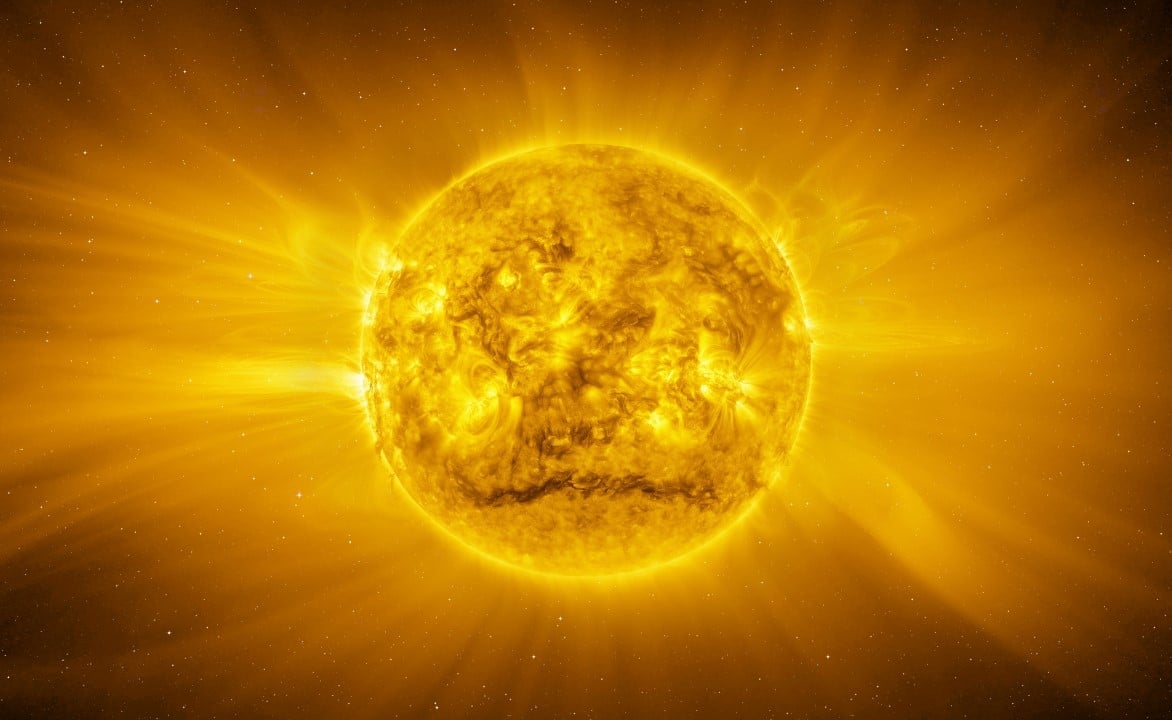
Intense solar activity has surprised scientists and satellite operators in recent days, with the giant sunspot AR4366 turning into a true epicenter of eruptions. The phenomenon resulted in an impressive 17 smaller explosions and three powerful X-class eruptions in less than 24 hours, raising a high alert for possible impacts on Terra.
The spot, which appeared a few days ago as a tiny dot, has grown rapidly and now resembles half the size of the notorious sunspot responsible for the Evento Carrington of 1859. Essa’s rapid expansion fuels a magnetic instability that suggests the likelihood of more eruptive events in the coming hours and days.
Space weather experts and meteorologists are monitoring the situation closely, predicting that AR4366’s continued instability could generate a “pyrotechnic display” over the weekend, with more solar flares on the way, keeping crews on standby.
The fury of Class X eruptions and their immediate effects
The culmination of this wave of activity was a tremendous X8.1-class solar flare, which peaked on February 1, 2026. The extreme ultraviolet event drastically ionized Earth’s upper atmosphere, resulting in a widespread shortwave radio blackout.
The impacts were felt mainly over the vast region of Pacífico Sul, encompassing areas such as Austrália and Nova Zelândia. Entusiastas amateur radio reported signal losses for hours at frequencies below 30 MHz, causing significant disruptions to air and sea communications.
In addition to X8.1, other X-type eruptions, such as X2.9, hit the same area as Sol in quick succession. Esses events were classified as R3, indicating their strong intensity, by Centro of Previsão of Clima Espacial of Administração Nacional Oceânica and Atmosférica (NOAA).
Understanding the origin of intense activity
Sunspot 4366, as it rotated and entered the field of view of Terra, in the northeast quadrant of Sol, exhibited a remarkable increase in size and magnetic complexity. The intricate “delta” configuration of its magnetic fields, twisted like rubber bands, is key to the release of accumulated energy in the form of the powerful solar flares observed.
The phenomenon of solar flares, which range from classes A (the weakest) to X (the strongest), is driven by these complex magnetic interactions. Subsequent Cada class represents a tenfold increase in the intensity of energy released, and X class eruptions are the most powerful and potentially impactful for Terra.
Alerts for coronal mass ejections (CMEs)
NOAA and Observatório Solar and Heliosférico (SOHO) coronagraphs are currently actively searching for coronal mass ejections (CMEs). Estas are dense clouds of plasma, billions of tons of solar material, which can be launched from the Sol at millions of kilometers per hour.
If a CME directed toward Terra, originating from the dark plasma plume of the X8.1 solar flare, is confirmed, the possibility of dazzling aurora borealis at high latitudes becomes real within one to three days. Entretanto, the main reason for concern is the potential negative impacts that these coronal masses can bring.
Risks of geomagnetic storms and their technological effects
Previous CMEs, which originated at similar solar locations, have been responsible for triggering significant geomagnetic storms. Estes events can cause a series of technological problems in Terra, with serious repercussions for modern infrastructure.
Potential effects include fluctuations in the electrical grid, which could lead to large-scale power outages and blackouts, as well as critical failures in orbiting satellites, which are vital for communications, navigation (GPS) and weather forecasting. Telecommunications infrastructure and air and sea navigation systems are particularly vulnerable, as demonstrated by radio blackouts that have already occurred.
The current scenario of solar cycle 25
The recorded increase in solar activity, especially intense solar flares in 2026, represents a high point from the previous year’s cycles. Este peak volatility reinforces the intensity of Ciclo Solar 25, which is currently approaching or has already reached its solar maximum, a period of great activity in the star.
Solar cycles last approximately 11 years, with periods of maximum and minimum activity. Durante solar maximum, the occurrence of sunspots, eruptions and CMEs is more frequent and intense, increasing the probability of events that affect the space environment and Terra. Scientists predict that the maximum of Ciclo 25 will be more powerful than initially expected, requiring continued monitoring.
Future Monitoring and Precautions
While there are no reports yet of large geomagnetic storms directly attributed to these recent events, radio blockages have already affected the hemisphere illuminated by Sol, and more are expected as AR4366’s geomagnetic activity remains intense. Especialistas in space weather reiterate the importance of constant monitoring, suggesting consulting NOAA alerts for the latest updates.
The scientific community and sectors dependent on space technology maintain a high level of vigilance. The ability to predict and mitigate the effects of these space storms is crucial to protecting global technological infrastructure and ensuring the security of communications and navigation systems that are essential to contemporary society.
