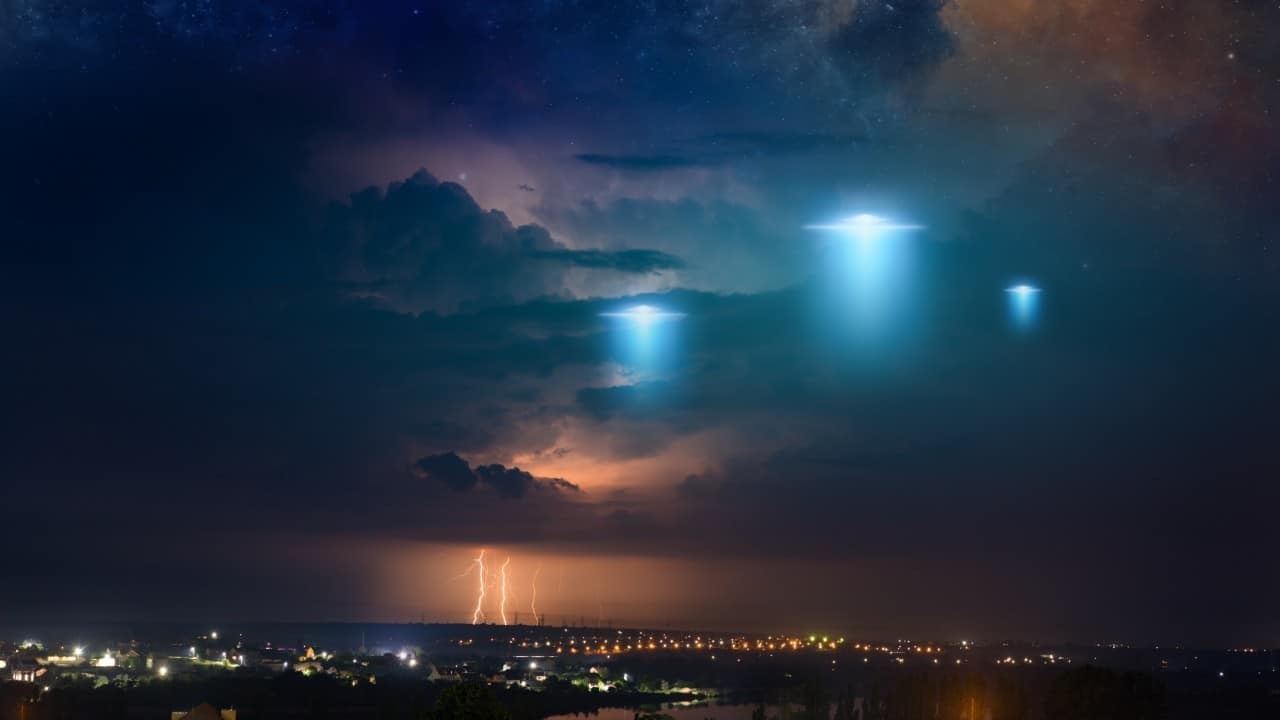
A provocative new theory proposed by astronomer David Kipping, of Universidade of Columbia, suggests that the first evidence of intelligent life outside of The proposal, called Hipótese Escatiana, offers a grim and pragmatic outlook for the search for extraterrestrial intelligence (SETI), fundamentally altering what scientists should be looking for in the cosmos.
The idea arises as a possible solution to the famous Paradoxo of Fermi, which questions the apparent lack of contact with other civilizations, despite the high probability of their existence in the vastness of the universe. Kipping argues that humanity may be looking for the wrong signals, focusing on continuous and stable communications, when the most detectable signals would actually be the most chaotic and transient.

Published in the scientific journal Monthly Notices of the Royal Astronomical Society, the hypothesis is based on a well-established concept in science: observational selection bias. Este principle dictates that the first examples of any new phenomenon discovered tend to be the most extreme and easiest to detect, rather than the most common or representative.
The logic behind the Escatian hypothesis
The foundation of the Kipping theory lies in the premise that sustainable and long-lived civilizations would, by nature, be energy efficient and, consequently, “silent”. An advanced society that optimally harnesses its resources would minimize energy waste, making its technosignatures — the technological marks of its presence — faint and difficult to capture at interstellar distances.
In contrast, a civilization facing imminent collapse, whether through war, environmental disaster or resource depletion, would release enormous amounts of energy in an uncontrolled and anomalous way. Essas transient emissions, although brief on the cosmic scale, would be intense enough to stand out from the background noise of the universe, becoming visible to distant observatories, such as those on Terra.
Signs of a civilization in crisis
The types of signals emitted by a declining society would be very different from the methodical radio transmissions that SETI programs traditionally seek. Kipping suggests that astronomers should focus on searching for anomalous, short-lived events that could be interpreted as markers of a planetary crisis.
These technosignatures could include a wide range of phenomena. For example, the detection of large-scale industrial pollutants in the atmosphere of an exoplanet, indicating uncontrolled industrialization. Outra possibility would be the detection of inexplicable energy explosions, which could be the result of nuclear conflicts or the collapse of megastructures.
Even a deliberate “cry for help,” a high-powered transmission sent as a last-ditch effort to contact other life forms, would fit this profile. Unidentified historical Sinais, such as the famous “Wow!” of 1977, which was strong and never repeated, could be reevaluated from the perspective of this new hypothesis.
Refocusing the search for extraterrestrial intelligence
Hipótese Escatiana implies a significant strategic change for projects searching for intelligent life. Rather than monitoring specific stars for ongoing signals, a more effective approach would be to conduct broad sky scans, focused on identifying transient, high-energy events that do not have a natural astrophysical explanation.
This new guideline values observatories capable of monitoring large areas of the sky with high frequency, such as the future Observatório Vera C. Rubin and the Square Kilometre Array (SKA). Tais instruments are designed to catalog rapid changes in the universe, making them ideal tools for testing the validity of the Kipping theory.
Furthermore, telescopes like James Webb play a crucial role. By analyzing the chemical composition of the atmospheres of distant planets, Webb could identify the biosignatures or technosignatures of a biosphere on the brink of collapse, such as abnormal levels of carbon dioxide or the presence of synthetic chemical compounds.
Collaboration between different types of observatories — radio, optical and gamma rays — is also essential. Combining data from multiple sources would allow scientists to cross-reference information and validate whether a detected anomaly has a technological or natural origin, increasing confidence in an eventual detection.
The parallel with astronomical discoveries
To strengthen his argument, David Kipping draws direct parallels with the history of astronomy. Supernovae, for example, are rare events that mark the death of massive stars. However, they are frequently observed because their final explosion makes them incredibly luminous, visible from billions of light years away. A stable star, although much more common, is invisible at this same distance.
The same principle applies to other discoveries. The first pulsars and black holes detected were the most extreme of their classes, those with the most powerful emissions and the most unusual characteristics. Apenas with the advancement of technology it was possible to find more “typical” and subtle examples. Hipótese Escatiana suggests that the same selection bias will apply to the search for civilizations, favoring the detection of the spectacular and catastrophic over the stable and discrete.
Debate in the scientific community and the paradox of Fermi
The publication of Hipótese Escatiana generated intense debate among astrobiologists and SETI researchers. Enquanto some see the theory as a valuable tool for refining search strategies and optimizing the use of resources, others remain skeptical, questioning whether observational bias is truly the dominant factor. The main criticism is that the duration of a civilizational collapse can be extremely short, making the probability of detecting it at the exact moment very low. However, the theory offers a partial and elegant explanation for the “Great Silêncio” proposed by Paradoxo of Fermi. Instead of an empty universe, we would have a cosmos populated by civilizations that, for the most part, are either too young to be detected, or too advanced and efficient to be noticed. Apenas those in the brief, turbulent phase of transition or collapse would become temporary cosmic beacons, and we may be the first to see one of them go out.
Implications for the future of humanity
In addition to its implications for the search for extraterrestrial life, the Kipping theory serves as a profound warning for humanity’s own trajectory. If sustainability and energetic discretion are the keys to cosmic longevity, then the current path of resource overconsumption and environmental degradation could be making Terra dangerously “visible” in the universe, not as a sign of success, but as a harbinger of instability.
