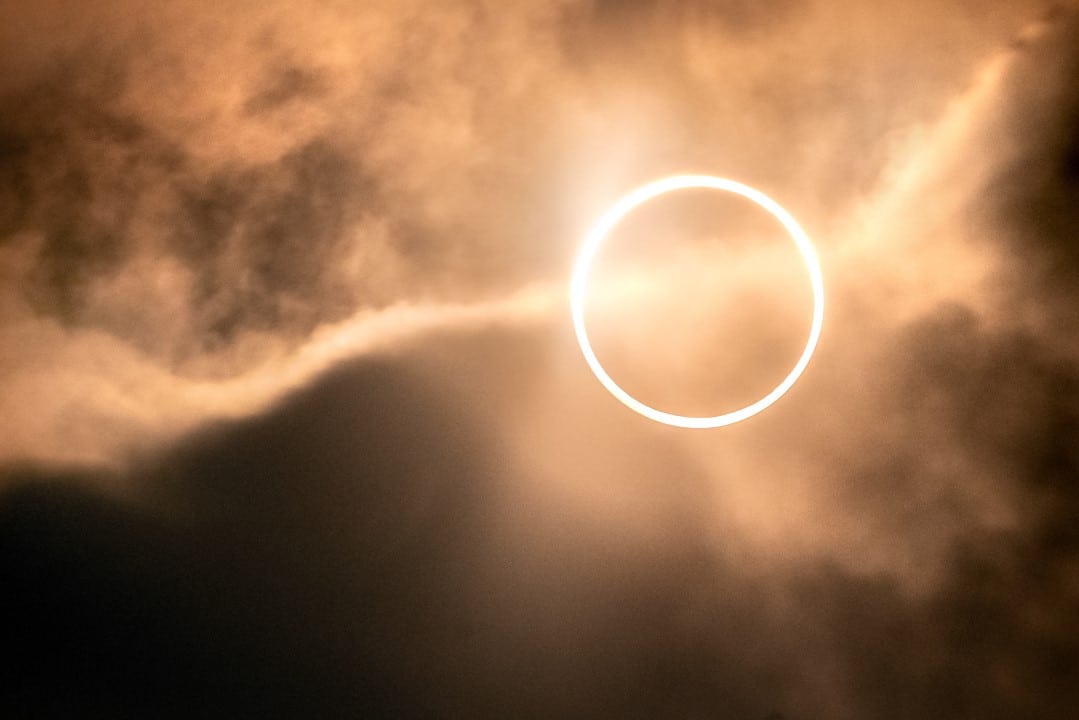
An annular solar eclipse will occur on Tuesday, February 17, 2026, marking the first phenomenon of its kind this year. The event will create the well-known “ring of fire” effect, when Lua positioned at apogee does not completely cover the solar disk, leaving a visible luminous edge. The annular phase will be observed mainly in Antártida, with partial visibility in selected regions of the southern hemisphere.
The phenomenon will not be visible directly from Brazilian territory. Transmissões live on the internet will allow real-time monitoring by observers from all over the world.
Experts highlight the rarity of the perfect alignment required for annular eclipses.
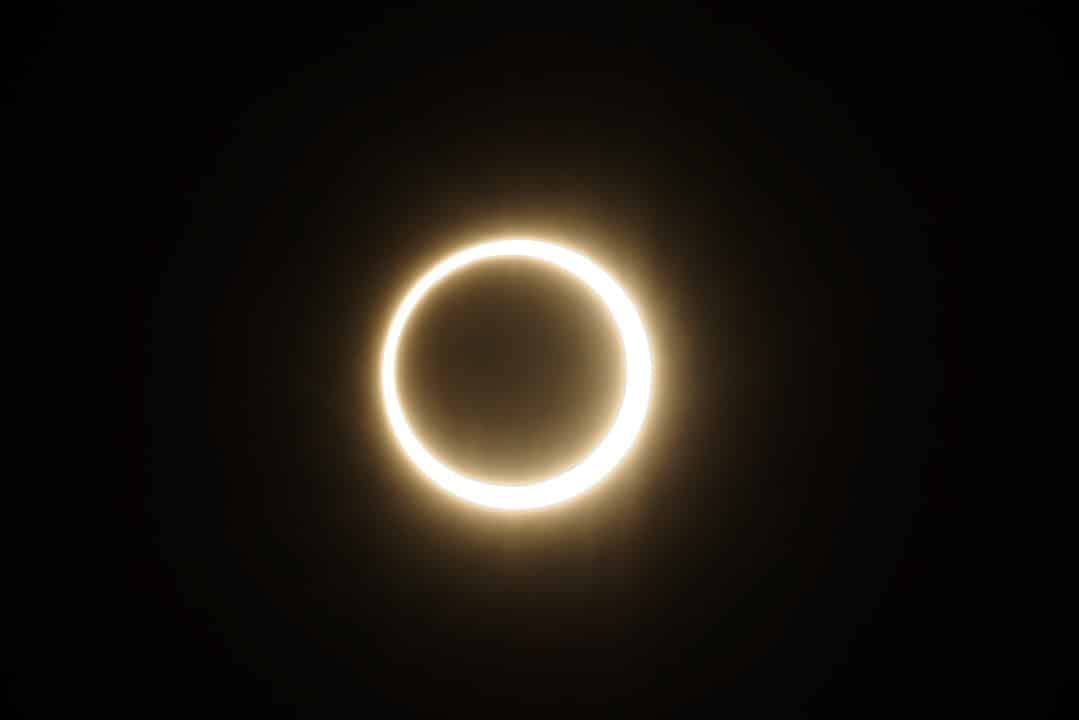
What characterizes the annular eclipse
The annular solar eclipse differs from the total one because the Lua, at the most distant point in Earth’s orbit, appears smaller in the sky. Essa configuration prevents complete coverage of the Sol, resulting in the characteristic luminous ring during the maximum phase.
The magnitude of the February 17th event will reach 0.963, with a maximum duration of the annularity of approximately two minutes at specific points along the path. The complete phenomenon, including partial phases, will last for more than four hours.
- Precise alignment between Sol, Lua and Terra
- Position of Lua at orbital apogee
- Formation of the ring of fire at the peak of the eclipse
- Visibility limited to polar and oceanic regions
These elements combined make the event unique in the 2026 astronomical calendar.
Path of annulment and affected regions
The annular range will be concentrated over Antártida, covering research stations such as McMurdo and Amundsen-Scott. The narrow path will cross icy areas of the continent, with the point of greatest eclipse located in coordinates close to the south pole.
Partial visibility will extend to parts of the southern tip of América and Sul, including regions of Argentina and Chile, in addition to southern portions of África and ocean Índico. Países like Austrália and Nova Zelândia will not register the phenomenon.
Main times of the phenomenon
The eclipse will begin its partial phase at 9:56 am Coordinated Universal Time (UTC). The annulment will begin at 11:42 UTC, reaching a maximum at around 12:00 UTC.
The end of the annular phase will occur minutes later, with the partial extending until early afternoon in UTC. At Antártida local times, the peak will coincide with the austral summer daytime period.
- Partial start: 9:56 am UTC
- Annular start: 11:42 UTC
- Eclipse maximum: approximately 12h UTC
- Annular end: variable by location
- Partial end: around 2pm UTC
These schedules allow for precise planning for broadcasts and scientific observations.
Safe Observation and Recommendations
Direct observation of Sol, even during a partial eclipse, requires adequate protection to avoid damage to the retina. Filtros certified by ISO 12312-2 must be used in special glasses or optical equipment.
Indirect methods, such as pinhole projection or telescopes with solar filters, offer safe alternatives. Profissionais warn against the use of radiographic films or ordinary glasses, which are insufficient to block harmful radiation.
Researchers at Antarctic stations will have professional instruments to collect data during the event. The general public will best follow through online streams.
Broadcasts and online coverage
Platforms specializing in astronomy will offer live broadcasts of the eclipse from points on Antártida. Canais like Time and Date and collaborative projects with space agencies will make images available in real time.
In Brasil, where the phenomenon will not be visible, these transmissions will represent the main form of monitoring. Instituições local scientists will promote virtual events to explain the event to the public.
Coverage will include comments from experts on orbital mechanics and the importance of the phenomenon.
Similar upcoming astronomical events
The February eclipse will open the 2026 calendar, followed by another total solar eclipse in August, visible in regions of Europa and Ártico. Eclipses lunar moons are also predicted for the year.
Annular phenomena occur in regular cycles, but the Antarctic location makes this particularly challenging for in-person observation. Expedições scientists take advantage of these opportunities for atmospheric and orbital studies.
The February 17 alignment reinforces global interest in accurately predictable celestial events.
Scientific importance of the phenomenon
Solar eclipses allow precise measurements of Lua’s orbital parameters and studies of the solar corona under unique conditions. Dados collected in polar regions contributes to climate models and geophysical research.
Observations during annularity help refine calculations of Terra-Moon distance and orbital variations. Projetos international organizations coordinate efforts to maximize the scientific benefit of the event.
The rarity of annular eclipses in remote areas highlights the relevance of transmission technologies to democratize access to astronomical knowledge.
