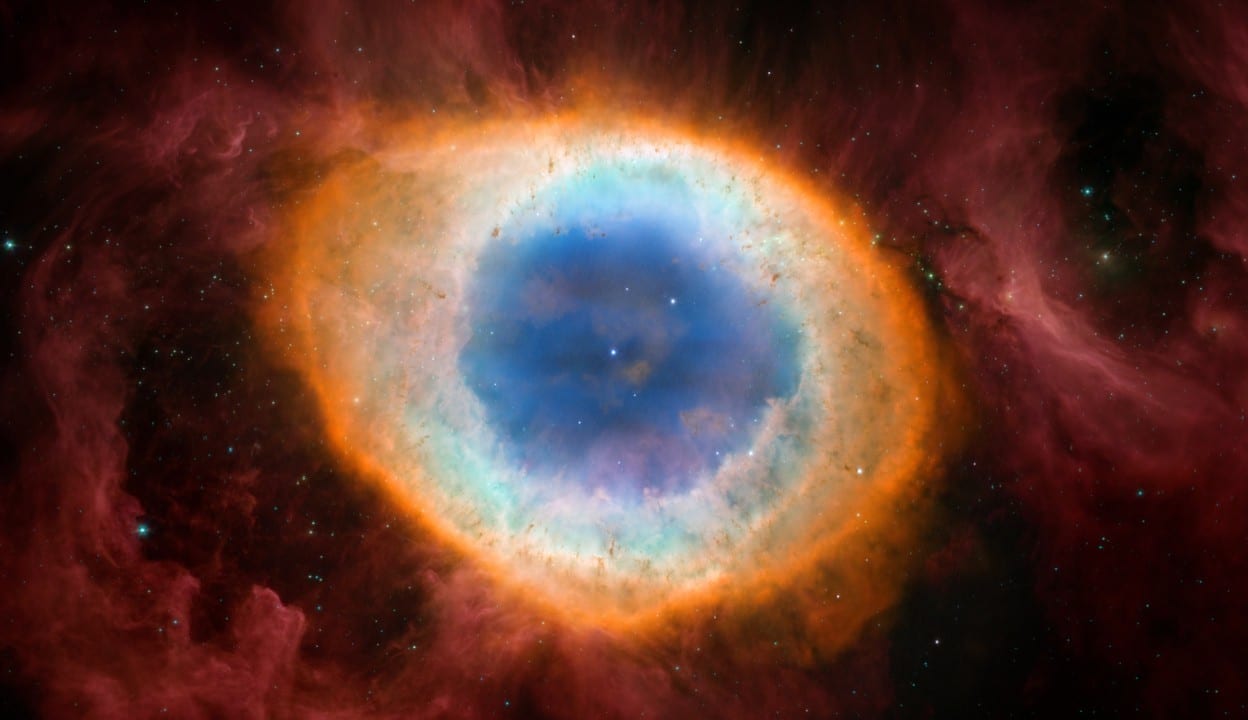
Astronomers have identified a filamentary structure rich in ionized iron at the center of Nebulosa of Anel, also known as M57, located in the constellation of Lira approximately 2,600 light-years from Terra. The discovery occurred through spectroscopic data obtained with the WEAVE instrument, installed on Telescópio William Herschel, on Ilhas Canárias. Essa formation, described as an elongated bar or filament, had never been recorded in previous observations, despite the nebula being studied since the 18th century.
Nebulosa of Anel is one of the most observed and photographed planetary nebulae in the night sky. Sua’s characteristic ring shape is due to the ejection of outer layers from a star similar to Sol in its final stage of life. The presence of ionized iron in high concentration in this central region raises questions about chemical enrichment processes in planetary nebulae.
The data reveal that the structure extends across the nebula’s disk, presenting specific emissions of doubly ionized iron. Essa feature was only possible to detect thanks to the integral field spectroscopy technique, which simultaneously analyzes thousands of points in the nebula.
History of Nebulosa observations of Anel
Nebulosa of Anel was discovered in 1779 by the French astronomer Antoine Darquier of Pellepoix. Pouco later, Charles Messier included it in his catalog as object M57. Durante For more than two centuries, ground- and space-based telescopes have recorded its elliptical appearance, with a bright ring surrounding a fainter central region.
Observations with Telescópio Espacial Hubble in the 1990s and 2000s showed details such as dense knots and radial filaments. Imagens recent images of Telescópio Espacial James Webb, captured in infrared, highlighted complex molecules and hydrocarbons on the periphery of the nebula. However, none of these campaigns identified the concentration of ionized iron now revealed.
Technical details of the new detection
The WEAVE instrument, coupled to the 4.2-meter Telescópio William Herschel, allows the collection of spectra from large areas of the sky at once. Essa capability revealed the spectral signature of ionized iron in an elongated region at the center of the nebula. The structure has an extension equivalent to several times the diameter of the visible ring.
The spectra indicate that the material is highly ionized, suggesting high temperatures in the region. The bar crosses the nebula’s disk in an asymmetrical way, which differentiates this formation from previously known radial filaments.
- Emissions detected mainly in [Fe III] lines, characteristic of doubly ionized iron.
- Concentration limited to the central zone, without significant extension to the periphery of the ring.
- Absence of similar structures in other planetary nebulae observed with the same technique.
- Data collected in observational sessions held between 2024 and 2025.
Chemical composition and origin of iron
Planetary nebulae often display light elements such as hydrogen, helium, oxygen and nitrogen in abundance. Heavier Elementos, such as iron, are less common, as stars of similar mass to Sol do not produce significant amounts of these metals in their cores. The presence of ionized iron suggests unusual mixing or enrichment processes.
Previous research has detected traces of heavy elements in some planetary nebulae, but never in the form of a concentrated filamentary structure. The bar may indicate asymmetric ejection of material from the core of the central star during late stages of its evolution.
The central star of Nebulosa is a white dwarf with a surface temperature greater than 100 thousand kelvins. Sua intense radiation ionizes the surrounding gas, making iron emissions visible. The asymmetry of the structure suggests the influence of magnetic fields or interaction with an undetected stellar companion.
Implications for stellar evolution models
The discovery challenges current understandings about the distribution of elements in planetary nebulae. Modelos traditional methods predict a more uniform distribution of ejected metals. The bar-shaped concentration indicates possible action of dynamic mechanisms during the mass loss phase of the progenitor star.
- Review of hydrodynamic simulations of ejection from stellar envelopes.
- Inclusion of magnetic effects in planetary nebula formation models.
- Comparison with other nebulae that present similar asymmetries.
- Planning new observations to map temporal variations in the structure.
Context of planetary nebulae
Planetary nebulae represent the final phase of the evolution of low- to intermediate-mass stars, between 1 and 8 solar masses. Essas stars exhaust the nuclear fuel in their cores and expel outer layers, forming expansive envelopes illuminated by the ultraviolet radiation of the remaining star. Nebulosa of Anel has served as a prototype of this type of object since its discovery.
It is estimated that there are tens of thousands of planetary nebulae in Via Láctea, although only about 3,000 have been catalogued. Sua lifetime is relatively short in astronomical terms, on the order of tens of thousands of years, before the gas disperses into the interstellar medium.
Additional observations made
In addition to the WEAVE data, archived images of Hubble and James Webb were reanalyzed to look for indirect evidence of the structure. Embora optical and infrared images show radial filaments, the iron signature only appears in detailed spectra. Observações future tests with other spectroscopic instruments should confirm the stability of the formation.
International teams are already planning additional campaigns in the northern hemisphere to monitor variations in the intensity of emissions. Nebulosa’s location in the boreal sky facilitates continuous access by European and North American telescopes.
Main characteristics of the detected structure
The ionized iron bar has a length equivalent to several times the radius of the main ring. Sua orientation crosses the main axis of the nebula, creating an asymmetrical appearance in spectral maps. The density of the material appears higher than that of the surrounding gas, which explains its visibility in specific emission lines.
Preliminary studies indicate that formation does not vary significantly over short time scales. Isso suggests that this is a stable characteristic, the result of processes that occurred during the proto-planetary nebula phase.
Advances in integral field spectroscopy
The technique used by WEAVE represents a significant advance in observational astronomy. Ela allows you to map chemical compositions in large objects with high spatial resolution. Similar Aplicações have already revealed details in other nebulae and distant galaxies.
The success at Nebulosa of Anel demonstrates the technology’s potential for revisiting classic objects. Traditional Catálogos can now be complemented with detailed chemical maps, revealing structures previously invisible in conventional images.
Future research perspectives
New observational campaigns should focus on searching for similar structures in other known planetary nebulae. Objetos as well as Nebulosa Helicoidal and Nebulosa of Dumbbell are priority candidates. The comparison will help determine whether the iron bar represents an isolated case or a common feature not previously detected.
Integration of multi-wavelength data, including radio and X-rays, can clarify the interaction between ionized iron and the surrounding medium. Modelos updated theorists will incorporate this data to refine predictions about galactic chemical enrichment.
