
The global astronomical scene turns its attention to recent data obtained about 3I/ATLAS, the third celestial body confirmed with origins outside our Sistema Solar to cross the cosmic neighborhood. Após reaches its closest approach to Terra in late 2025, detailed analyzes conducted by experts of Harvard have brought to light physical features that challenge traditional comet models. The focus of the studies is on an unusual tail structure, which points in the direction of Sol, composed of materials that should not be there according to standard cometary physics.
Renowned astrophysicist Avi Loeb led the interpretation of this new evidence, pointing out that the intense brightness and persistence of this “anti-tail” can only be explained by the presence of grains of matter significantly larger than usual fine dust. Enquanto domestic comets release easily dispersed microscopic particles, this interstellar visitor appears to eject robust grains, with diameters between 1 and 100 microns.
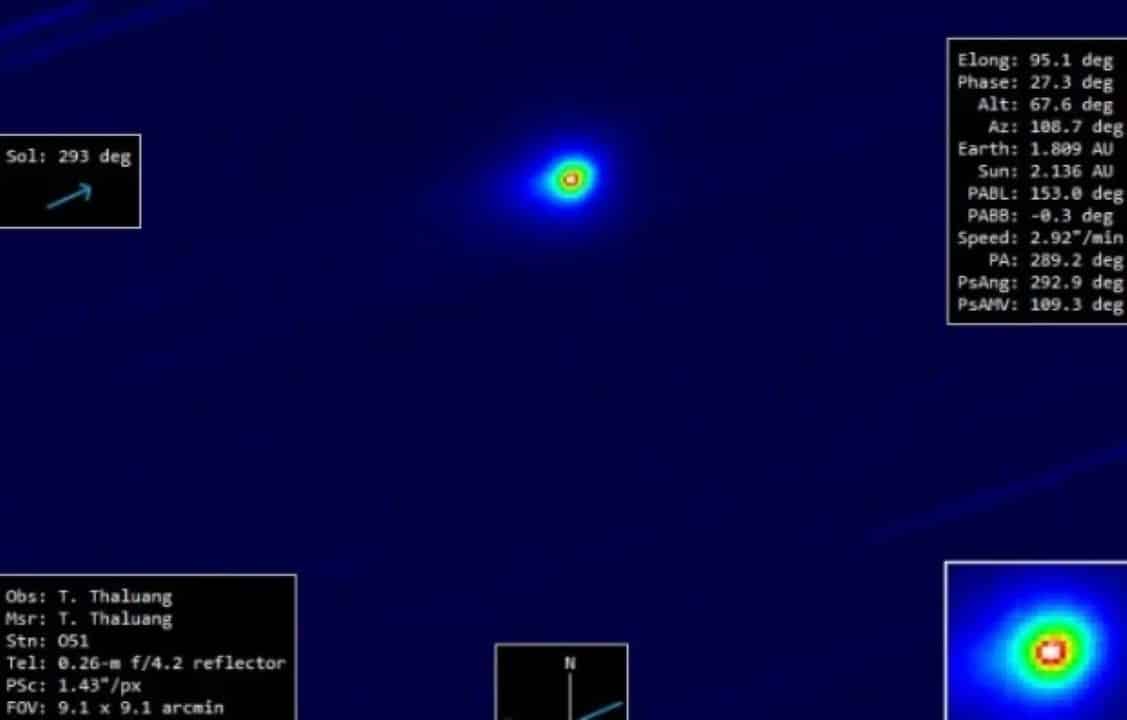
- The observed structure maintains a tight collimation, resembling a directed jet.
- The resistance of the particles to solar radiation pressure indicates a greater than average mass.
- The phenomenon was consistently recorded even after passing through perihelion.
This discovery places 3I/ATLAS in a distinct category from its interstellar predecessors and locally formed comets. The physics involved suggest that this object’s matter release mechanism has a peculiar internal dynamic, capable of launching heavy material against the flow of the solar wind, maintaining a structural cohesion that intrigues terrestrial and space observers.
Trajectory and confirmation of origin
Initially detected by the ATLAS warning system at Chile, the object quickly demonstrated a hyperbolic orbit, an unmistakable characteristic of bodies that are not gravitationally bound to Sol. Sua speed and angle of entry into the system confirmed its interstellar origin, marking a historic event for modern astronomy shortly after its identification in the middle of last year.
The passage through perihelion, the point of closest approximation to Sol, occurred in October, when the object’s activity intensified. Diferente of inert asteroids, 3I/ATLAS developed a visible coma, which allowed its hybrid classification and increased interest in its chemical and physical composition during the period of greatest exposure to stellar heat.
Observatories around the world monitored its exit route, taking advantage of its approach to Terra in December to capture spectroscopic data. The lack of risk of collision allowed for a smooth observation campaign, focused entirely on collecting scientific data on this rare galactic traveler.
Peculiarities of the observed structure
The most striking feature documented in the processed images is the so-called anti-tail, a visual phenomenon where the comet’s trail appears to point toward the star, defying common visual intuition. Embora anti-tails may be optical illusions caused by the perspective of Terra, 3I/ATLAS analysis suggests a real, dense physical structure.
Images captured with special filters revealed that this jet is extremely narrow, maintaining its linear shape for hundreds of thousands of kilometers. Essa “Tight” collimation is unusual for fine dust, which would tend to fan out under the influence of radiation pressure and solar wind.
The persistence of this formation during the months of November and December reinforced the hypothesis that it was not a transient event. The jet maintained its structural integrity, suggesting a continuous emission source located on the surface of the object’s core.
Additional studies sought to identify the gaseous composition, finding traces of cyanide, but it was the solid component that dominated academic discussions. The luminosity reflected by this anomalous tail indicated a density of material that does not match rarefied gases or submicron dust.
The physics of giant particles
The central argument of Para for the structure observed in 3I/ATLAS to remain so long and directed, it is imperative that the grains have sufficient inertia to resist this pressure, which implies larger physical sizes.
These grains, with radii estimated to be greater than one micron, need to be swept along by powerful gas flows to escape the core’s gravity, but be heavy enough not to be swept away immediately by the solar wind. Essa selective dynamics differentiates 3I/ATLAS from most comets of
Differences from other visitors
When comparing 3I/ATLAS with the first two confirmed interstellar visitors, the distinctions become evident and fundamental for the classification of these bodies, as ‘Oumuamua did not show visible cometary activity or tail, being initially classified as an asteroid or an object of unknown nature, while 2I/Borisov behaved very similarly to a typical comet from our system, with a familiar chemical composition; 3I/ATLAS, on the other hand, presents this hybrid behavior with a mass ejection that favors macroscopic particles, suggesting formation or erosion processes in its home system that differ from what we observe locally or in the case of Borisov, expanding the range of possibilities regarding the diversity of objects that roam interstellar space.
Observations and technical data
Large telescopes, such as Gemini, were essential in confirming that the width of the jet was ten times smaller than its length, a proportion that denotes the high directivity of the ejection. The use of image processing with gradient removal allowed us to isolate this structure from other coma emissions.
The stability of the phenomenon suggests that the rotation of the object’s core may be exposing a specific active region to the Sol on a periodic or continuous basis. Essa cometary “volcano mouth” would be responsible for launching the heaviest material into space, creating the unique visual signature that now intrigues scientists.
The future of interstellar research
As the object moves definitively away into deep space, the data collected will continue to be refined for years. The confirmed presence of these larger particles offers new clues about the makeup of distant planetary systems and the materials they eject into the interstellar medium.
Keywords and Pesquisa
Main keywords:3I/ATLAS, interstellar object, Avi Loeb, anti-tail.
Long-tail keyword:anomaly in interstellar comet particles.
Sources researched:
Scientific American – “Avi Loeb on the New Interstellar Visitor”
NASA/JPL Small-Body Database – “Trajectory details of 3I/ATLAS”
The Astrophysical Journal Letters – “Morphology of Interstellar Objects”
