
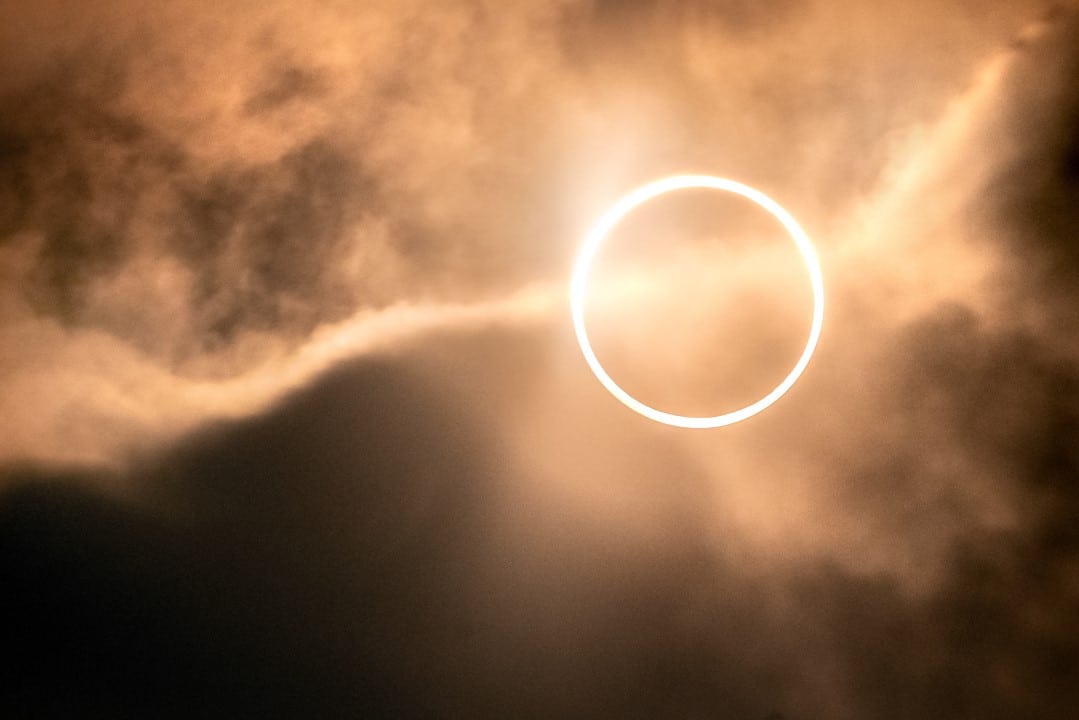
The annular solar eclipse scheduled for February 17, 2026 creates a spectacle known as a ring of fire in the sky. The Esse phenomenon occurs when the Lua is positioned between the Terra and the Sol at its furthest point, partially covering the solar disk and leaving a luminous circle visible around it. The annular phase reaches a maximum duration of 2 minutes and 20 seconds in specific regions.
The event begins with the partial phase at varying times depending on the location, reaching the peak of annularity at around 12 pm in coordinated universal time. Observadores in favored areas records the visual transformation of the Sol into a bright ring. Full visibility is mainly restricted to Antártida, with partial phases on other continents.
Experts highlight that the eclipse represents the first solar phenomenon of the year. Transmissões live allows global monitoring even in regions without direct visibility.
What characterizes the annular eclipse
The annular eclipse differs from the total one because Lua appears smaller in the sky due to the greater distance from Terra. The Essa configuration prevents complete blocking of the Sol and results in the formation of the characteristic luminous ring.
Scientists explain that the precise alignment between Sol, Lua and Terra occurs at specific times in the orbital cycle. The magnitude of the February eclipse reaches 0.963, indicating that about 96% of the solar disk is hidden at its maximum point.
- The Lua covers the center of the Sol;
- The outer contour remains visible;
- The phenomenon lasts a few minutes in the main phase.
These elements combine to produce the visual effect popularly known as the ring of fire.
Places with better visibility
The annularity band mainly crosses the Antarctic continent, offering ideal conditions in several scientific bases located in the region. Observadores positioned along this trajectory record the phenomenon in its complete form.
Regions in the extreme south of América and Sul, including parts of Chile and Argentina, experience significant partial phases. Países in the south of África also access partial visibility of the event.
Oceanic areas close to Antártida complete the favorable observation points. Mapas experts indicate precise trajectories for planning expeditions.
Times and duration of the phenomenon
The eclipse begins its partial phase at varying local times, depending on the geographic position of the observers. The annulment begins around 11 am in coordinated universal time in the first affected regions.
The event peaks around noon in UTC, with maximum duration recorded at specific points on Antártida. The annular phase progressively ends until it ends completely at around 2pm universal time.
Observers in partial zones notice different start and end times. The total duration of the phenomenon, including partial phases, extends for more than two hours in some locations.
Essential security measures
Direct observation of Sol during any solar eclipse requires adequate protection to avoid permanent damage to vision. Filtros Special certificates block harmful radiation emitted by the star.
Eclipse glasses represent the most affordable and safest option for the general public. Telescópios and binoculars require specific filters attached to the front lenses.
Indirect projection through a box with a hole offers a simple and safe alternative. Métodos caretakers without certification do not guarantee sufficient protection against eye injuries.
Other eclipses predicted for 2026
The year 2026 holds four eclipses in total, alternating between solar and lunar phenomena. The February event opens the sequence with its distinctive annular feature.
A total lunar eclipse occurs on March 3, visible in several regions including parts of Brasil. Esse phenomenon colors Lua with reddish tones due to atmospheric refraction.
- Total solar eclipse on August 12;
- Partial lunar eclipse on August 27th and 28th.
These events complement the astronomical calendar of the year.
Scientific importance of eclipses
Solar eclipses provide unique opportunities for studies of the solar corona and the star’s upper atmosphere. Pesquisadores take advantage of these moments to collect data that is difficult to obtain under normal conditions.
Observations during the annular phase allow detailed analyzes of the solar chromosphere. Instrumentos positioned on Antarctic bases record valuable information about solar activities.
Continuous monitoring contributes to the understanding of long-term solar cycles. Dados collected assist predictions of space phenomena that affect terrestrial communications.
Preparations for remote observation
Online broadcasts make it possible for millions of people around the world to follow the eclipse. Observatórios and space agencies organize live coverage from Antártida.
Specialized platforms provide real-time images captured by professional telescopes. Aplicativos mobile devices provide alerts and guides for virtual monitoring.
These alternatives democratize access to the astronomical phenomenon. Interessados prepare in advance to take advantage of the scheduled transmissions.
Differences between types of solar eclipses
Solar eclipses are classified into three main categories depending on orbital alignment. The annular type occurs when the Lua is further away and does not completely cover the Sol.
Total eclipses happen in perfect alignments that block all direct sunlight. Partial Fenômenos represent the incomplete view of the alignment in peripheral regions.
Each category has unique visual characteristics. Understanding these differences enriches the appreciation of astronomical events.
Complete calendar of phenomena
The year presents a balanced sequence of solar and lunar eclipses in different months. Observadores plan activities according to the regional visibility of each event.
Switching between types maintains astronomical interest throughout the months. Specific Regiões are highlighted on different dates.
- February 17: annular solar eclipse;
- March 3: total lunar eclipse;
- August 12: total solar eclipse;
- End of August: partial lunar eclipse.
These dates mark important moments for celestial observation.
February’s annular eclipse stands out for its remote location and characteristic visual spectacle. Observadores prepared take advantage of the available opportunities to record the unique phenomenon. Avanços technologies facilitate global access to astronomical events previously restricted to a few regions.
