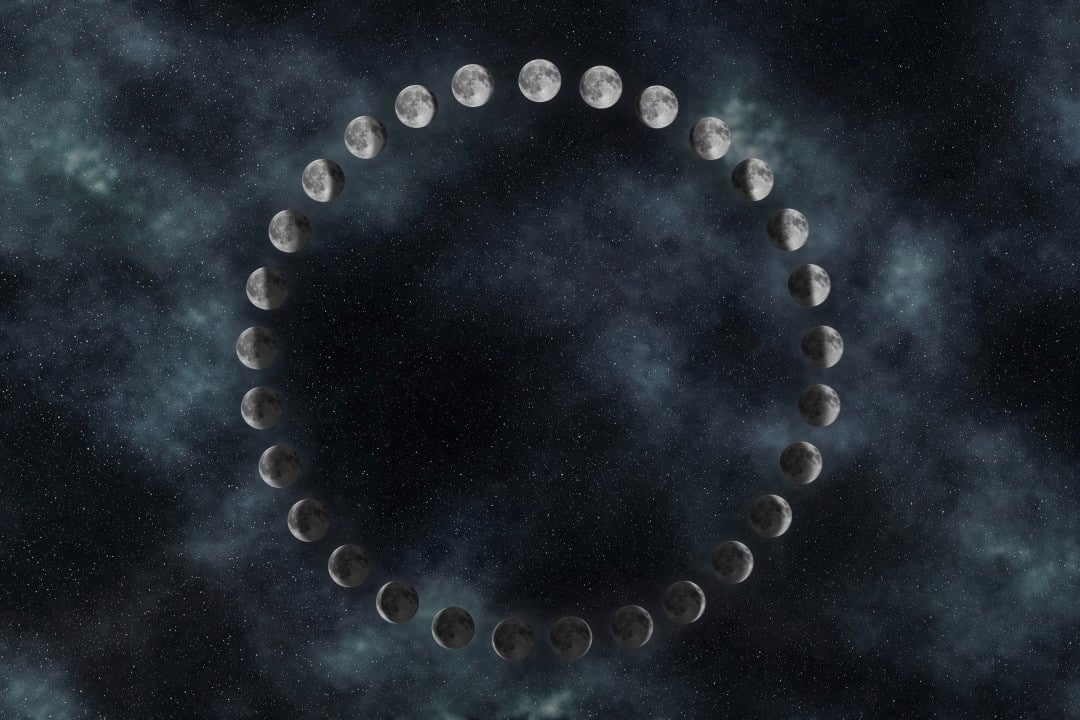
The second month of the year presents an immediate astronomical spectacle for sky observers, starting with the maximum illumination of the natural satellite on the first day. The complete cycle, known technically as a synodic month, will have a standard duration of approximately 29.5 days, a period in which the Lua transits through all of its four main configurations. The Este phenomenon occurs due to the relative positioning between the Sol, the Terra and the Lua, generating different angles of incidence of light visible from the earth’s surface.
The specific dates and times for the phase changes have been accurately calculated by astronomical observatories and follow the time zone of Brasília. The schedule established for February defines the exact moments in which each transition reaches its peak, serving as a guide for activities that depend on nighttime brightness or tidal variations. The sequence of celestial events for the month was defined as follows:

– Lua Cheia: February 1st at 7:10 pm
– Quarto Minguante: February 9 at 9:44 am
– Lua Nova: February 17th at 9:03 am
– Quarto Crescente: February 24th at 9:28 am
Closing the cycle with the crescent phase at the end of the month sets the stage for March observations, maintaining the orbital regularity that governs the civil and agricultural calendar. The visibility of these events does not depend on professional equipment, although the use of binoculars can reveal details of the lunar topography, especially in the lines that divide the illuminated part from the dark.
Lua Cheia dynamics and tidal effects
The configuration that opens the month, Lua Cheia, occurs when the satellite is in opposition to Sol, with Terra positioned between the two stars. Neste alignment, the side facing the planet receives direct and full solar illumination, resulting in the characteristic intense glow that dominates the night sky. The phenomenon on February 1st, at 7:10 pm, marks the moment of 100% illumination, providing the best conditions for those who wish to admire the satellite without the aid of optical instruments.
In addition to the visual aspect, this rectilinear alignment generates direct physical consequences in the Earth’s oceans. The sum of the gravitational forces exerted by Lua and Sol on Terra reaches its maximum point, causing what oceanographers call spring tides. Durante this period, Brazilian coastal regions experience the greatest tidal ranges, with higher maximum levels and lower minimum levels than average, requiring attention from navigators and fishermen.
Transition to Quarto Minguante and reduction of light
After the luminosity peak, the cycle advances to Quarto Minguante on day 9, at 09:44. At the Nesta stage, the angle formed between the Sol, the Terra and the Lua approaches 90 degrees, making only half of the lunar disk visible from the Earth’s surface. Para observers located in the southern hemisphere, the illuminated portion corresponds to the left side of the satellite, indicating the progressive decay of the reflected light.
The change in orbital geometry also alters the gravitational influence on the oceans. With the stars forming a right angle in relation to Terra, the forces of solar and lunar attraction no longer add up and start to act perpendicularly. The result is the occurrence of neap tides, characterized by a much smaller variation between high and low tide. Este period of calmer waters and reduced nighttime lighting favors the observation of other stars and constellations, as the lunar glow does not overshadow the most distant celestial bodies.
The phenomenon of Lua Nova and night darkness
The cycle reaches its point of “invisibility” on February 17th, at 9:03 am, with the arrival of Lua Nova. In the Nesta phase, the satellite is positioned between Terra and Sol, meaning that its illuminated side faces the star entirely, while the dark side faces our planet. Durante at night, Lua becomes practically imperceptible to the naked eye, plunging the sky into darkness and creating the ideal setting for astronomers looking to observe galaxies and deep nebulae.
Although not visible at night, Lua Nova can occasionally be detected during the day under very specific atmospheric conditions and clear skies. Do gravitational point of view, the alignment returns to a syzygy configuration, similar to that of Lua Cheia, again causing an increase in tidal amplitude. Coastal communities are once again recording more significant fluctuations in sea level, following the celestial mechanics that govern ocean movements.
Closing with Quarto Crescente
The last stage of the month takes place on the 24th, at 9:28 am, with the entry of Quarto Crescente. The satellite once again displays half of its illuminated surface, but this time the highlight goes to the right side of the lunar disk, signaling the path back to the full phase. The luminosity increases progressively each night, making it easier to identify lunar craters and seas for those using amateur telescopes.
As with Minguante, Quarto Crescente represents a tidal quadrature moment, with moderate gravitational forces. The February 2026 cycle exemplifies the precision of celestial mechanics, where each phase lasts just over seven days, completing the orbital revolution in perfect synchrony. Para scholars and enthusiasts, the month offers a complete opportunity to follow the evolution of the satellite in a short space of time.
Visibility conditions at Brasil
The observation of lunar phenomena in February directly depends on regional meteorological conditions. No Norte and Nordeste from Já In regions Sul and Sudeste, typical summer instability can alternate clear nights with cloudy periods, requiring patience from observers.
Large urban centers such as São Paulo and Rio of Janeiro face the additional challenge of artificial light pollution, which reduces sky contrast. However, the Lua Cheia and rooms are bright enough to be seen even in metropolitan areas. Para a more detailed experience, it is recommended to travel to rural or remote coastal areas, where the darkness allows you to appreciate not only Lua, but the entire stellar context around it.
It is worth mentioning that the published times follow the time zone of Brasília. Moradores of states with a different time zone, such as Acre and parts of Amazonas (which have two and one hours less, respectively), must make the mental conversion to follow the exact moments of the phase changes. Brazilian oceanic islands, such as Fernando and Noronha, follow a forward time zone, but visual mechanics remain consistent throughout the national territory.
