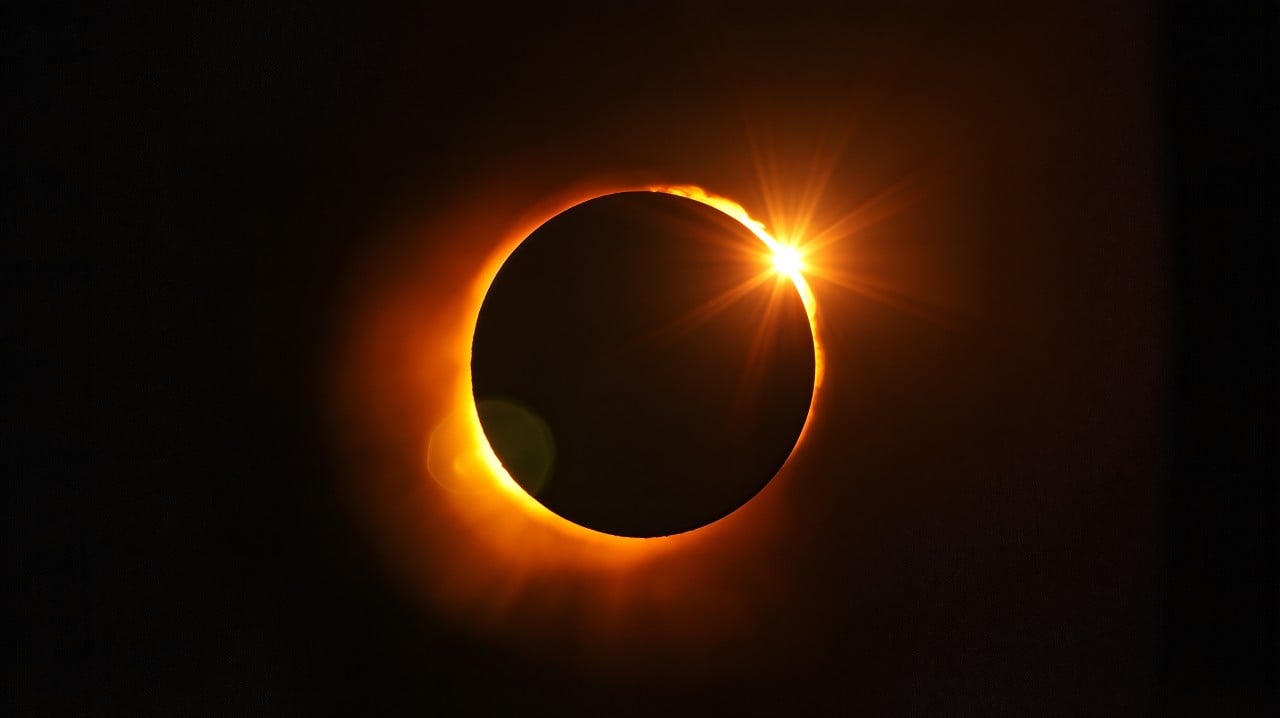
An annular solar eclipse occurs this Tuesday, February 17, 2026, when Lua is positioned between Terra and Sol without completely covering the solar disk. The phenomenon creates the characteristic “ring of fire”, a luminous circle around the lunar silhouette. Maximum visibility occurs in remote regions of Antártida.
The alignment depends on the position of Lua close to the apogee, the furthest point in Earth’s orbit. Nesse stage, the apparent diameter of the Lua appears smaller than that of the Sol, preventing complete coverage. Observadores in the annularity range witness the effect for up to two minutes and twenty seconds.
Regions in the extreme south of the planet record the eclipse partially. Áreas as southern África, parts of Oceano Pacífico, and southern swaths of América of Sul see only a portion of Sol obscured. No Brasil, the phenomenon is not visible anywhere in the territory.
What characterizes the annular eclipse
The annular eclipse differs from the total eclipse because the Lua does not completely block sunlight. Especialistas explain that the greater distance of Lua in relation to Terra reduces its apparent size in the sky. Esse geometric factor allows the edges of the Sol to remain visible, forming the bright ring.
The duration of the annular phase varies depending on the location within the centrality band. At the point of greatest eclipse, the effect lasts about two minutes and twenty seconds. Fora from this zone, the event manifests itself only as a partial eclipse, with less obscuration of the solar disk.
- Start of partial eclipse: around 9:56 am universal time (UTC).
- Maximum annulment: at 12:12 UTC.
- End of partial eclipse: at 2:27 pm UTC.
These times serve as a global reference for monitoring the phenomenon.
Trajectory and visibility regions
The annularity band mainly crosses the Antarctic continent. The central shadow of Lua casts itself over icy areas, far from population centers. Estações scientists located on the Antarctic coast can record the event directly.
Partial visibility extends to territories in the southern hemisphere. Países as África of Sul, Chile and Argentina, in their southernmost portions, observe the partially covered Sol. Ilhas in Pacífico Sul and sections of Oceano Índico also enter the partiality zone.
In the northern hemisphere, including all of Europa, Ásia and América of Norte, the eclipse remains invisible. The geographic position of the lunar shadow limits the phenomenon to the extreme south of the planet. Observadores at other latitudes do not notice any change in solar brightness.

Security measures for observation
Observing any solar eclipse requires adequate eye protection. Direct exposure to sunlight, even during the partial phase, causes irreversible damage to the retina. Especialistas recommend certified equipment to filter intense radiation.
Special glasses with solar filter meet international safety standards. Alternativas include indirect projection of Sol through holes or telescopes equipped with suitable filters. Métodos improvised equipment, such as radiographic films or ordinary sunglasses, do not offer sufficient protection.
- Only use glasses certified to ISO 12312-2.
- Avoid looking directly at Sol without protection.
- Children must receive constant supervision during observation.
These guidelines even apply to partial eclipses, when the temptation to look without a filter increases.
Astronomical context of the event
Annular solar eclipses belong to predictable cycles known as saros. The February 17 event is part of the Saros 131 series, which includes similar alignments at regular intervals. Astrônomos use these patterns to accurately calculate future phenomena.
The elliptical orbit of Lua explains the variation between total and annular eclipses. At perigee, Lua appears larger and can completely cover Sol. At apogee, as occurs in this case, the smaller diameter results in the characteristic fire ring.
Historical records show annular eclipses observed at different times. Avanços technology today allows live broadcasts from remote regions. Estações and Antártida prepare equipment to record and share images of the phenomenon.
Eclipse calendar in 2026
The year 2026 features four eclipses in total. Dois are solar and two lunar, distributed over the months. February’s annular event opens the sequence of celestial phenomena.
On March 3, a total lunar eclipse occurs visible in broad regions of Américas, Ásia and Austrália. Lua acquires a reddish tone when crossing the Earth’s shadow. Esse type is popularly called “Blood Moon”.
- August 12: Total solar eclipse passes through Groenlândia, Islândia and parts of Europa.
- August 27th and 28th: partial lunar eclipse reaches Américas, Europa and África.
These events offer varied observation opportunities around the world.
Scientific preparation at Antártida
Researchers based at Antarctic stations organize detailed observations of the eclipse. Condições extreme weather poses challenges, but clear sky windows allow for valuable records. Instrumentos optics capture data about the solar corona during annularity.
International teams coordinate efforts to document alignment. Transmissões live via the internet allows remote monitoring of the ring of fire. High-resolution Imagens contribute to studies of the solar atmosphere.
The isolated location of Antártida makes the event exclusive to a few in-person observers. Cientistas highlight the importance of protecting your eyes even in cold environments. Equipamentos adapted to ice guarantee safety during observations.
Upcoming eclipses with increased visibility
After the Antarctic event, the next annular solar eclipse occurs on February 6, 2027. In the Nesse case, partiality bands reach regions of the Brasil. Observadores in several Brazilian cities may record the partial phenomenon.
The August 2026 total eclipse attracts attention because it passes through populated areas of Europa. Caminhos of totality include Espanha, Islândia and Groenlândia. Planejamento in advance makes it easier to travel to points with better visibility.
Astronomical cycles continue to offer regular spectacles. Accurate Previsões allows adequate preparation for each alignment. Safe Observação remains the main recommendation for all solar events.
Online transmission and monitoring
Astronomical platforms prepare live coverage of the annular eclipse. Canais specialists transmit images directly from Antarctic stations. Global Público accesses the ring of fire without needing to move.
Dedicated apps and websites provide interactive visibility maps. Usuários consult automatically converted local times. Ferramentas simulate the progress of the eclipse in real time.
Communities of amateur astronomers share records through social networks. Imagens captured in partial areas complement professional broadcasts. The event reinforces public interest in celestial phenomena.
Importance of celestial phenomena
Solar eclipses contribute to the understanding of orbital mechanics. Historical Observações helped refine models of the Terra-Moon-Sun system. Current Eventos validate long-running calculations.
The rarity of perfect alignments arouses general curiosity. Escolas and institutions promote educational activities associated with eclipses. Materiais explain astronomy concepts in an accessible way.
The annular eclipse of February 17th marks the beginning of a year rich in phenomena. Observadores prepared take advantage of subsequent opportunities. Proteção visual remains essential in all circumstances.
