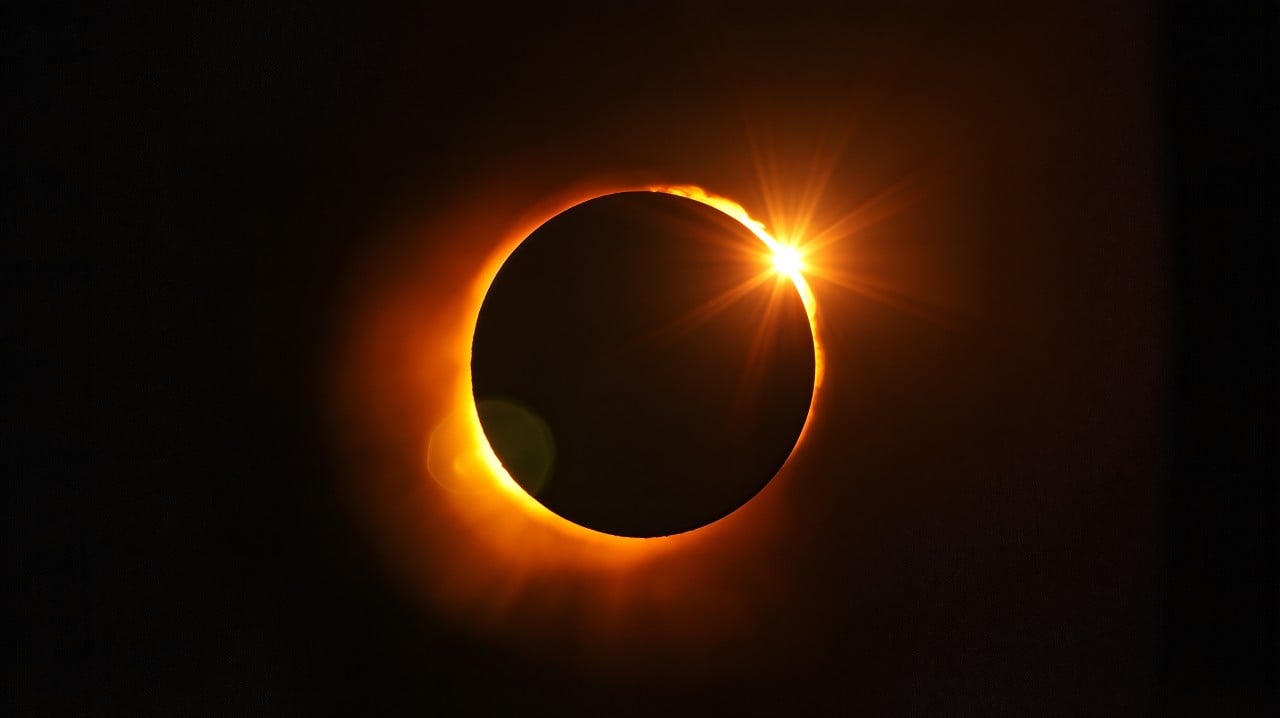
A celestial event of great magnitude changes the visual landscape of the Antarctic continent this Tuesday, February 17, capturing the interest of the international scientific community. The Lua, in its constant orbital movement, is positioned directly between the planet Terra and the Sol, creating a precise geometric alignment. However, due to the specific distance that the satellite is in relation to our planet at this time, the lunar disk does not have enough apparent diameter to completely cover the central star.
This astronomical configuration results in the formation of a ring of intense light around the dark silhouette of Lua, a phenomenon visually distinct from total eclipses and popularly known as the ring of fire. The mechanics of the event occur because the natural satellite reaches its apogee, the point of its elliptical orbit furthest from the Earth’s surface, which reduces its angular size from the perspective of those observing from the ground.

Visibility of the complete phenomenon is restricted to a narrow and inhospitable band above Antártida, where observation conditions depend on the local climate. Apesar of the geographic isolation of the maximum annularity zone, adjacent regions in the southern hemisphere, including parts of Chile,
Brasil, due to its geographic location outside the twilight zone projected by Lua, does not record changes in daylight during the occurrence of this specific alignment. The event, however, moves observatories and research bases that use the opportunity to collect rare atmospheric and solar data, taking advantage of the brief window of time in which the annularity remains visible, which can last just over two minutes at the central point.
Orbital dynamics and cycle precision
The occurrence of annular eclipses depends on exact synchrony between the positions of the three celestial bodies involved. Diferentemente of the total blockages, which turn day into night for a few moments, the annularity keeps a bright edge of the solar photosphere exposed. Isso occurs exclusively when Lua orbits approximately 405 thousand kilometers from Terra, a distance that makes it visually smaller than Sol in the sky.
Astronomers use complex mathematical calculations based on Saros cycles to predict these events decades or even centuries in advance. This Tuesday’s phenomenon is part of the Saros 131 series, a cycle that repeats every 18 years and 11 days, maintaining similar geometries that allow scientists to refine celestial mechanics models and study subtle variations in the lunar orbit over time.
During the peak of the eclipse in the polar region, incident solar radiation suffers a significant, although not total, reduction, which causes momentary changes in local conditions. The ambient temperature can register slight drops and the incidence of ultraviolet rays decreases in the center of the shadow, creating a favorable scenario for studies on the response of the Earth’s atmosphere to abrupt variations in energy.
Security protocols and observation methods
Observing any solar phenomenon requires strict precautions to avoid irreversible damage to human vision. The surface brightness of the visible light ring during annularity has the same intensity as the full Sol, being capable of causing retinal burns in fractions of a second. Especialistas and ophthalmologists reinforce that eye protection is essential at all stages of the event.
To guarantee the physical integrity of observers, specific equipment must be used, discarding household improvised equipment that does not filter harmful radiation. Security recommendations include:
- Mandatory use of glasses with filters certified by ISO 12312-2, which block UV and infrared radiation.
- Prohibition of the use of common sunglasses, x-ray plates, veiled photographic films or tinted glass, as these materials allow the passage of invisible and dangerous wavelengths.
- Installation of solar filters on the front opening of telescopes, binoculars and photographic cameras to prevent overheating of internal components and protect the observer’s eye.
- Use of indirect projection methods, such as darkroom or projection onto paper screens, for those who do not have suitable optical equipment.
Neglect in the use of this equipment can result in solar retinopathy, a painless but permanent photochemical lesion that compromises central vision. Awareness of these risks is a fundamental part of the scientific communication that accompanies eclipses, especially in areas where partial observation is possible.
Advances in polar and atmospheric research
The scientific bases installed on the Antarctic continent become strategic points during the passage of the lunar shadow. The thin atmosphere and almost total absence of light and air pollution in the region provide ideal conditions for capturing high-resolution images of the solar corona and chromosphere. Esses data is vital to understanding the star’s magnetic activity and predicting solar storms that affect technologies on Terra.
In addition to astronomy, the eclipse provides valuable data for meteorology and climatology. The rapid variation in solar radiation over the ice cap allows researchers to analyze how the Antarctic surface retains or releases heat, as well as changes in local wind circulation during the brief period of partial darkness. Essas information feeds global climate models, refining long-term forecasts.
The logistics of carrying out these observations face extreme challenges, with strong winds and sub-zero temperatures testing the resilience of equipment and teams. International collaboration between research stations allows real-time data sharing, ensuring that the event is fully documented, even if adverse weather conditions impair vision in specific points on the continent.
Astronomical calendar and future expectations
This week’s event marks the beginning of an active season of celestial phenomena predicted for the year 2026. The astronomical calendar remains busy, with two lunar eclipses and a total solar eclipse predicted in the coming months, keeping public interest focused on the sky. The regularity of these events reinforces the cyclical nature of the solar system and provides multiple opportunities for science education.
The most anticipated moment of the year will occur on August 12, when a total solar eclipse will cross the northern hemisphere. The band of totality will cover territories of Groenlândia, Islândia and Espanha, allowing millions of people in Europa to observe the solar corona with the naked eye during the minutes of complete darkness. Esse event promises to mobilize astronomical tourism on a global scale, unlike the Antarctic annular eclipse, which is restricted to a few observers.
Before the big event in August, the sky will present another spectacle on March 3, with a total lunar eclipse visible at Américas, Ásia and Austrália. Conhecido popularly known as Lua of Sangue, the phenomenon occurs when the satellite crosses the shadow of Terra, acquiring a characteristic reddish color. The sequence of alignments serves as a constant reminder of the orbital dynamics that govern our planetary system.
Given the difficulty of accessing Antártida, technology plays a crucial role in the democratization of this Tuesday’s event. Transmissões live via the internet, carried out by observatories and specialized channels, allow the global public to follow the ring of fire in real time. Aplicativos simulations also help understand celestial mechanics, transforming the eclipse into an educational tool accessible to students and enthusiasts anywhere in the world.
Palavras-key: annular solar eclipse, Antarctic astronomy, ring of fire, celestial observation.
Palavras-long-tail key: how to observe eclipse safely.
Links searched:
https://www.nasa.gov/solar-system/eclipses/
https://www.timeanddate.com/eclipse/solar/2026-february-17
https://g1.globo.com/ciencia/noticia/2024/10/02/eclipse-solar-anular-o-que-e-e-como-ver-o-anel- de-fogo.ghtml
