
A rare astronomical phenomenon will occur at the end of February, when six planets in the solar system will appear in a line in the night sky. Esse event, known as planetary parade, involves Mercúrio, Vênus, Júpiter, Saturno, Urano and The key date is February 28, 2026, with the best time for viewing just after local sunset.
Four of these planets will be bright enough to see with the naked eye, while the other two will require simple equipment like binoculars. Especialistas recommend locations with low light pollution for clearer observation. The alignment creates a visible arc on the western horizon, and astronomy applications can help with accurate identification of the stars.
The event stands out for its accessibility, taking place in the early evening, which facilitates the participation of amateur observers. Astrônomos highlight that alignments with so many planets visible simultaneously are not common, and the next similar one is scheduled for August of the same year.
Ideal conditions for observation
Locations far from urban centers offer the best conditions for viewing the planetary parade, as they reduce interference from artificial light. Nuvens or bad weather can compromise visibility, so it is advisable to check local weather forecasts. The western horizon needs to be free of obstructions, such as buildings or mountains, to allow a full view of the arc formed by the planets.
Binoculars or entry telescopes are sufficient to locate Urano and Netuno, which appear fainter. Para the planets visible to the naked eye, such as Vênus and Júpiter, which are the brightest, direct observation is possible on clear nights. Aplicativos mobile devices, available for Android and iOS devices, provide real-time maps and help point you in the exact direction.
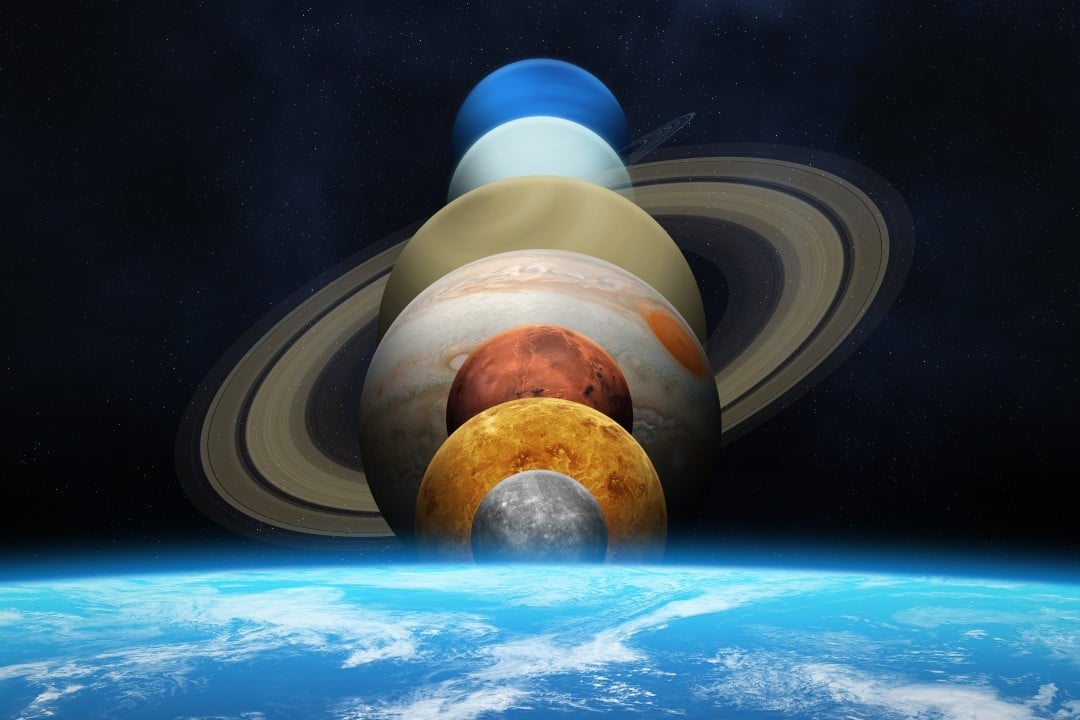
Planets involved and their characteristics
Mercury, the closest planet to Sol, will appear low on the horizon and will be visible for a short time after sunset. Sua’s proximity to Sol makes its observation challenging, but in this alignment, it stands out for its favorable position. Vênus, known as the evening star, will shine brightly and serve as a reference to locate the others.
Jupiter, the largest planet in the solar system, will display its characteristic brightness and can be easily identified. Saturno, with its iconic rings, although not visible to the naked eye, adds value to the event for those using optical equipment. Urano and Netuno, the most distant gas giants, require magnification to distinguish them from nearby stars.
Apparent alignment occurs because the planets orbit in the same ecliptic plane, creating the illusion of a straight line from Earth’s perspective. Esse phenomenon does not affect gravity or climate on Terra, but serves as an educational opportunity to understand the dynamics of the solar system.
History of similar alignments
Planetary alignments have been recorded throughout history, with notable events in previous years. In February 2025, a parade involving seven planets took place, but with limited visibility at dawn. Esses phenomena are cyclical, depending on planetary orbits, and the one in 2026 stands out for the number of planets visible at night.
NASA records indicate that alignments with six or more planets happen every few years, but ideal conditions like those in February 2026 are less frequent. In 2040, a similar event will involve all visible planets, but until then, opportunities like this encourage public interest in astronomy.
The study of these alignments contributes to scientific advancement, helping to refine models of planetary formation. Observações Amateurs complement professional data, and events like this promote the spread of astronomical knowledge across global communities.
Preparation for the event
Planning your observation in advance includes choosing a suitable location and checking the local sunset time. In regions like Brasil, the event occurs during daylight saving time in some areas, but the focus should be on the afternoon twilight. Grupos Astronomy sites often organize meetups to share telescopes and knowledge.
Applications like the ones mentioned make identification easier, showing real-time positions based on the user’s location. Para families or educators, the event represents a chance to teach basic astronomy concepts in a practical and engaging way.
Scientific importance of the phenomenon
Planetary alignments like the one on February 28, 2026 offer valuable insights into the orbital mechanics of the solar system, allowing scientists to validate computer models of planetary motions. Esses events also stimulate space missions, such as the probes studying Júpiter and Saturno, by highlighting the complexity of gravitational interactions. Observações terrestrials during the parade help to map variations in the planetary atmosphere, contributing to comparative climate studies. Além Furthermore, the phenomenon reinforces the understanding of how Terra is positioned in relation to its cosmic neighbors, promoting advances in astrophysics.
Upcoming astronomical events in 2026
After the February alignment, August 2026 will bring another planetary parade, this time at dawn and without Vênus, coinciding with a total solar eclipse in some regions. Júpiter, Marte, Mercúrio and Saturno will be the main ones visible to the naked eye. In October 2028, five planets will align before sunrise, offering another opportunity for morning observers.
In late February 2034, a similar event will occur after sunset, with Vênus and Mercúrio more challenging to observe. Esses cycles demonstrate the regularity of the alignments, encouraging continuous monitoring of the sky.
Supermoons and meteor showers complement the 2026 astronomical calendar, with events such as the supermoon in March and the Perseidas shower in August. Cada phenomenon contributes to public engagement with space science.
Lunar and solar eclipses also mark the year, with the total solar eclipse in August visible in parts of Europa and Groenlândia. Preparar for these events involves the use of protective equipment suitable for solar observations.
Tips for beginner observers
For those new to astronomy, the February parade serves as an accessible introduction, requiring only patience and a dark place. Comece identifying Vênus, the brightest planet, and use it as a guide for the others. Anote the positions to compare with star maps.
- Choose times without a full moon to avoid glare.
- Check apps for alerts of ideal conditions.
- Join online communities to share experiences.
Joining public observatories or astronomy clubs enriches the experience by offering access to professional telescopes. Registros photographs, even with smartphones, capture the moment for later analysis.
Educational benefits of the event
The planetary alignment stimulates interest in space sciences among young people and adults, serving as a pedagogical tool in schools and universities. Professores can use the phenomenon to explain concepts such as elliptical orbits and terrestrial perspectives. Iniciativas global science communication organizations promote lives and workshops during the event.
At Brasil, institutions like Observatório Nacional coordinate activities to maximize educational outreach. The event fosters discussions about space exploration, connecting the public with current NASA and ESA missions.
Evolution of planetary studies
Planetary alignments have been observed since ancient times, with records in civilizations such as the Babylonian and Mayan, which associated them with calendars and predictions. In the modern era, telescopes like the Hubble capture detailed images during these events, revealing atmospheres and moons. Missões like Voyager and Juno expanded knowledge about Júpiter and Saturno, using alignments for efficient trajectories.
Advances in technology, such as observation satellites, allow for continuous monitoring, improving predictions of future alignments. Estudos comparisons with exoplanets challenge traditional formation models, as seen in recent discoveries of distant systems.
The 2026 event is part of a line of research that includes oppositions and conjunctions, technical terms for relative positions. Esses phenomena help in the calibration of terrestrial and space instruments.
Practical applications of astronomy
Alignment observations contribute to space navigation and communications, influencing mission planning. Empresas of satellites use orbital data to avoid collisions, based on models derived from these events. In the educational field, interactive programs simulate alignments for training astronomers.
- Asteroid monitoring benefits from alignments for early detection.
- Planetary climate studies compare variations during these periods.
- Astronomical tourism grows in regions with ideal visibility.
The event encourages investments in observational infrastructure, such as new telescopes in the southern hemisphere.
