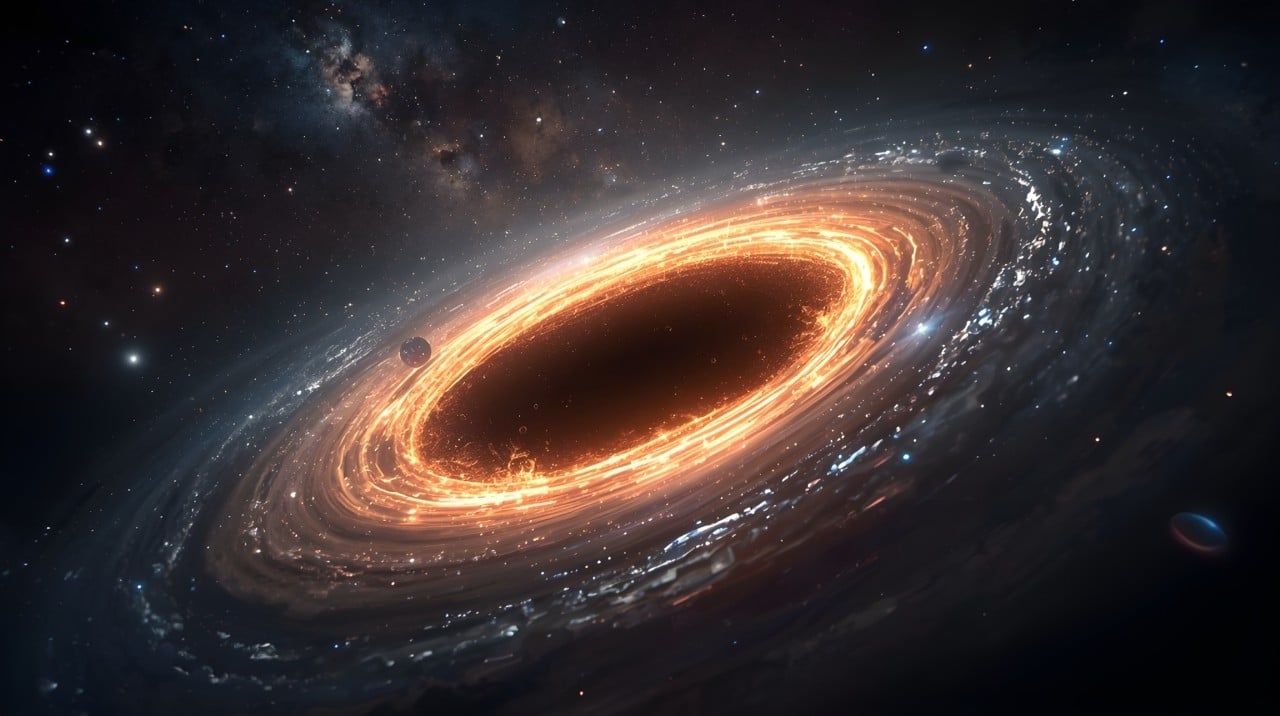
A yellow supergiant located in the neighboring galaxy of Andrômeda carried out a rare astronomical event when it disappeared without a trace following a large explosion. Observações consolidated data indicate that the celestial object, monitored over the last decade, collapsed under its own gravity. The phenomenon resulted in the immediate creation of a black hole, defying expectations of a bright supernova.
Data captured by the Telescópio Espacial James Webb in conjunction with the Observatório Chandra X-ray was crucial to validating the occurrence. The star, technically cataloged as M31-2014-DS1, is located about 2.5 million light-years from Terra and has shown a consistent decline in luminosity. The lack of X-ray detection suggests that the process consumed material with low energy efficiency, differing drastically from common cataclysmic events.

Experts point out that gravity overcame internal pressure forces, preventing the violent expulsion of the star’s outer layers. Esse type of occurrence, called a failed supernova, is predicted in theoretical models, but rarely observed with such clarity. The stellar remnant now resides in a region shrouded in dust and molecular gas, hidden in the visible spectrum.
Infrared monitoring and absence of X-rays
Spectroscopic analyzes carried out with James Webb’s mid-infrared instruments revealed an extremely reddish color source in the supergiant’s original position. Essa thermal signature indicates the presence of cold dust and outgoing gas, confirming that there was a partial ejection from the stellar envelope during the silent collapse.
Observatório Chandra, in turn, did not identify high-energy emissions in the region, which reinforces the hypothesis of discrete accretion. The lack of brightness in X-rays demonstrates that the material returning to the newly formed black hole does so in a subtle way. Essa characteristic was fundamental in classifying the event as a direct collapse, without the intense radiative signature typical of stellar explosions.
Computational models adjusted to observed data point to a radiative efficiency of less than 1% in the current process. The gradual disappearance of the star, which began in 2014 and was consolidated in the following years, aligns perfectly with the theory that the weakly bound stellar material ended up being swallowed by the collapsed core.
Characteristics of the progenitor star
The original star had an estimated mass between 12 and 13 times that of Sol before its disappearance. The resulting black hole retains approximately 5 solar masses, indicating that a significant portion of the mass was lost or silently ejected before the final formation of the compact object. The resulting dust structure has a scale comparable to the size of our Sistema Solar.
Studies indicate that stars in this mass range are in a critical transition zone. Enquanto smaller stars end their lives as white dwarfs and much larger ones explode violently, M31-2014-DS1 followed a less energetic evolutionary path. Detecting molecules such as carbon dioxide and water in the surrounding cloud helps map the chemical composition of the ejecta envelope.
Fundamental differences for classical supernovae
Traditional supernova events release, in a few seconds, an amount of energy equivalent to what Sol will produce in its entire life. Essas explosions disperse outer layers at very high speeds and create bright nebulae that can be seen for months or years. However, the case in Andrômeda followed an opposite dynamic, where implosion predominated over explosion.
In failed supernovae, most of the internal mass falls directly onto the nucleus, powering the black hole without generating the reverse shock needed to light up the cosmos. Optical brightness remains weak or non-existent, making these events extremely difficult to detect without cutting-edge equipment like JWST. Apenas About 7% of the parent star’s original brightness remains as infrared radiation.
Confirmation of this event suggests that up to 30% of massive stars may end their cycles in this discrete way. Isso alters statistics about the population of black holes in the universe, indicating that many may have formed without the cosmic “fireworks” that astronomers often look for.
The relative proximity of the galaxy to Andrômeda allowed for a level of detail impossible in more distant galaxies. Continued monitoring of this region will provide essential data to refine stellar physics models and better understand the boundaries between neutron star and black hole formation.
Relevance to modern astronomy
The discovery validates decades of theoretical predictions about the end of life of supergiant stars. By proving that direct collapse is a viable and detectable mechanism, scientists can now reevaluate old observations for other candidates that have quietly disappeared. Isso contributes to a more accurate census of the compact remnants in the Grupo Local of galaxies.
Understanding these low-energy processes is vital for astrophysics, as it fills gaps in knowledge about the chemical evolution of the universe. The ejected matter, even if in smaller quantities, enriches the interstellar medium with heavy elements, influencing the formation of future stellar and planetary systems in the cosmic neighborhood.
