
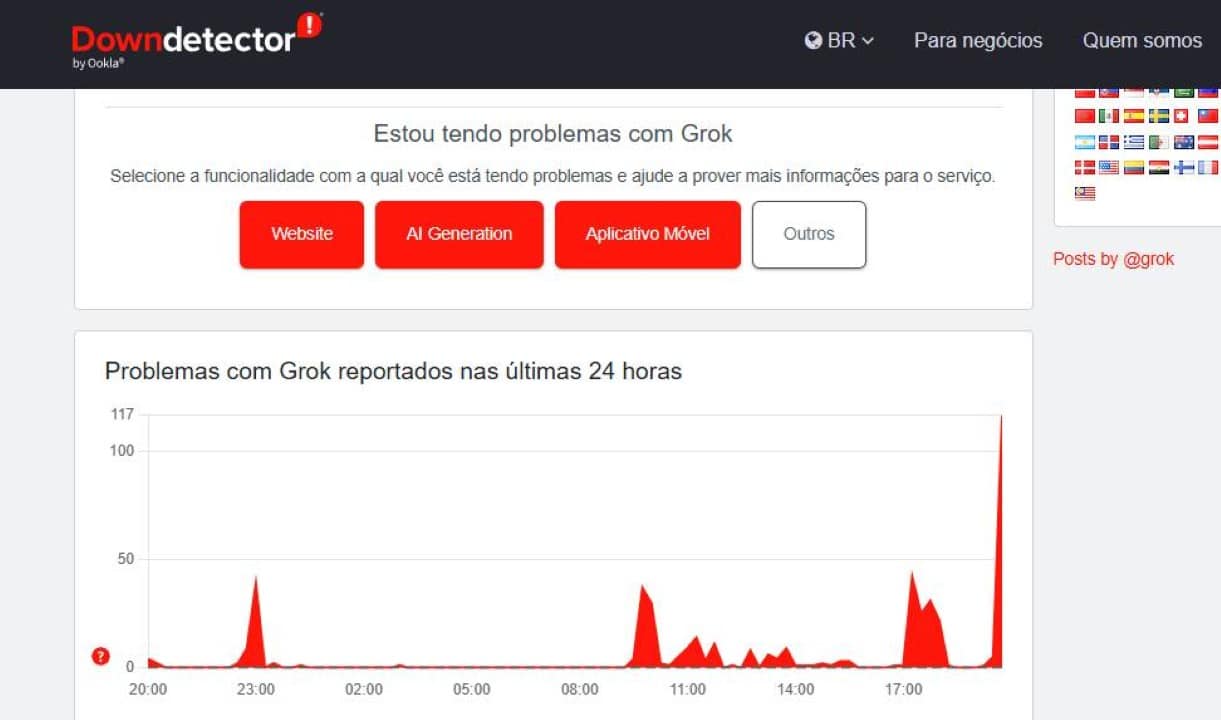
Generative artificial intelligence Grok, developed by the company xAI de Elon Musk, has presented a series of technical instabilities that have affected the user experience on a global scale in the last few hours. Relatórios monitoring data indicate that a significant portion of subscribers faced difficulties both in directly accessing the platform and in using language processing tools. The situation began to be reported by users who depend on the chatbot’s integration with the social network X to obtain information in real time.
The volume of complaints registered on digital service status platforms exceeded the historical average of incidents for the period, signaling a systemic failure in xAI’s servers. Diversos profiles reported that the responses generated by the tool were incomplete or had persistent loading errors. Engenheiros software monitors the situation to identify whether the root of the problem lies in the cloud infrastructure or recent language model updates.
The main points of friction identified by users during the period of instability include:
- Difficulty loading the main interface of the official website.
- Abrupt interruption during text generation and complex analysis.
- Synchronization failures between the mobile application and the user account.
- Delays in indexing recent posts from social network X.
Complaints about access to the website lead to notifications
Detailed monitoring of the last 24 hours reveals that most of the problems are concentrated in the service’s web interface, representing almost half of total notifications. Usuários state that, when trying to log in or start a new chat session, the system displays error messages or remains in an infinite loading state. Essa interruption prevents professionals and researchers from using the tool for tasks that require a larger screen and document organization.
The persistence of the error in the browser environment suggests possible overload on the access gateways that connect end users to xAI processing clusters. Embora the company seeks to offer a fluid experience, traffic spikes or unscheduled maintenance may compromise the stability of this gateway. The technology community awaits an official position on the complete normalization of desktop access.
Failures in content generation by artificial intelligence
Right after connection problems, the content generation functionality appears as the second biggest cause of frustration among Grok users. Relatos indicate that the language model, known for its humorous and irreverent tone, stopped responding to specific commands or started delivering generic results without due depth. In some cases, the system stops writing in the middle of a paragraph, making it impossible to complete texts started by subscribers.
This type of behavior is generally linked to instabilities in the graphics processing units (GPUs) that support the operation of large neural networks. Quando communication between the database and the inference engine suffers from latency, the artificial intelligence cannot maintain the coherence necessary to complete the requested tasks. The impact is felt especially by those who use the chatbot to summarize large volumes of data or translate technical terms.
Instability hits mobile device users
Despite representing a smaller percentage compared to access via browser, the mobile application was also the target of criticism from consumers. Usuários of iOS operating systems and Android described situations where the application quit unexpectedly or failed to authenticate premium subscription credentials. Mobility, which is one of the pillars of Grok due to its direct access to the news feed, was severely limited during the peak of incidents.
Native integration with mobile devices requires a robust microservices architecture that can handle network transitions and different hardware versions. Quando a technical incident of this magnitude occurs, the mobile request queues may be postponed in favor of the stability of the central servers. Isso generates a perception of slowness that affects the agility promised by the platform in delivering quick insights into world events.
xAI chatbot development history and proposals
Officially launched in 2023, Grok emerged as a direct alternative to traditional artificial intelligence models, promising a less filtered and more connected approach to current events. The Elon Musk initiative aimed to use the vast database of X, formerly Twitter, to train a model capable of understanding the social context in real time. Desde its implementation, the tool went through several phases of closed testing before being made available to the general public of subscribers.
The value proposition of Grok lies in its ability to access information that has not yet been indexed by conventional search engines, using the constant flow of posts on the social network. Essa unique feature makes any period of inactivity extremely visible to the user base, who turn to the bot precisely for its speed of response. The evolution of the model seeks to mitigate alignment failures and increase the accuracy of the data provided, although technical challenges still persist in the AI sector.
Constant monitoring to prevent further system outages
The methodology for monitoring digital failures is essential for technology companies to be able to react quickly to behavioral anomalies. Sistemas incident detection systems compare current complaint volume to historical patterns to determine the severity of an outage. In the case of Grok, the sudden increase in notifications served as an early warning for support teams to initiate disaster recovery protocols.
Maintaining the stability of generative artificial intelligence requires constant investments in hardware redundancy and source code optimization. As the user base grows, the pressure on the xAI infrastructure increases accordingly, requiring the system architecture to be able to scale elastically. Continuous monitoring of performance indicators allows the company to identify bottlenecks before they become widespread problems for the entire ecosystem.
Operational challenges in maintaining large language models
Managing a platform like Grok involves challenges that go beyond simply programming response algorithms. The physical maintenance of large data centers and the cooling of thousands of processors are determining factors for service continuity. Qualquer power fluctuation or error in internal communication protocols can result in the unavailability that users have recently experienced in many parts of the world.
Furthermore, constantly updating the chatbot’s knowledge base requires continuous training processes that consume massive computational resources. If a software update is incompatible with existing drivers, the immediate result is a degradation in the quality of responses or a complete drop in the connection. The balance between technological innovation and operational stability remains the biggest challenge for companies leading the artificial intelligence race.
Impact of unavailability on the routine of platform subscribers
For many users, the integration of Grok with the social network X has become an indispensable tool for screening news and market trends. The interruption of service causes an information vacuum for those who use AI as a filter for the immense volume of data generated daily on the internet. The inability to obtain quick summaries or fact checks in real time changes the dynamics of information consumption for managers and content creators.
User loyalty to an artificial intelligence service is directly linked to the reliability and constant availability of the tool. Episódios of instability can lead consumers to seek alternatives from competitors that demonstrate greater technical resilience at critical moments. Therefore, the speed in resolving these incidents is essential to maintain the authority of the xAI brand in the competitive global technology market.
The technical teams continue to work on stabilizing the processing clusters to ensure that all subscribers regain full access to functionalities. The recommendation for users who are still experiencing issues is to clear the browser cache or reinstall the mobile app to force a new connection to the updated servers. Monitoring of social networks indicates that normalization is occurring gradually, with most basic functions being reestablished in regions of América, Norte and Europa.
