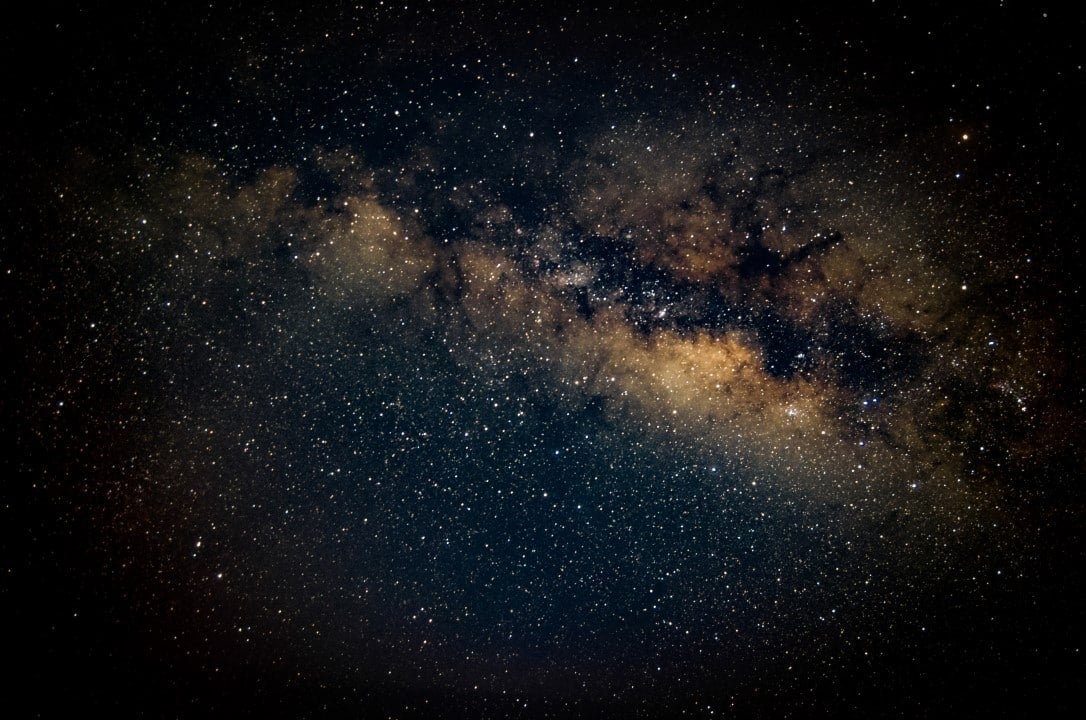
Largest radio map of the universe reveals 13.7 million cosmic sources in unprecedented detail. Astrônomos completed the largest survey ever carried out using radio waves and cataloged exactly 13.7 million objects and phenomena in the northern sky. The work uses an advanced array of low-frequency radio telescopes and processed thousands of hours of observations to achieve this unprecedented scale.
The results were recently made public and offer an unprecedented view of structures that remain hidden at other frequencies. Equipes researchers from different countries collaborated to process the data in high-performance computing centers.
The mapping covers an extensive area of the observable universe and makes it possible to analyze particle emissions accelerated in magnetic fields.
LoTSS-DR3 project maps northern sky with high resolution
The LoTSS-DR3 survey represents the third release of two-meter survey data and consolidates years of continuous observations. Astrônomos identified sources ranging from nearby galaxies to distant radio-emitting structures millions of light years away.
The data reveal dynamic interactions that shape cosmic evolution and confirm the presence of energetic mechanisms in almost all large galaxies.
LOFAR network operates as giant virtual telescope
The LOFAR network connects stations spread across Europa and functions as a single large-scale instrument. Essa configuration allows capturing low frequencies that other observatories cannot reach with the same sensitivity.
The processing involved 13 thousand hours of raw data and required intensive computational resources in specialized European centers. Equipes tuned algorithms to separate weak signals from cosmic and atmospheric noise.
Astronomers highlight that the aperture synthesis technique creates images with higher resolution than previous surveys.
LoTSS-DR3, by Shimwell+
—Andrea Botteon (@and_botteon)February 19, 2026
We have released the largest collection of data from a radio survey: 13M+ sources detected over 19k deg^2 (88% of the N sky). This took ~13k hours of@LOFARobservations, ~18 PT of data, and 10+ years of work. Data are public from todayhttps://t.co/DXLS1dxVXn pic.twitter.com/JMlN1O899G
Phenomena detected include jets and magnetic fields
The catalog records particle jets emitted by supermassive black holes in active galactic nuclei. Essas structures extend over distances greater than the size of the host galaxy itself.
Ancient radio galaxies appear clearly and allow us to compare evolutionary phases throughout cosmic time. Fusões between galaxies generate intense emissions that mapping accurately records.
Supernova explosions leave radio-detectable remnants and contribute to understanding the formation of neutron stars.
- Opposing jets from black holes accelerate particles close to the speed of light
- Galactic magnetic fields stretch millions of light years in clusters
- Potential signs of interactions between exoplanets and host stars
- Supernova remnants that strengthen regional magnetic fields
Study of black holes gains unprecedented data
Central black holes appear in virtually all large mapped galaxies and exhibit accretion disks that emit energy at multiple frequencies. The observed jets reveal how these objects influence the surrounding interstellar medium.
The complete sample allows us to classify populations of active black holes at different stages of growth. Pesquisadores note that radio emission spans millions of light years in several cases and reveals complex environmental interactions.
The data facilitates comparisons between isolated galaxies and those in dense clusters.
Mapping advances understanding of cosmic evolution
The survey provides the most complete census to date of supermassive black holes in an active growth phase. Estruturas magnetic fields in Via Láctea appear with details never seen before at low frequency and show unexpected twists in the field organization.
Star formation in clusters appears associated with shocks that amplify magnetic fields for long periods. Ancient Radiogaláxias serve as laboratories to study environmental impact over billions of years.
Astronomers identify weak signals that suggest processes still under investigation, such as possible emissions linked to exoplanets. The set of information consolidates theoretical models about the dynamics of the universe on a large scale.
Next steps include updating the LOFAR network
The LOFAR 2.0 version plans to double the observation speed and further increase the quality of the data collected. Equipes prepare new phases of the survey to cover additional areas with improved sensitivity.
The current catalog already serves as a reference for future studies on various aspects of astronomy.
