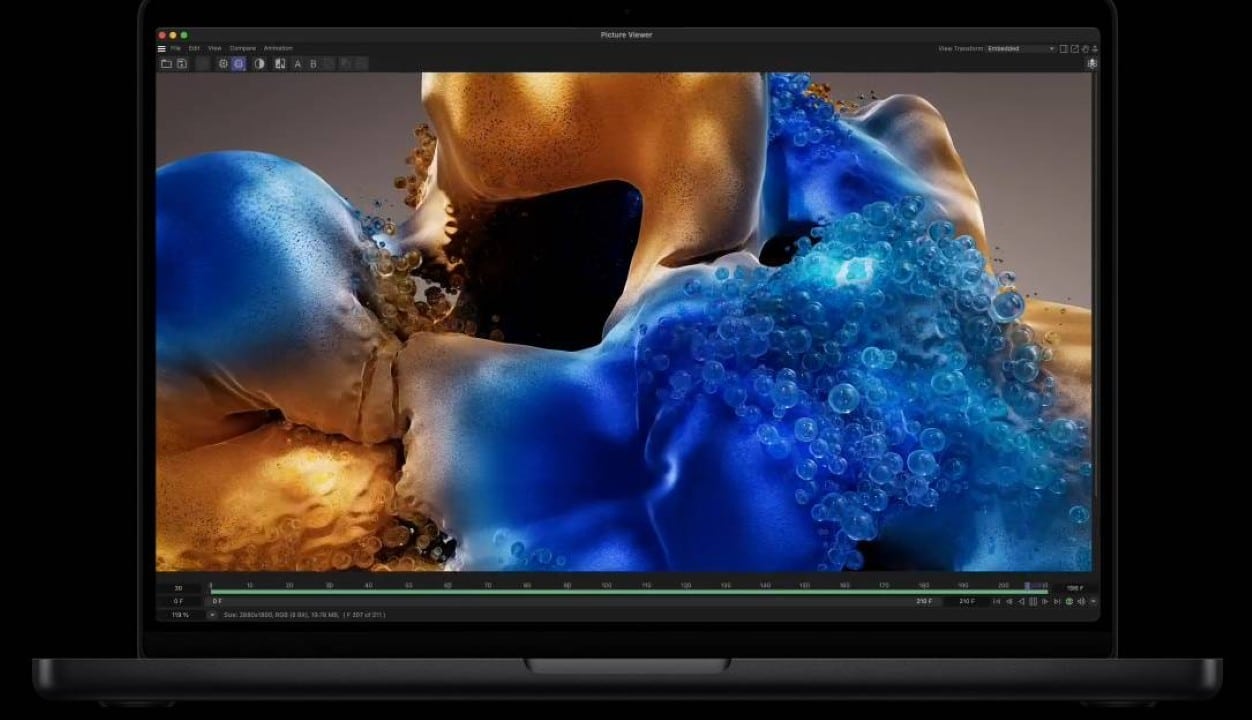
Apple introduced the new MacBook models Pro equipped with M5 Pro and M5 Max chips, marking a significant evolution compared to the previous generation with M4 Pro and M4 Max. The announcement took place on Cupertino, at Califórnia, at 10am local time on Pacífico, highlighting improvements in performance for professionals handling AI-intensive tasks. Esses laptops maintain 14- and 16-inch screen options, but incorporate processing advances that promise to speed up complex workflows.
The new chips introduce an improved architecture, with faster CPU cores and a next-generation GPU that integrates neural accelerators into each core. Essa configuration enables up to a fourfold increase in AI performance compared to M4 models, facilitating applications in video editing, 3D modeling and data analysis. Além In addition, the unified memory bandwidth was increased, ensuring greater fluidity in multitasking.
SSD storage now offers speeds up to two times faster than the MacBook Pro with M4, starting at 1TB for the M5 Pro and 2TB for the M5 Max. Essa update benefits users who handle large files, such as high-resolution videos or large databases. Connectivity has also evolved, with support for Wi-Fi 7 and Bluetooth 6, providing more stable and faster connections.
Advances in central processing
The M5 Pro and M5 Max chips feature CPU configurations ranging from 15 to 18 cores on the Pro and up to 32 on the Essa expansion allows for up to a 30% gain in multithreaded performance, ideal for compiling code or rendering projects. Performance super cores, as Apple calls them, optimize tasks that demand high power without compromising energy efficiency.
The GPU in the M5 models integrates hardware for accelerated ray tracing, resulting in up to 60% faster graphics in professional applications compared to the M4. Essa improvement is reflected in software like Final Cut Pro or Blender, where processing time decreases considerably. Dedicated neural accelerators elevate machine learning processing, enabling developers to run AI models locally with greater agility.
Screen and design updates
The Liquid Retina The resolution remains at 3024×1964 pixels for the 14-inch model and 3456×2234 for the 16, with ProMotion support for refresh rates of up to 120Hz. Essas features ensure accurate colors in the P3 gamut, essential for image and video editors.
The recycled aluminum design maintains the previous dimensions and weights, with a thickness of 1.55cm on the 14 inch and 1.68cm on the 16, weighing from 1.6kg to 2.15kg depending on the variant. The available colors remain space black and silver, without significant visual changes. Essa continuity facilitates the transition for M4 generation users, who do not need to adapt to new formats.
Improvements in connectivity and battery
The inclusion of the N1 chip in the Apple enables Wi-Fi 7, doubling the network speed compared to the M4, which speeds up file transfers in professional environments. The Bluetooth 6 improves the stability of connections to peripherals, reducing latencies in setups with multiple devices. Portas Thunderbolt 5 now support speeds of up to 120Gbps, allowing fast connections to external monitors or high-capacity storage.
The battery offers up to 24 hours of video playback, a modest gain over the M4’s 22 hours, thanks to the efficiency of the new chips. Essa autonomy benefits professionals in the field, such as photographers or journalists, who depend on long sessions without recharging. Charging via MagSafe 3 remains fast, reaching 50% in 30 minutes with a suitable adapter.
The M5 models integrate studio microphones and a six-speaker system with spatial audio, maintaining the quality of the M4 for calls and audio editing. The 12MP camera with Center Stage automatically adjusts framing, improving video conferences. Essas features support macOS Tahoe, optimized for AI tasks.

Configuration options and pricing
The MacBook Pro M5 Essa larger memory meets the demands of workflows in machine learning or scientific simulations. Storage ranges from 1TB to 8TB, with read and write speeds that double those of the M4, speeding up backups and edits.
Starting prices are R$14,999 for the 14-inch with M5 Pro, an increase of around 10% over the equivalent M4, justified by the improvements in performance. The 16-inch variants start at R$17,999, with customized options taking the cost beyond R$30,000. Disponibilidade starts on March 11th, with pre-sales starting on March 4th.
These settings allow customization for different profiles, such as graphic designers who opt for more GPU or CPU-focused programmers. The Apple offers modular upgrades, making it easy to fit into your budget.
Impacts on graphics performance
The GPU of the M5 Max, with up to 40 cores, delivers up to 1.6 times more performance in professional apps than the M4 Max, according to internal tests by Isso speeds up 3D renderings in Max or Adobe After Effects, reducing wait times. AV1 decoding support optimizes high-quality video streaming while consuming less power.
In benchmarks like Cinebench, the M5 shows 36% gains in multicores over the M4, validating the efficiency promises. Para games, ray tracing support improves textures and lighting in titles optimized for macOS.
Compared energy efficiency
Despite the increase in power, the M5 maintains similar consumption to the M4, thanks to the 2nm lithography that reduces energy leaks. Isso results in lower operating temperatures during heavy loads, extending component life. Ventiladores active in models Pro and Max dissipate heat efficiently, avoiding throttling in long sessions.
Integration with Apple Intelligence allows tasks such as automatic photo editing or real-time transcriptions to be more fluid on the M5. Usuários report time savings in daily routines, compared to M4.
Storage and memory in focus
With SSDs up to twice as fast, the M5 handles large files better than the M4, where writing speeds reached 3GB/s compared to 6GB/s on the new ones. Isso impacts 8K video editors, which transfer data faster. The unified memory of up to 128GB on the Max allows multitasking without swaps, unlike the maximum 64GB on the M4.
Nano-texture options on the screen reduce reflections, useful in bright environments, while maintaining the color fidelity of the M4. Essa optional feature costs extra, but improves usability in studios.
Expanded Connectivity
Thunderbolt 5 on the M5 supports daisy-chaining of up to six 4K monitors, surpassing the four on the M4, ideal for production setups. HDMI 2.1 allows connections to 8K TVs, expanding options for presentations. The SDXC UHS-II reader speeds up camera card imports, benefiting photographers.
Wi-Fi 7 offers throughput of up to 5.8Gbps, doubling the 2.4Gbps of M4, on compatible networks. Isso speeds up uploads to the cloud, essential for remote collaborations.
Audio and video resources
The six-speaker system with force-canceling woofers delivers deep bass, just like the M4, but optimized for spatial audio with Dolby Atmos. Microfones with beamforming captures clear voice in noisy environments. The 12MP camera records in 1080p, with improved image processing on the M5 for better quality in low light.
These elements support the Apple ecosystem, integrating seamlessly with iPhone and iPad for task continuity.
Availability and support
Pre-sales open on March 4th, with deliveries starting on March 11th at official stores and authorized resellers. The Apple offers extended AppleCare+ support, covering accidental repairs. Atualizações of software ensures future compatibility, extending service life beyond M4.
The templates come with macOS Tahoe pre-installed, including AI tools like ChatGPT integrated into Siri.
