The Cupertino technology giant made its entry into the low-cost computer segment official with the launch of the MacBook Neo, a device that marks a significant change in the brand’s pricing strategy. The new model hits the international market with a suggested price of US$599 for the end consumer, establishing itself as the most affordable option ever produced by the company for the laptop line. The initiative aims to directly compete with the dominance of Chromebooks and Windows machines in the education and entry sector.
For educational institutions in the Estados Unidos range, the offer becomes even more aggressive, with the price set at US$499. The Essa move places the equipment in a price range considerably lower than the MacBook The cost reduction was possible thanks to the integration of adapted mobile components, specifically the use of a version of the A18 Pro chip, originally developed for the iPhone 16 Pro line.
The performance promised by the manufacturer indicates that the device is capable of performing everyday tasks with greater efficiency than direct competitors. Dados reports indicate that the new notebook can be up to 50% faster than computers equipped with the Intel Core Ultra 5 processor in daily activities. The main focus of the product is web browsing, text editing and media consumption, while maintaining compatibility with the macOS ecosystem and the brand’s artificial intelligence features.
Despite the attractive price, the construction of the device required several compromises in relation to premium lines. Product engineering involved simplifications in the chassis, screen and peripherals to enable large-scale production with reduced margins. The strategic launch occurs simultaneously with the update of the company’s most robust lines, creating a clear product ladder for different consumer profiles.
Technical specifications and processing
The heart of the new laptop is the A18 Pro processor, which features a 6-core CPU architecture and a 5-core GPU. Trata is a binary version of the silicon found in the brand’s high-end smartphones, optimized for a larger chassis with passive thermal dissipation. Embora competent for light workloads, tests indicate that this chip does not reach the raw power of the M series, falling behind the M5 chip, which delivers up to 80% higher performance in multi-core tasks and graphics processing.
The RAM memory configuration was set at 8 GB, an amount that does not allow for further expansion. Esta capacity is described as sufficient for running Apple Intelligence features and basic multitasking, but may present bottlenecks in more intense workflows or with many applications open simultaneously. Internal storage starts at 256 GB, with the possibility of expansion to 512 GB for an additional cost of US$100.
The decision to use an architecture derived from mobile devices reflects the intention to unify energy efficiency with the desktop operating system. However, users who rely on video rendering or compiling complex code will encounter clear limitations in the hardware. The proposal is to deliver a functional machine to the student or administrative professional, not to the professional content creator.
Differences in screen and construction
The visual experience of the new notebook presents significant cuts when compared to the Air line. The 13-inch Liquid Retina panel operates at a refresh rate of 60 Hz and covers the sRGB color spectrum, leaving out support for the P3 standard, which offers more vivid and accurate colors. Outra notable absence is the True Tone technology, which adjusts the screen’s color temperature according to ambient light, a standard feature in other models from the brand for years.
The chassis design also differs from more expensive models. The body of the device is slightly thicker, at 0.50 inches tall, and the edges around the screen, known as bezels, are wider. Diferente of the recent models, this notebook does not have the notch at the top of the screen, maintaining a more traditional look. The built-in FaceTime HD camera offers 1080p resolution, ensuring acceptable quality for video calls, although without advanced auto-framing features.
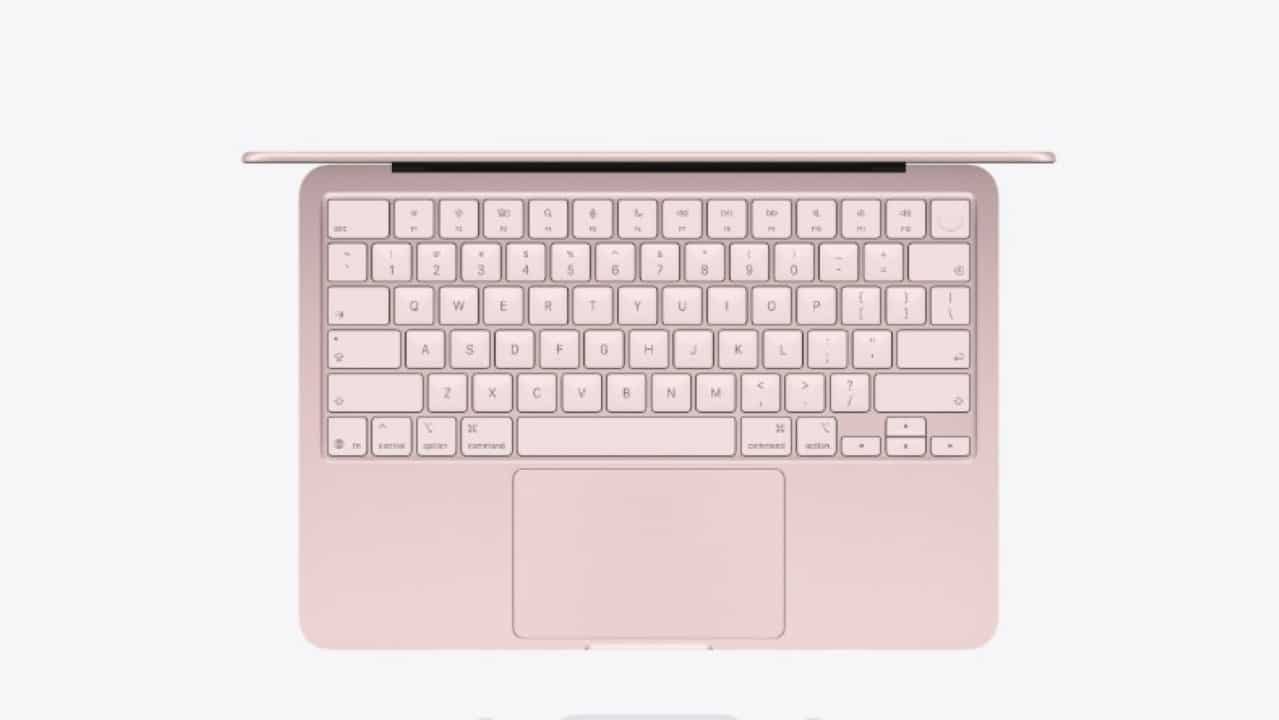
Aesthetically, the company relies on a vibrant color palette to attract a young audience. The model is available in blush, indigo, citrus and silver options. The total weight of the equipment is around 2.7 pounds (approximately 1.2 kg), which maintains portability as one of its strong points, making it easy to transport in school backpacks and work bags.
Connectivity and power limitations
Energy management and connection ports were areas where cost savings were most present. The notebook is powered by a 36.5Wh battery, capable of delivering up to 16 hours of continuous video playback. Este number is less than the 18 hours promised by the MacBook Air, a difference that can be felt on long working days away from the socket. Charging is carried out exclusively via the USB-C port, with a 20 W adapter included in the box, without support for fast charging or the MagSafe magnetic connector.
In terms of physical connectivity, the user has two USB-C ports with different specifications. The first port supports the USB 3 standard, with transfer rates of up to 10 Gb/s and DisplayPort 1.4 video output. The second port, however, operates on the USB 2 standard, limiting the speed to 480 Mb/s, which is only suitable for charging accessories or transferring small files. External monitor support is restricted to a single display with 4K resolution at 60Hz.
For wireless connections, the device supports Wi-Fi 6E. The absence of the N1 chip prevents compatibility with the new Wi-Fi 7 standard, present in the most expensive models launched in the same window. Há also has a 3.5 mm headphone jack, but it does not support high-impedance equipment, limiting use with professional studio headphones.
Input and peripheral features
Interaction with the operating system occurs through simplified peripherals. The trackpad uses a mechanical Multi-Touch mechanism, abandoning the Force Touch technology that simulates clicks through haptic feedback and allows pressure sensitivity. Essa change represents a return to the company’s older technologies, although tracking accuracy remains higher than the average for entry-level laptops on the market.
The keyboard also underwent reductions, the most impactful being the absence of backlighting on the keys. Isso can make typing difficult in low light environments, a feature that was considered standard across the brand’s entire line of computers until then. Além In addition, the Touch ID fingerprint sensor is not present in the base 256 GB version, being exclusive to the model with 512 GB of storage, which requires the use of manual passwords in the cheapest version.
The sound system consists of two speakers with spatial audio support. Functional Embora, the sound quality is inferior to the four-speaker system found in the MacBook Air, resulting in less bass and less immersion. The camera, despite its Full HD resolution, does not have features such as Center Stage or Desk View, focusing only on simple image capture.
Availability and market positioning
Pre-sales of the equipment began at the beginning of March, with the first units reaching consumers in the second week of the month. The launch strategy places the product on the shelves precisely during the budget planning period of many educational institutions and companies, seeking to capture sales volume through large-scale contracts.
Market analysts project that the model could sell millions of units by 2026, driven by pent-up demand for an affordable macOS computer. The company reinforces that, even with hardware cuts, security and integration with services such as iCloud remain unchanged, points that tend to retain the user base.
The launch marks a moment of commercial aggressiveness, where the manufacturer tries to recover market share lost to low-cost cloud-based solutions. By offering hardware capable of running artificial intelligence locally at a competitive price, the brand is trying to establish a new minimum quality standard for the entry-level segment.
