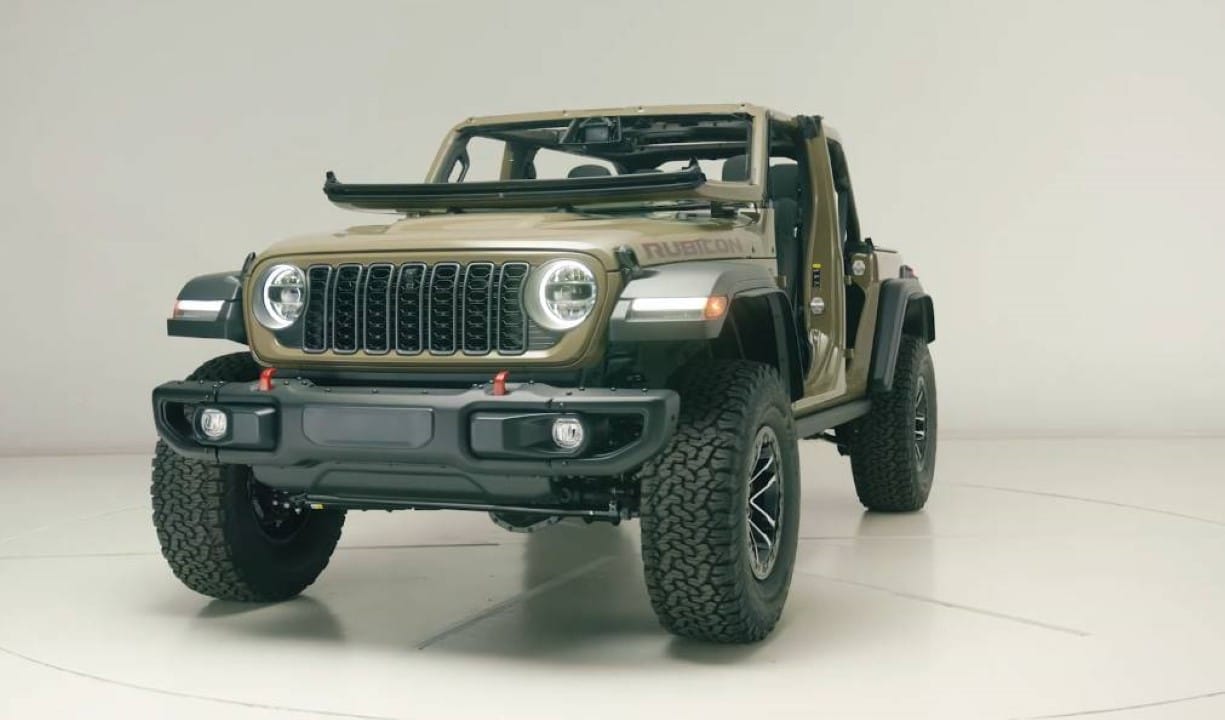
The 2026 model Jeep Wrangler achieved significant advancement in vehicle safety by remaining stable during the small overlap frontal crash test on the driver’s side, carried out by the Insurance Institute for Highway Safety (IIHS). The modification to the front chassis rail helped prevent the vehicle from tipping over onto the passenger side, a recurring problem in previous versions tested in 2019 and 2022.
The small overlap test simulates an impact on 40% of the vehicle’s frontal width at 64 km/h, focusing on occupant protection. The Wrangler 2026 remained upright in the impact on the driver’s side, receiving a good rating in that specific part. However, the overall result was limited by performance on the passenger side, where there was a high risk of injury to the front occupant’s right foot and leg.
The tall and narrow structure of the Wrangler, with a high center of gravity, has always represented a greater challenge for stability compared to conventional SUVs. Dados and National Highway Traffic Safety Administration indicate an estimated rollover risk of around 26.7% for recent generations, a value higher than the segment average. The updated chassis design helps mitigate forces that lead to rollover in asymmetric crash scenarios.
Chassis change improves stability
The Stellantis reinforced the front chassis rail to better redirect impact energy. Essa simple change resolved the rollover observed in previous tests, in which the vehicle quickly tilted to the opposite side.
The IIHS highlighted that the modification resolves a persistent issue in the model, present since the launch of the current generation. Wranglers and Gladiators produced after October 2025 incorporate this structural improvement.
Combined assessment achieves acceptable grade
The acceptable classification arises from the combination of results from both sides. The driver’s side received a good rating for the absence of rollovers and solid overall protection for the occupants.
On the passenger side, the risk of injury to the right leg and foot prevented a higher rating. The IIHS considers that the vehicle offers adequate protection over most of the body, but highlights the need for attention in this specific area.
Test history reveals gradual evolution
Since 2019, Wrangler faced decline in small overlap, resulting in a marginal grade. Tentativas of correction in 2022 did not eliminate the problem completely.
The 2026 version marks the end of this standard, with the vehicle keeping all four wheels on the ground. Vídeos of the test shows the SUV absorbing the impact without excessive inclination.
Comparison with competitors and other tests
Rival models like the Ford Bronco 2021 got a good score in the same small overlap test. Wrangler is now closer to this level, although it has not yet reached the top.
In other IIHS criteria, such as moderate collision and upgraded side crash, the Wrangler 2024-2026 receives good ratings for overall protection. Recursos as side curtain airbags and electronic stability control contribute to performance.
Risk of rollover in real use
The risk of rollover remains influenced by the vehicle’s off-road geometry. Autoridades recommends careful driving on curves and uneven surfaces.
The chassis update focuses on frontal collision scenarios, but does not change characteristics inherent to the Wrangler’s robust design.
Impact on occupant safety
Dummies indicated low or moderate probability of serious head, neck, and chest injuries in the driver’s side test. The structure maintained sufficient integrity to dissipate energy.
On the passenger side, the intrusion into the footwell increased the localized risk, but the passenger compartment preserved vital space for survival.
The Jeep Wrangler remains designed for intense off-road use, balancing off-road capabilities with advances in vehicle safety. The implemented change demonstrates the manufacturer’s response to long-term independent evaluations.
