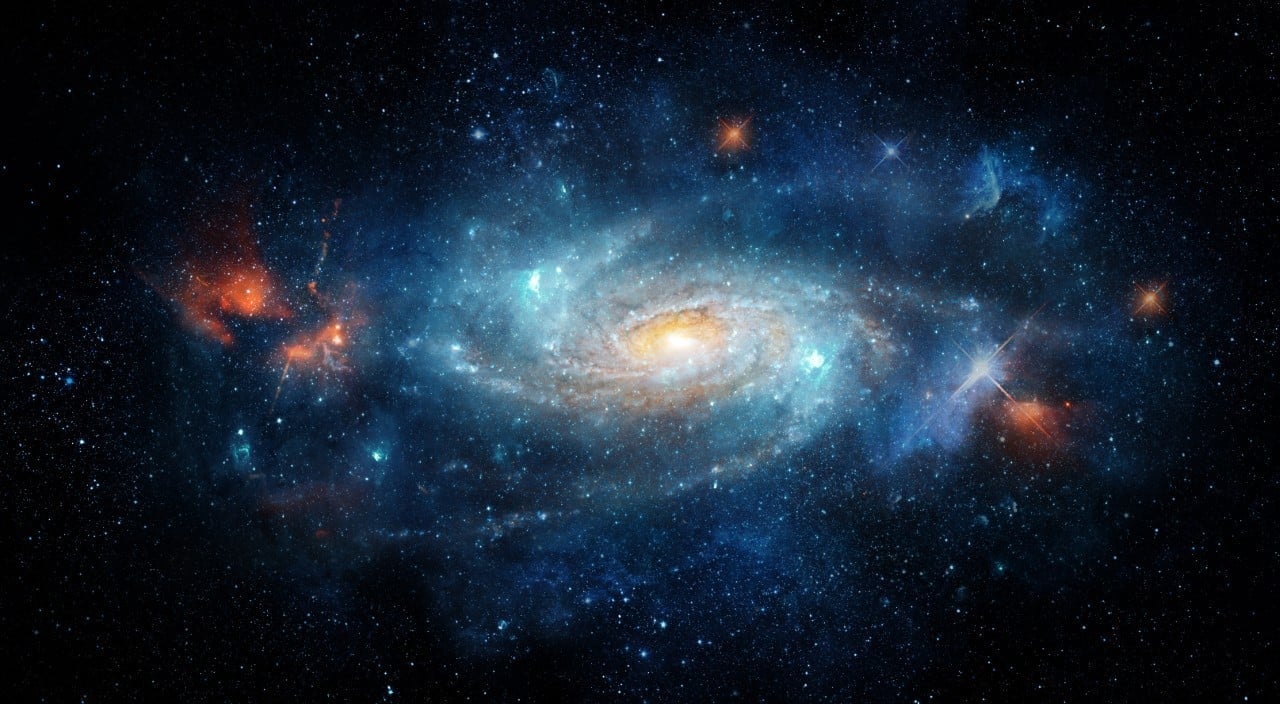
Neil deGrasse Tyson assesses the hypothesis that the universe functions as an advanced computer simulation as probable. The astrophysicist argues that progress in simulation technologies makes it possible to create virtual realities that are indistinguishable from the original. A more advanced civilization could have constructed our reality as a sophisticated program.
Physicist Melvin Vopson, from Universidade from Portsmouth, advances this discussion with a concrete scientific proposal. Ele introduced the second law of infodynamics, which describes the behavior of information entropy in systems. Diferente of the second law of thermodynamics, where physical entropy increases, informational entropy tends to remain constant or decrease to a minimum in equilibrium.
Information entropy and digital optimization
Vopson notes that information systems organize themselves efficiently over time. Essa minimization of unnecessary information suggests data compression mechanisms. A simulated universe would need to optimize computational resources to run sustainably.
The law applies to several fields, including digital, genetic and atomic physical information. Padrões observed in nature, as mathematical symmetries, reinforce the idea of computational processing underlying observable reality.
Applications in biology and cosmology
In biological systems, mutations and genetic evolution appear to follow principles of information minimization. Isso contrasts with increasing thermodynamic disorder, but balances the overall system.
In cosmology, the expansion of the universe keeps total entropy constant in certain respects. Infodynamics offers a complementary explanation for this constancy by reducing informational entropy.
Gravity as a computational process
Recent studies of Vopson suggest that gravity emerges as data optimization. The gravitational force would act to compress information and reduce computational load in the simulated system.
This view aligns with the simulation hypothesis, where physical laws serve the program’s efficiency. The attraction between masses would minimize informational redundancies.
Experiments proposed for testing
Vopson outlined experimental protocols to verify his ideas. One involves particle and antiparticle annihilation to detect information deletion signatures.
Specific results on photon frequencies could indicate which particles store bits of information. Tal discovery would strengthen the mass-energy-information equivalence.
Connection with technological advances
The rapid development of realistic simulations in computing reinforces the argument for Tyson. Advanced Civilizações would have the capacity to create simulated universes on a cosmic scale.
The combination of statistical probability and physical evidence makes the hypothesis more plausible. Pesquisas continue to explore implications across multiple scientific disciplines.
Implications for fundamental physics
The second law of infodynamics challenges traditional views by proposing information as a fundamental component. Isso integrates physics, information theory, and biology into a unified framework.
Researchers analyze how this law applies on quantum and cosmological scales. Novos experiments can confirm or refute the predictions made.
The discussion about simulation gained renewed interest with these contributions. Cientistas debate evidence and testability of the idea in academic forums.
