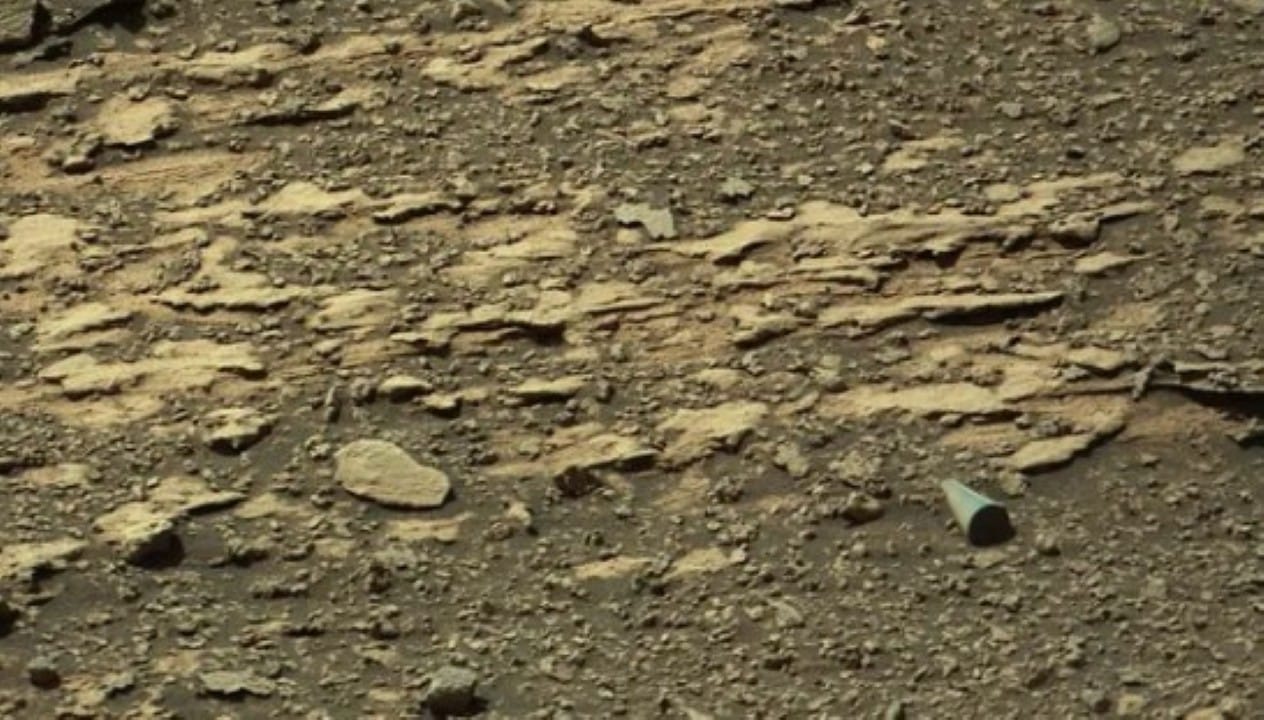
The Mastcam camera attached to the Curiosity rover recorded an intriguing anomaly that continues to move astronomy and astrophysics departments on a global scale. The equipment captured the image of a cylindrical object partially buried in the Martian soil, specifically in the region known as Passo Paraitepuy, located inside Cratera Gale. The original recording took place in August 2022, but the detailed analysis of the high-resolution images keeps the topic in the spotlight in technical discussions and forums specializing in extraterrestrial anomalies.
Independent researchers and aerospace engineering experts dedicated months to scrutinizing photographs made available in the North American space agency’s public databases. The structure features a regular geometric shape, measuring approximately 20 centimeters in length, with remarkably flat ends and a surface that reflects sunlight in an unusual way for the arid environment.
The technical data extracted from the Mars Science Laboratory mission details the following points about the photographic find:
– The artifact was officially cataloged as object 713174794 in academic planetary monitoring repositories.
– The discovery occurred on the slopes of Monte Sharp, an area characterized by rocky debris and narrow passages that are difficult to navigate.
– The exact location of the record is in a geological transition zone constantly monitored by orbital mapping teams.
This structural symmetry contrasts drastically with the natural rock formations commonly found on the Red Planet. The visual peculiarity of the item caught the attention of prominent figures in academia, raising the level of debate about the origin of the material and the need for more in-depth investigations at the site to determine its exact composition.
Physical characteristics and location on Passo Paraitepuy
The exact point where the photograph was captured requires careful maneuvering of the machinery due to the rugged topography and the presence of sharp rocks that threaten the integrity of the locomotion system. The region is rich in geological information about the planet’s wet past, containing minerals that indicate a history of liquid water and sediment accumulated over billions of years at the base of the crater’s central mountain.
The morphology of the cylinder is completely different from native geological formations, such as the so-called hematite spheres or the gypsum crystals that the equipment usually excavates in its daily routine. Wind erosion in the Martian environment has the ability to sculpt rocks into curious shapes over millennia, but the geometric precision of the item strongly suggests a process of industrial manufacturing and mechanical molding.
The clarity of images captured at multiple angles and different focal lengths eliminates the possibility of digital processing errors or optical illusions caused by low-lying evening lighting. The technical debate is divided between professionals who consider the case closed as a fragment of human engineering and those who defend the need for an in-person chemical analysis to definitively rule out any alternative hypothesis about the nature of the artifact.
Main hypothesis points to fragments of the mission itself
The explanation most accepted by the scientific community indicates that the artifact is, in fact, artificial debris originating from the human exploration systems sent from Terra. The landing process on the red planet involves complex machinery that is ejected and discarded before the main vehicle safely touches down.
It is standard aerospace engineering procedure for the aerial crane or heat shield used in the descent to leave fragments scattered for kilometers. The force of the impact of these disposable parts and the subsequent dispersion by local winds justify the presence of metal parts far from the original landing site in 2012.
The metallic-looking cylinder could be a component of the internal cabling, a mechanical seal or even a piece detached from the aluminum wheels of the exploration vehicle itself. The machinery suffers extreme wear and tear as it navigates the abrasive and dusty terrain, which often results in the loss of small structural parts over more than a decade of continuous operation.
Previous visual inspections have already documented punctures and the breaking of small pieces of metal on the robot’s wheels, highlighting the severity of the environment. Especialistas in robotics remember that similar incidents in the past, initially classified as unexplained, were later identified as plastics, cables or metals originating from the machinery’s thermal protection system.
Maneuver proposal and the robot’s logistical challenges
Renowned researchers formally suggested that the rover return to the exact point of discovery to carry out tests with its contact instruments, such as the X-ray spectrometer and the disintegration laser. Atualmente, the machinery is located approximately eight kilometers away from the crevice where the artifact was seen, a considerable distance by extraterrestrial navigation standards and which would require meticulous route planning.
Even operating at its maximum speed of 0.16 kilometers per hour, the robot would require weeks of continuous travel just to retrace the route back to Passo Paraitepuy. The North American space agency prioritizes pre-established research objectives and preserving the useful life of the equipment, avoiding route deviations that could compromise the main mission of searching for organic compounds and drilling unexplored sedimentary rocks.
Data transparency and the role of the independent community
Open access to the repositories of government institutions and jet propulsion laboratories allows citizen science to work together with official agencies in cataloging Martian soil. The identification of this cylinder by external researchers demonstrates the effectiveness of open data policies maintained for long-duration interplanetary missions. Quando visual anomalies are publicly debated, the global scientific community can apply different analysis methodologies to reach an informed consensus on the material. The rigorous data acquisition process ensures that independent analysts have access to these details even before they are processed for general release portals, strengthening the credibility of discoveries and international collaboration in solar system exploration.
The accumulation of artificial materials on the Martian surface
The glowing object has become a point of technical interest that illustrates the difficulty of maintaining planetary purity during ongoing space exploration. As more robotic equipment is sent into space, the presence of debris manufactured on Terra becomes a constant variable that alters the natural landscape of craters and plains.
Planetary geologists need to learn to catalog and differentiate these synthetic materials from original geological discoveries to avoid false positives in chemical tests. The discussion around the cylindrical artifact reinforces the commitment to the direct search for answers and the rigorous application of planetary protection protocols established by international committees.
Visual analysis and failure prevention protocols
Accurately identifying each component that detaches helps flight engineers design stronger machinery for next-generation missions. Telemetry data from the equipment shows remarkable resilience, but daily exposure to extreme temperature variations and fine dust affects all exposed instruments. Continuous monitoring of these missing parts provides vital information for developing more efficient protective technologies, setting the stage for advanced surface exploration programs and establishing secure bases for the arrival of human crews in the future of space exploration.
