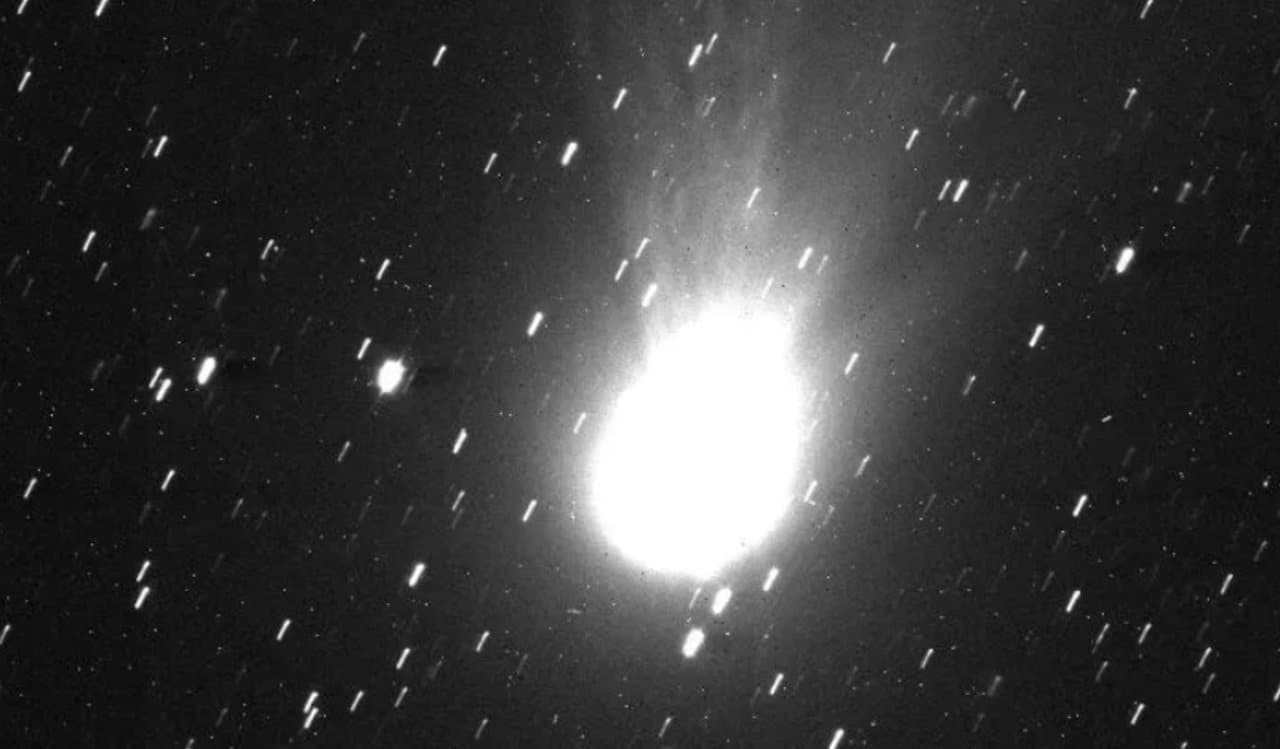
A space exploration plan proposes sending a probe to reach the 3I/ATLAS object, a celestial body originating from another star system that crosses our cosmic neighborhood. The space rock travels at a speed of more than 60 kilometers per second, rapidly moving away from the central region of the solar system.
The window of opportunity for an immediate interception has already closed due to the extreme speed of the object and its exit trajectory. The astronomical community is now working on a long-term alternative to collect direct data on this rare interstellar visitor.
The project requires the development of a mission that will span several decades, combining specific planetary alignments and complex gravitational maneuvers. The main objective is to analyze the composition of an intact fragment formed in a distant planetary environment.
Origin and speed of the cosmic visitor
The celestial body 3I/ATLAS differs from traditional asteroids and comets in that it did not form in the orbit of Sol. Ele acts as a messenger from another region of the galaxy, making only a temporary passage through our system before returning to deep space.
The initial identification occurred when the object had already crossed the orbit of Júpiter, revealing its impressive displacement rate. The speed of 60 kilometers per second made it impossible to organize an interception expedition with the standard propulsion technology available at short notice.
The time required to design, build and launch a conventional spacecraft exceeded the period in which the comet remained accessible. Essa limitation forced researchers to discard traditional space exploration approaches for this specific target.
The formulated alternative is based on a prolonged chase, accepting that the encounter will occur far beyond the known borders of the solar system. The strategy requires detailed planning to compensate for the increasing distance between the Terra and the target.
Launch strategy scheduled for the next decade
The execution of the mission depends on a rare astronomical alignment that will occur in the year 2035. During a specific period, the relative position of Terra, Júpiter and Sol will create the ideal gravitational conditions to propel a spacecraft in the correct direction.
Choosing this date optimizes fuel consumption and maximizes the efficiency of the initial trajectory. The launch will take advantage of the planetary configuration to begin a journey that will require maximum performance from navigation and propulsion systems.
Deep space rendezvous projection
Orbital calculations indicate that the space probe would reach comet 3I/ATLAS only around the year 2085. Esta projection establishes a flight time of half a century, configuring one of the most extensive missions ever proposed in the history of space exploration.
At the time of interception, the object will be located at an approximate distance of 732 astronomical units from Sol. The Esta mark represents a distance four times greater than the path taken by the Voyager 1 probe during its almost five decades of continuous operation.
Communication and data transmission from this cosmic depth will require very high sensitivity antennas on Terra. The spacecraft will need to operate autonomously for most of the journey, activating its scientific instruments only in the final approach phase.
Execution of the orbital acceleration maneuver
The success of the chase is based on the application of a physics principle known as the Oberth effect, which uses stellar gravity to multiply the speed of a space vehicle. The probe will be directed towards an extreme dive towards Sol, activating its main engines exactly at the point of closest approach, called perihelion. The burning of fuel in this zone of extremely high gravitational attraction converts orbital energy into a massive kinetic impulse, functioning as a catapult that launches the ship towards the ends of the solar system with a force unattainable by conventional rockets.
The effectiveness of this technique depends on absolute precision when activating the thrusters. If the maneuver generates a speed variation of 10.36 kilometers per second during perihelion, the travel time to the comet can be reduced to around 30 years. Caso the impulse reaches slightly lower values, in the range of 8.36 kilometers per second, the chase will last for the full period of 50 years. Modern engineering has already demonstrated similar capabilities in previous missions, proving that the orbital mechanics required for this speed jump are theoretically feasible and executable.
Thermal protection against extreme temperatures
The need to perform the acceleration maneuver at a distance of just 3.2 solar radii from the center of the star poses the biggest technical obstacle of the entire mission. Nesta zone of extreme proximity, the spacecraft will face an environment of radiation and heat far superior to that supported by any previous human artifact. Temperatures will easily surpass the 1,300 degree mark The structural integrity of this shield is the determining factor for the probe’s survival; any millimeter failure would result in the instantaneous vaporization of scientific instruments and communication systems. The thermal defense architecture will need to completely envelop the ship’s core during the solar dive, opening only after safe separation to allow components to cool and navigation panels to power up for the long journey in dark, freezing space.
Engineering and propulsion architecture
The probe’s design foresees a total mass of 500 kilograms, optimized to carry only the essential spectrometry and imaging instruments. The flight plan includes a preliminary flyby of Júpiter to align the trajectory before the solar dip, using super-heavy payload launch vehicles to place the equipment on the correct initial route.
Search for new celestial bodies in the galaxy
The complexity of this prolonged pursuit raises discussions about the feasibility of waiting for the discovery of more accessible targets. The activation of new continuous-scan astronomical observation complexes will dramatically increase the detection rate of interstellar rocks in the coming years.
Early identification of a new visitor would allow shorter, less extreme interception missions to be launched. Independentemente of the adopted strategy, the direct study of material formed in other stellar systems remains one of the most valuable objectives of contemporary astrophysics.
