
The celestial body classified as 3I/ATLAS advances on its hyperbolic trajectory through space and reaches a crucial point in its journey in the coming weeks. The object travels at an impressive speed of 58 kilometers per second, which makes any permanent gravitational connection with our central star impossible. The closest approach to the largest planet in our system marks a rare event for contemporary astronomical observation.
The initial discovery occurred through monitoring systems installed on Chile, adding the object to the select list of external visitors already documented by science. Trata is the third body with this classification confirmed, succeeding the famous 1I/’Oumuamua and 2I/Borisov, which redefined the parameters for studying the formation of other stellar systems. The global scientific community mobilizes various terrestrial and space equipment to record each phase of this transit.
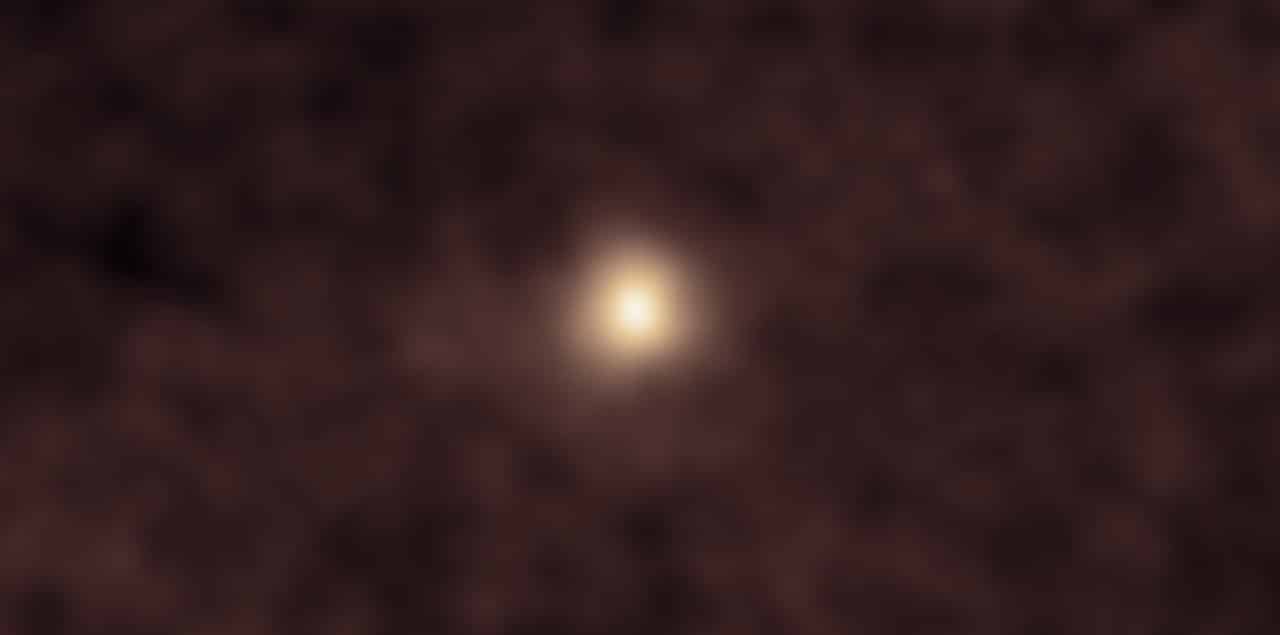
The most recent calculations indicate that the peak of this interaction will occur in mid-March, when the celestial body will cross a specific gravitational boundary. Nesse moment, the forces exerted by the gas giant will overcome the solar attraction, causing measurable changes in the visitor’s route before he resumes his journey towards deep space.
Orbital dynamics and the influence of the gas giant
The celestial body’s passage takes place very close to the so-called Hill radius, a spherical region around a planet where its own gravity dominates the attraction of other larger bodies, such as Sol. The estimated limit for this specific zone is approximately 0.355 astronomical units.
Mathematical simulations developed by experts demonstrate that the minimum distance between the visitor and the planet will be 0.358 astronomical units. Essa extreme proximity turns the event into the most significant planetary disturbance of the object’s entire passage through our system. The resulting deviation, although subtle in absolute terms, definitively alters the celestial body’s exit coordinates towards the interstellar medium.
Direct interaction with a gravitational field of such magnitude offers an unprecedented opportunity to test and refine current physical models of celestial mechanics. Quando a hyperbolic object crosses the zone of influence of a gas giant, an exchange of orbital energy occurs that can accelerate or decelerate the smaller body, depending on the angle of approach. Data collected during this observation window will serve as the basis for future projections involving errant bodies that eventually cross our cosmic neighborhood, allowing researchers to better understand how massive planets act as natural gravitational shields or slingshots.
Advanced monitoring by space telescopes
High-resolution equipment, such as the Hubble and James Webb telescopes, were used to capture structural details of the nucleus during the moments of closest approach to Terra. The images revealed intense activity, with the formation of a bright coma and a very pronounced dust tail.
The JUICE probe, operated by the European space agency, also recorded the phenomenon using its JANUS navigation camera. The records confirmed the active nature of the celestial body, which expelled large amounts of volatile material shortly after reaching the point of closest proximity to Sol.
Data captured by the Juno mission in orbit
The presence of the Juno probe, which has been orbiting the gas giant since 2016, creates an ideal scenario for monitoring the gravitational interaction. Instruments onboard the spacecraft are programmed to take precise measurements during the critical approach window.
The probe’s proximity to the event allows the collection of information about variations in the magnetic field and possible interactions with the local plasma. The teams responsible for the mission are awaiting the sending of data packages to begin cross-referencing with observations made from the Earth’s surface.
Galactic origin and chemical composition of the nucleus
Spectroscopic analyzes indicate that the object formed in the thick disk of Via Láctea, a region characterized by the presence of older stars. The Essa area has movement dynamics quite different from the thin disk, where our solar system is positioned.
The chemical signature detected in the celestial body’s coma works as a fossil record of stellar environments located thousands of light years away. The identified elements help to map the distribution of primordial materials in other regions of the galaxy.
Models of stellar evolution suggest that the object was ejected from its original system billions of years ago, and has been wandering in the interstellar void ever since. The lack of severe wear on its surface indicates that it spent most of this time away from intense sources of radiation or heat.
Thermal effects and the release of gases at perihelion
The extreme heating suffered by the celestial body during its passage through perihelion generated non-gravitational phenomena that impacted its trajectory. The rapid sublimation of surface ices created jets of gas that acted as small natural propellants.
These jets applied a continuous but irregular force to the rotating nucleus, causing microaccelerations that were difficult to predict using the laws of classical gravity alone. The pressure exerted by solar radiation on the ejected dust particles also contributed to moving the material away from the star.
The combination of these thermal factors requires astronomers to constantly update the object’s ephemeris. Qualquer Error in calculating the strength of these jets can result in significant discrepancies in the long-term route projection.
The impending gravitational perturbation will need to be calculated taking this residual acceleration into account. The dynamic behavior of the active core adds a layer of complexity to the mathematical simulations performed by supercomputers.
Hyperbolic trajectory and escape velocity
The recorded speed of 58 kilometers per second far exceeds the threshold needed to escape the gravitational pull of Sol, mathematically confirming that the object does not belong in the Oort cloud or any other local comet reservoir. The eccentricity of its orbit is one of the highest values ever measured in celestial bodies, which attests to its external origin and its status as a mere passerby in our system.
Before approaching the gas giant, the celestial body had already suffered small influences when crossing the orbit of Marte, although the effects were marginal. The current planetary interaction is the last major dynamic obstacle before the visitor begins his definitive journey towards deep space, without any possibility of returning to our cosmic neighborhood.
Scientific relevance for understanding Via Láctea
The passage of interstellar bodies through our system offers a rare opportunity to directly sample materials formed under physical and chemical conditions completely different from those that gave rise to Terra and neighboring planets. Detailed study of the isotope ratio and molecular structure of the released gases allows researchers to test theories about nucleosynthesis in different eras of galactic evolution. Além Furthermore, the frequency with which these objects are detected helps estimate the population density of wandering bodies in Via Láctea, providing crucial data for calculating the invisible mass distributed among stars. The continuous improvement of night sky scanning systems ensures that events of this nature, previously considered undetectable anomalies, become part of the regular catalog of astronomical phenomena monitored by the world’s main space agencies.
Definitive route towards the constellation of Gêmeos
After overcoming the planetary influence zone, the celestial body will follow a straight trajectory projected towards the constellation of Gêmeos. Observations will continue until the object’s brightness decreases beyond the detection capability of the most sensitive instruments currently available.
