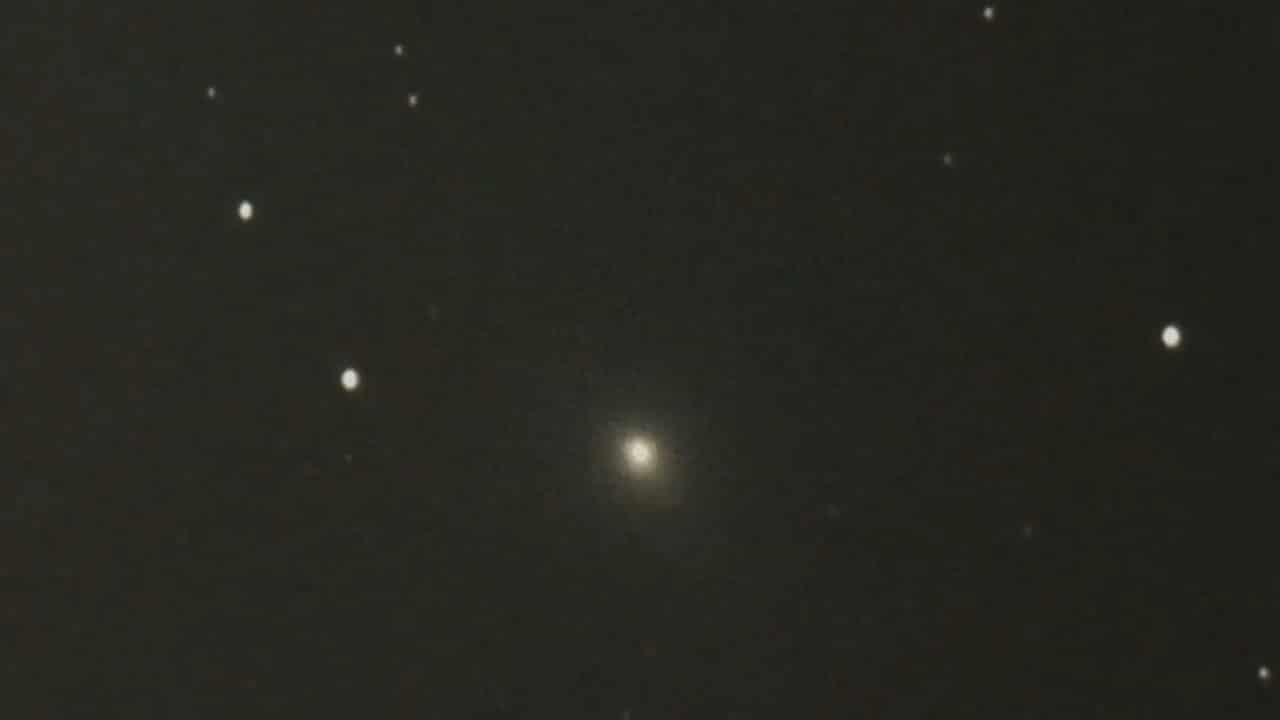
The celestial body classified as 3I/ATLAS, the third interstellar visitor confirmed to cross our cosmic neighborhood, presents a continuous and accelerated reduction in its luminosity as it definitively moves away from Sistema Solar. Descoberto initially in July last year via the asteroid warning system on Chile, the object recently completed a complex hyperbolic trajectory, which included a very close pass to the planet Júpiter in mid-March. Atualmente, global astronomical research centers monitor the comet’s distance, which leaves behind a trail of questions due to a set of twenty-two physical and orbital characteristics considered highly unusual by experts. The observed non-gravitational acceleration, driven by a system of gas and dust jets, turned this event into one of the most debated in the contemporary scientific community, requiring the mobilization of several terrestrial and space observatories to collect data before the object completely disappears from the reach of optical instruments.
Orbital trajectory and approach to gaseous planets
The comet’s flight dynamics caught the attention of astronomers since the first orbital calculations released by space agencies. The object traced a retrograde route, moving in the opposite direction to the rotation of most bodies in our system, with almost perfect symmetry relative to its entry point. Essa orbital feature required constant monitoring to accurately predict its next movements and ensure the correct pointing of the telescopes.
During its outbound journey, the approach to Júpiter represented a crucial moment for the collection of high-precision telemetry data. The comet passed at a distance of approximately 53.6 million kilometers from the gas giant, a value that touches the limit of the planet’s so-called Hill radius, the region where Jovian gravity dominates the attraction of satellites and smaller bodies. Essa gravitational interaction caused a slight but measurable change in the interstellar visitor’s acceleration.
Before this planetary encounter, the celestial body reached its perihelion, the point of closest proximity to Sol, at a distance of 1.4 astronomical units. During this specific period, the instruments recorded a significant increase in the comet’s brightness, driven by solar heating that intensely activated the sublimation of materials on its surface. The position of Terra at that time, however, prevented continuous direct observation, limiting imaging in specific spectra during peak thermal activity.
Chemical composition and detection of organic molecules
Spectrographic analyzes carried out by high-resolution telescopes, such as the Hubble and the SPHEREx infrared observatory, revealed a chemical signature that differs considerably from comets formed in Nuvem of Oort or in Cinturão of Kuiper. The gaseous plume ejected before perihelion demonstrated a concentration of nickel higher than that of iron, with a ratio between nickel and cyanide that exceeds known standards in our stellar neighborhood by several orders of magnitude. Além In addition, after the solar contour, sensors detected water production twenty times greater than initial estimates, accompanied by the release of complex organic molecules, including methanol, formaldehyde, methane and ethane, indicating a rich and preserved internal chemistry.
Another factor that intrigues researchers is the sudden disappearance of the ice signature shortly after passing through the hottest point in the orbit. Esse phenomenon suggests that volatile materials were confined in deep layers of the core, protected from cosmic radiation for billions of years during their journey through interstellar space. Measurements of the isotopic abundances of hydrogen and carbon also confirm an exotic origin, pointing to the formation of the comet in a stellar environment with a very low temperature, lower than 30
Unusual geometry and anti-tail alignment
The probability of random occurrence of the geometric characteristics of 3I/ATLAS is considered statistically remote by current mathematical models. The comet’s retrograde orbit aligned within less than five degrees with the orbital plane of the Sistema Solar planets.
The exact moment of its arrival also appears to have minimized the distances relative to Marte and Júpiter, facilitating sequential gravitational interactions. The nucleus’ initial rotation axis showed an alignment of less than eight degrees with the solar direction at the entrance of the system.
One of the most visual anomalies was the formation of an anti-tail before perihelion, which exhibited direct collimation towards Sol. Essa dust structure extended hundreds of thousands of kilometers into space, a behavior unprecedented in the documented astronomical literature.
Earlier this year, orbital geometry provided a unique observational event for research centers. The object aligned with the axis between Sol and Terra with a variation of just 0.69 degrees, which directed the anti-tail almost perfectly into the line of sight of ground-based telescopes, allowing high-fidelity images of the jet structure to be captured.
Jet dynamics and polarization of light
Activity on the comet’s surface revealed a highly structured and unusual emission system. Advanced processing of images captured by the space telescope demonstrated the existence of three mini-jets of ejected material, separated symmetrically by angles of 120 degrees. Curiosamente, the bases of these jets only became active when facing directly towards solar radiation, remaining inactive on the night side of the nucleus during months of continuous observation, which indicates an immediate and highly localized thermal response in the object’s crust.
The interaction of this material with the space environment generated peculiar optical data that is still under analysis. The anti-tail was able to penetrate the solar wind over extensive distances, which indicates the presence of significantly larger and denser dust particles than usual to explain the observed scattering of light. Adicionalmente, the instruments recorded an extreme negative polarization of the reflected light and a bluer color than sunlight itself, characteristics without parallels recorded in astronomical catalogs of local comets or previous visitors.
Differences from previous interstellar visitors
The history of confirmed interstellar objects includes asteroid 1I/’Oumuamua and comet 2I/Borisov, but 3I/ATLAS establishes a new paradigm of physical and behavioral complexity. In direct comparison to its predecessors, this third visitor has a substantially more massive core and travels at a considerably greater escape velocity relative to the gravitational pull of Sol. Enquanto ‘Oumuamua crossed the system quickly and without developing a visible coma or dust tail, and Borisov showed chemical behavior that closely resembled the local comets of Nuvem and Oort, ATLAS combines extremely pronounced cometary activity with perfectly symmetrical jets and a composition rich in heavy metals and organic compounds. The compilation of data from multiple missions, which ranged from the TESS satellite to navigation cameras from interplanetary probes in operation, such as the Juice and the Mars Reconnaissance Orbiter, formed a robust database that highlights how this celestial body challenges conventional models of planetary formation in other star systems, requiring a reevaluation of theories about the ejection of matter in binary systems or low-mass stars.
Continuing investigations into the origin of the celestial body
The comet’s current distance and consequent loss of brightness severely limit the ability of observatories to perform new direct imaging or spectroscopy. However, the discrepancy in the parental mass budget, which exceeds the expected reservoirs in protoplanetary disks of low-metallicity stars, requires immediate revisions to prevailing astrophysical theories. Researchers are now dedicating their efforts to processing the vast volume of data accumulated over the last few months, seeking to determine whether natural and extreme physical processes in interstellar environments can explain the totality of recorded anomalies, or whether the persistence of activity at great distances demands the formulation of new hypotheses about the nature and structural composition of these rare deep space travelers that cross our system.
