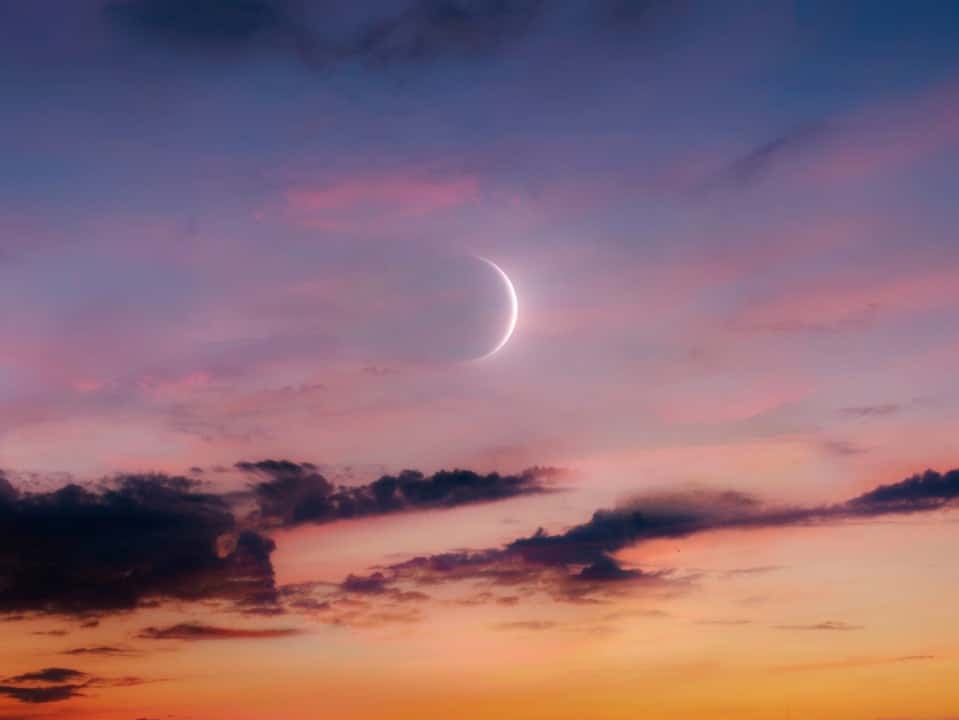
The March 2026 new moon occurs on March 18 and provides dark skies ideal for astronomical observation. The phenomenon eliminates lunar interference and allows bright planets and constellations to stand out clearly. Observadores in places with low light pollution can identify deep-sky objects that are normally hidden.
Venus appears just after sunset on the western horizon. The planet shines brightly and disappears about 90 minutes later. Júpiter appears as the brightest object in the southern night sky, close to the stars Castor and Pólux of the constellation Gêmeos.
- Venus requires unobstructed view to the west
- Jupiter dominates the sky at dusk
- Uranus requires telescope near Aldebaran
Planets visible during the lunar phase
The planets offer varied observation opportunities during this period. Vênus remains visible for a short time after dusk. Júpiter remains accessible throughout much of the night and makes it easy to use binoculars or small telescopes for details.
Uranus is positioned in the constellation Touro. The planet is faint for direct viewing, but a 200-millimeter instrument reveals its blue-green disk about five degrees below and to the right of Aldebaran, near Plêiades. Mercúrio appears low on the eastern horizon before dawn at the end of the month.
Mars and Netuno remain close to the sun and difficult to locate. The absence of the moon favors the detection of these celestial bodies in suitable dark conditions. Observadores should avoid pointing equipment at the rising sun to prevent permanent damage to vision.
Constellations and asterisms in the March sky
The stars of Hexágono and Inverno dominate the southwestern horizon in the hours following sunset. Sirius in the constellation Cão Maior rises above the southern horizon at dusk. Rigel, the blue supergiant in Órion, appears to the right and above Sirius.
Aldebaran marks Touro’s eye and stands out in the sequence. Capela shines high in the constellation of Auriga. Pollux, in the head of one of Gêmeos’s twins, is next to Júpiter. Procyon completes the asterism between Pollux and Sirius in the constellation Cão Menor.
These stars form a broad pattern that remains visible into early spring. Hexágono defies the seasonal transition and offers clear reference points for those beginning observation. The new moon increases the visibility of these objects without light interference.
Star clusters and deep-sky objects
Moonless nights highlight open clusters in the spring sky. As Híades form a “V” that extends from Aldebaran in the constellation of Touro. Esse group represents the face of the celestial bull and appears as diffused light to the naked eye in dark places.
The Plêiades appear about 15 degrees to the right of the Híades. The cluster known as Sete Irmãs reveals its main stars with 10×50 binoculars. A small telescope shows dozens of additional components among the thousands that make up the group.
Aglomerado of Colmeia, or M44, occupies the core of the Câncer constellation. Localizado to the left of Castor and Pólux, the cluster of about 100 stars appears as a hazy patch in moonless skies. Spring also opens windows to distant galaxies in constellations that come to prominence at this time.
Zodiacal light gains prominence at the end of the month
The zodiacal light appears as a pale column extending from the western horizon in the hours after sunset. The phenomenon results from the reflection of sunlight in interplanetary dust along the ecliptic. Peak visibility occurs between March 10 and 25 in places with dark skies.
Observers in the Northern Hemisphere and parts of the South can record the soft triangular glow when atmospheric conditions cooperate. The new moon intensifies the contrast and makes this faint light easier to detect. The upcoming equinox reinforces the presence of the phenomenon by aligning the plane of the solar system.
Tips for Safe and Effective Observation
Choose locations away from cities to reduce light pollution. Aguarde at least 20 minutes for the eyes to adapt to darkness before starting to search for diffuse objects. Use applications or star maps to confirm positions of planets and asterisms.
Binoculars or telescopes magnify details in clusters and planets. Júpiter reveals atmospheric bands and Galilean moons on modest instruments. Vênus shows phases in a telescope, but requires care with the time to avoid residual solar glare.
The new moon phase extends until the return of the waxing moon around March 25th. Esse range offers the best opportunity to explore the March night sky without interference. Planeje sessions on clear nights to maximize the use of available celestial events.
Transitional constellations in the spring sky
Winter constellations still hold out at the start of the season while spring galaxies begin to appear. Órion and Touro lose height in the west over the weeks. Câncer and Gêmeos maintain favorable positions for night observation.
The Hexágono of Inverno serves as an initial guide for those observing without advanced equipment. Bright stars form visual connections that help with celestial navigation. The absence of a moon allows fainter objects, such as nebulae and galaxies, to gain visibility.
Amateur astronomers record these patterns annually during the new moon. The combination of bright planets and ancient clusters creates a spectacle accessible to different levels of experience. Zodiacal light adds a unique element to the end of the month.
Preparation for observation sessions
Check weather forecasts for clear nights. Leve clothing suitable for nighttime temperatures and insect protection in open areas. Registre observations with notes or simple photographs to compare future sessions.
Basic equipment such as 10×50 binoculars already reveals significant details in the clusters. Larger Telescópios make it easier to see Urano and galactic structures. The new moon in March 2026 represents one of the best windows of the month for those looking to immerse themselves in the night sky.
Regional variations in visibility
Locations near the equator and in mid-latitudes record Hexágono of Inverno with good elevation. In the southern hemisphere, the asterism appears inverted, but maintains the same main stars. Zodiacal light demands an unobstructed western horizon in any region.
Jupiter and Vênus maintain similar positions in different time zones, although local times vary. Mercúrio appears before dawn in late March in many locations. The combination of these elements creates global opportunities for keen observers.
The current lunar phase only lasts a few days before the crescent intervenes again. Aproveite the period to explore planets, stars and diffuse phenomena. The March 2026 sky offers a balance between easy objects and challenges that reward patience and proper equipment.
