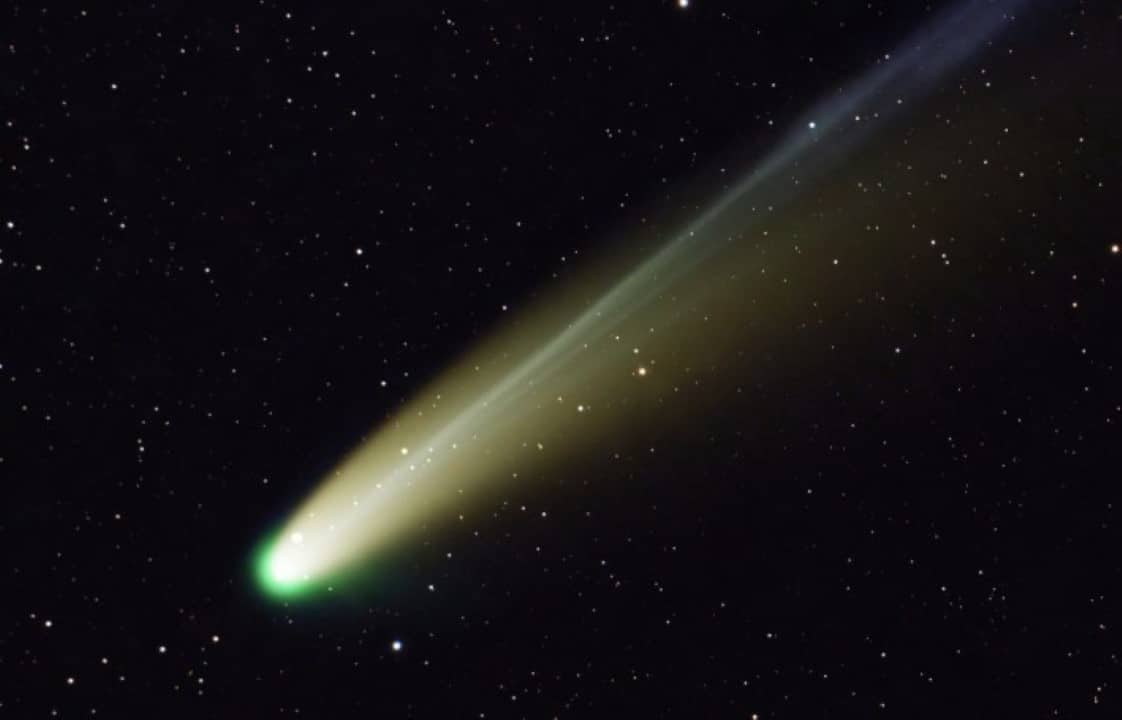
Comet C/2025 A6 (Lemmon) remains visible in the night sky after its closest approach to Terra on October 21, 2025, when it passed approximately 89 million kilometers from the planet. The phenomenon, discovered in January this year by Mount Lemmon Survey, in Arizona, Estados Unidos, reached sufficient brightness for observation with the naked eye in ideal dark sky conditions. Astrônomos indicate that the comet displays a characteristic greenish color due to the release of gases such as cyanogen and carbon dioxide as it approaches Sol. Visibility persists over the following days, although the brightness gradually decreases as the object moves away.
Comet C/2025 R2 (Swan) was also present in the sky during the same period, with its closest approach occurring on October 20. Descoberto in September by a Ukrainian amateur astronomer in images from the SWAN instrument on board the SOHO satellite, the comet showed a developed tail and notable brightness shortly after its detection. Diferentemente of Lemmon, Swan proved fainter to casual observers, requiring binoculars or telescopes in many locations.
Both comets are classified as long-period, with elongated elliptical orbits that take them to extreme distances of Sol. Lemmon should only return after around 1,300 years, while Swan is estimated to last between 650 and 700 years. Esses celestial objects originate from Nuvem of Oort, a region distant from Sistema Solar composed of ice and rock, and their current passage represents a rare opportunity for observation.
Discovery and characteristics of comet Lemmon
Comet C/2025 A6 (Lemmon) was initially identified as an asteroidal object on January 3, 2025. Later Imagens revealed a condensed coma and a short tail, confirming its cometary nature. Perihelion occurred on November 8, 2025, at 0.53 astronomical units from Sol.
The maximum brightness occurred close to Earth’s approach, with apparent magnitude varying between 3.5 and 4.4 in observer reports. The green color results from the fluorescence of molecules released by the heated nucleus.
The comet maintained an extensive ionic tail visible in photographs, reaching up to 12 degrees in length by mid-October. Observações indicate that the object moved through the constellation of Ursa Maior before crossing the celestial equator.

Tips for Optimal Observation
Comet watching benefits from dark skies, away from urban light pollution. Especialistas recommend going out to rural areas or suburbs, where the night sky allows your eyes to better adapt to the darkness after a few minutes.
Common binoculars serve as an initial tool for locating the comet, revealing details of the coma and traces of the tail. Aplicativos of astronomy for smartphones helps identify the exact position in the sky.
Telescopes that are portable or available at libraries and universities facilitate more detailed observations. The ideal time to search is in the early evening or before dawn, depending on the comet’s current position.
Comparison between comets Lemmon and Swan
Comet Lemmon stood out as the brighter of the two during October, making it easier to detect with the naked eye in places with low light interference. Já o Swan, despite being closer to Terra, presented lower brightness and required optimal conditions or equipment for clear viewing.
Both exhibited a typical greenish color, but Lemmon maintained greater prolonged visibility after perihelion. Swan, in turn, showed a prominent tail shortly after discovery, but quickly weakened.
The simultaneity of the passages generated global interest among amateur and professional astronomers. Observações coordinates contributed to accurate data on cometary orbits and activity.
Other celestial phenomena in October
The Orionídeos meteor shower, associated with Cometa Halley, remained active until early November. The event provided up to 20 meteors per hour in ideal conditions, complementing the observation of comets.
Superlua of Castor, scheduled for November 5th, marked another highlight in the astronomical calendar. The Esse phenomenon occurs when the Lua reaches perigee close to the full phase, appearing larger and brighter in the sky.
October concentrated multiple celestial events, including the presence of comets and meteors, offering varied opportunities for astronomy enthusiasts.
Current visibility and final recommendations
Comet Lemmon remains observable in the Northern Hemisphere during the nights of late October, although with decreasing brightness. Observadores should prioritize times with clear skies and no lunar interference.
Simple equipment such as binoculars or amateur telescopes allow you to capture detailed images. Patience for eye adaptation improves the viewing experience.
The spectacle reinforces the importance of monitoring the night sky regularly. Eventos like these highlight the dynamics of Sistema Solar and encourage interest in astronomy.
