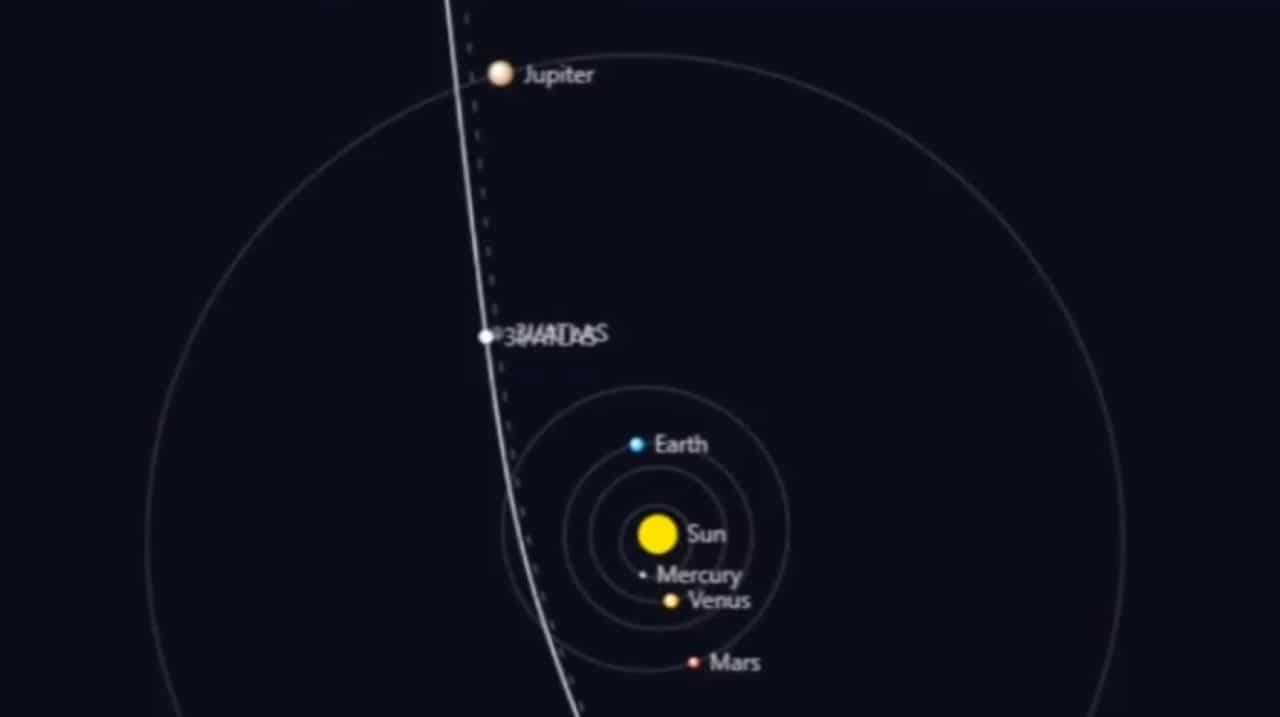
The interstellar celestial body identified as 3I/Atlas recently reached its point of closest approach to Sol, an event that triggered intense physical reactions on its surface. The closest approach caused the rupture of a thick outer layer that had long sealed the object’s core. Essa structural degradation has allowed ground- and space-based observatories to record the eruption of volatile compounds, kept frozen and protected from degradation in the deep vacuum of space. Análises immediate spectroscopic tests confirmed the presence of elements fundamental to organic chemistry, ejected in high-speed directional jets.
The astronomical phenomenon gains relevance due to the estimated age of the celestial body, which carries unchanged materials from a time before the formation of our planetary neighborhood. Detectado Initially using a tracking system on the Chile, the object traveled through deep space until it crossed the inner region of our planetary system.
🚨SARKLI UZAYLI KUYRUKLUYUZLU ☄️
Yıldızlararası kuyruklu yıldız 3I/ATLAS’ı araştıran bilim insanları onun “alkolle dolu” olduğunu söylüyor.
⚠️Atacama aktığını tespit etti…pic.twitter.com/CcXfXA8URS
— 3I/ATLAS güncellemeleri (@Defence12543)13 Mart 2026
Ancestral origin in Via Láctea
Astrometric calculations based on the hyperbolic trajectory of 3I/Atlas indicate that its estimated age varies between ten and twelve billion years. Essa dating places the origin of the object in a primordial phase of the galaxy, long before the condensation of the molecular cloud that gave rise to Sol and the local planets. The traced source points to the thick galactic disk, a vast region characterized by the presence of old stars and significantly lower metallicity.
The materials preserved inside the cometary nucleus function as a chemical time capsule, offering direct samples of the environmental conditions of this remote era. The thermal insulation provided by the interstellar medium ensured that the original molecules did not undergo significant changes through sublimation throughout their journey.
Dynamics of rupture and gas emission
The surface of the celestial body has developed a hardened crust approximately twenty meters thick, the result of the continuous bombardment of galactic cosmic rays during their transit through the interstellar medium. Long exposure to high-energy radiation altered the molecular structure of the outermost layers, creating a dense natural polymer that acted as a highly effective thermal barrier against mass loss.
The collapse of this protective structure occurred only after months of gradual solar warming, when the temperature difference between the surface and interior surpassed the cohesive strength of the changing ice. The rupture resulted in an explosive and asymmetric release of material, generating a non-gravitational acceleration that subtly altered the body’s orbital parameters.
Chemical signatures and detected elements
The fragmentation of the crust has exposed anomalous concentrations of methanol, which exceed the average levels documented on native celestial bodies by up to four times. Observações at millimeter wavelengths confirmed that the emission of this alcohol occurred in specific peaks, synchronized with the rotation of the nucleus and the exposure of the fissures to solar heat.
Spectrometers also identified the presence of hydrocyanic acid, water, carbonyl sulfide and several allotropic forms of carbon, in addition to methanol. The simultaneous detection of these elements reinforces the thesis that complex chemical reactions can occur on the surface of dust grains in cold molecular clouds. Traços of ionized nickel were also detected in the inner coma, adding a rare inorganic component to the emission profile.
Gravitational interaction with Júpiter
The object’s route included a strategic pass in the vicinity of Júpiter on March 16, 2026, reaching a minimum distance of zero point three hundred and fifty-eight astronomical units from the gas giant. The celestial body quickly crossed the planet’s Hill sphere and suffered tidal forces that, although measurable, were not enough to cause the disintegration of the main core.
The gravity of Júpiter caused millimetric deviations in the hyperbolic trajectory, insufficient to capture the visitor in a closed orbit. The speed maintained at sixty-eight kilometers per second in relation to the Sol provided the kinetic energy necessary for the definitive escape route towards the limits of the planetary system.
Global monitoring and escape route
The observation campaign mobilized unprecedented global and space infrastructure to record each phase of the comet’s activity during closest approach. The James Webb space telescope used its mid-infrared instruments to map the thermal distribution of ejected dust, while the ALMA observatory focused on detecting the rotational transitions of cold gas molecules in the outer coma.
Simultaneously, the instrumented telescope of the Juice mission, en route to the Jovian system, was calibrated to capture the ultraviolet spectrum of the event. Escapando of the gravitational influence of the giant planets, the celestial body now follows a straight trajectory towards the limits of the heliosphere, returning to its original dormant state for another long journey towards the interstellar void.
…
