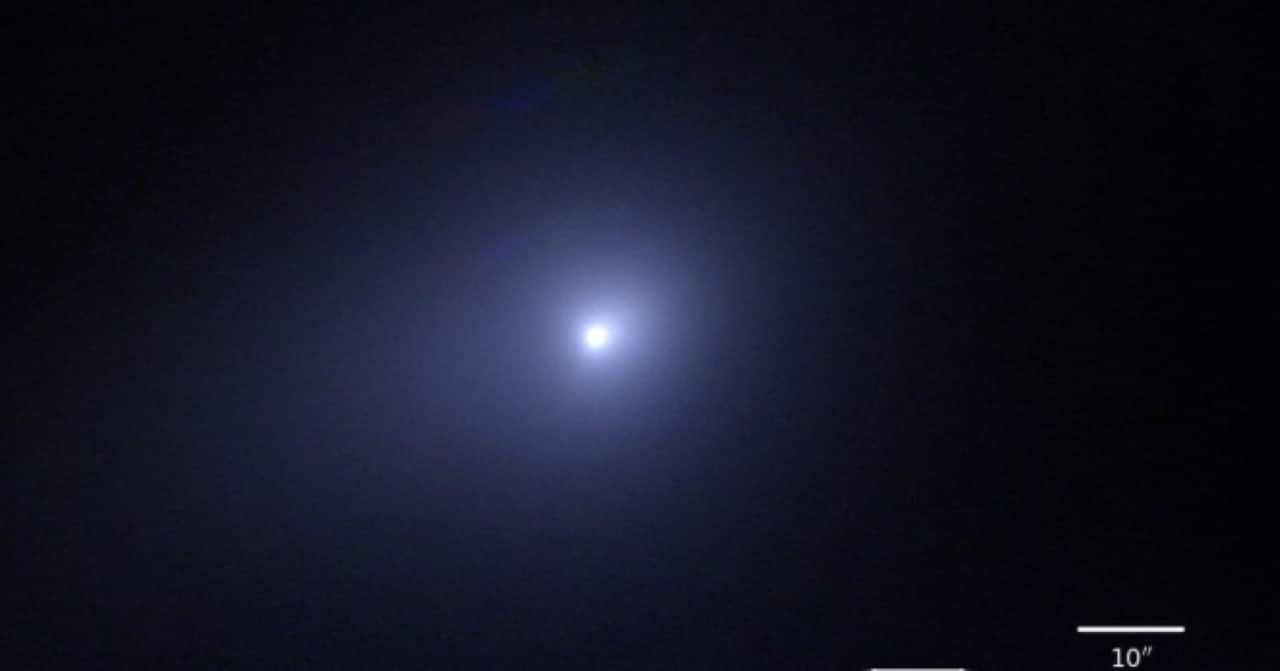
Recent data captured by the space observatory revealed an unusual concentration of deuterium in the emissions of molecules coming from the interstellar object 3I/ATLAS. The discovery points to proportions of this isotope in relation to hydrogen that far exceed the values recorded in comets in the solar system. The celestial body quickly passed through the inner region of our cosmic neighborhood, allowing detailed spectroscopic observations of its chemical composition before continuing its trajectory into deep space.
The analyzes focused mainly on the methane and water emissions released by the interstellar visitor during its closest approach to Sol. Deuterium acts as a fundamental chemical tracer for understanding temperature and density conditions at planetary formation sites. The abundant presence of this element suggests that the celestial body originated in an extremely cold and ancient environment, providing unprecedented data on the primordial chemistry of the universe.

Researchers identified unique chemical characteristics during the celestial body’s passage through our system. Entre the main discoveries recorded by high-precision instruments highlight determining factors for the continuity of astrophysical research.
– Detecção of deuterated organic molecules using near-infrared spectroscopic data.
– Medições of water with significantly higher isotopic enrichment orders than known comets.
– Assinaturas which indicate a formation in a metal-poor region at the beginning of Via Láctea.
Spectroscopic measurements and chemical ratios
The space observatory’s high-precision instruments measured a deuterium-to-hydrogen ratio of approximately 0.95% in the water released by the object. Esse value represents more than ten times the amount found in comets previously mapped by scientists. A second independent analysis detected an even more surprising proportion of about 3.31% in methane, a level considered extremely rare for interstellar objects. Processing the spectroscopic data required the collaboration of teams from different research institutions around the world, separating the chemical signals into the infrared spectrum to isolate the deuterium signature from regular hydrogen emissions.
These chemical signatures act as a cosmic fossil, indicating that the formation of the material occurred at temperatures below 30 Kelvin, in a region of the galaxy with a low presence of heavy elements. Modelos of galactic chemical evolution applied to the data suggests that the accretion of this material happened between 10 and 12 billion years ago, long before the formation of Sol itself. The international team responsible for processing this information included the participation of scientists from space flight centers and propulsion laboratories linked to North American space agencies, submitting the studies to highly rigorous scientific journals for peer validation.
Origin of the celestial body and formation theories
The abundance of deuterium found in the ejecta results from a formation process in an ancient, icy protoplanetary disk. The research authors conclude that 3I/ATLAS formed under extreme conditions in the galaxy’s distant past. The environment allowed the trapping of heavy isotopes much more efficiently than local celestial bodies.
This natural interpretation explains the collected data without the need to resort to anomalous processes. The retention of deuterated molecules in very low temperature environments is a phenomenon widely documented in interstellar chemistry simulations. The process corroborates the thesis of a purely natural origin for the cosmic visitor.
Astronomer Avi Loeb raised questions about recent discoveries, highlighting that deuterium actively participates in nuclear fusion reactions. Essa peculiar characteristic motivated debates about the possibility of the element representing a technological signature. The isotope is the basis for clean energy research at Terra.
Despite questions about the use of the isotope as a potential fusion fuel, most researchers prioritize explanations based on natural astrophysical processes. The observations captured gas emissions around the object just as it crossed the hottest region of its orbit, ensuring the accuracy of the data collected.
Dynamics of giant molecular clouds
The detection of high levels of deuterium in 3I/ATLAS provides direct observational evidence about the chemical processes that occur in giant molecular clouds, considered the nurseries of stars. Durante the initial phases of collapse of these clouds, low temperatures favor isotopic exchange reactions where deuterium replaces normal hydrogen in molecules formed on the surface of cosmic dust grains. Quando a planetary system begins to take shape, these grains covered in deuterium-rich ice clump together to form planetesimals and comets. The fact that the visitor presents concentrations so much higher than those in our system suggests that it was formed in a molecular cloud with substantially different thermal and chemical characteristics than the primordial solar nebula. Essa chemical disparity not only confirms the object’s extrasolar origin, but also serves as a natural laboratory for testing astrophysical theories about the variation in the ratio of deuterium to hydrogen throughout the history of Via Láctea. The phenomenon provides a tangible link between the chemistry observed in distant regions of star formation and the physical bodies that travel through interstellar space, preserving the original composition for billions of years without undergoing significant changes until they approach an intense heat source.
External visitor monitoring
3I/ATLAS represents the third interstellar object confirmed to visit the inner solar system, following in the footsteps of its predecessors. Sua hyperbolic trajectory and chemical composition offer unique opportunities to study intact materials from other stellar systems. The new measurements add crucial layers of information about the chemical diversity present in ancient regions of the galaxy.
The rapid passage of the celestial body required a coordinated response from observatories to ensure the capture of data before it definitively moved away. The ability to analyze the composition of a fragment of another star system directly from our neighborhood transforms the way scientists understand the distribution of elements in the universe.
Continuous monitoring of anomalous trajectories has proven essential for identifying these rare visitors. The results highlight striking differences between 3I/ATLAS and the celestial bodies orbiting Sol. The extreme isotopic signatures unequivocally point to low metallicity environments and temperatures close to absolute zero.
Instrumentation and data accuracy
The detection of deuterated molecules in methane represents an extremely rare case in the study of interstellar visitors, requiring extremely sensitive equipment. The analyzes combined data from multiple instruments aboard the space telescope to refine isotopic ratios with precision unprecedented in the history of space exploration.
The co-authors of the scientific articles present a large overlap in their conclusions, which reinforces the consistency of the published preliminary results. Water measurements show an enrichment that challenges the formation models of our own planetary system, while methane presents even more discrepant values in relation to the gas giant planets and icy moons already studied.
Implications for galactic evolution
Scientists emphasize that the formation in cold protoplanetary disks perfectly explains the retention of deuterium in molecules such as water and methane. Esse process of isotopic enrichment occurs over billions of years under very specific radiation and density conditions. The current interpretation aligns observational data with the most accepted theoretical models of galactic evolution.
The observations contribute significantly to understanding how primordial materials accumulate in distant star systems. The object released gases that acted as a window into the past, allowing detailed analyzes of its original chemical composition. Researchers continue to process the vast volume of information collected during the passage to extract additional data.
Continuity of space investigations
Research teams plan additional refinements to data interpretation models to consolidate preliminary findings. The detection of deuterated organic molecules paves the way for future investigations into the complexity of interstellar chemistry. The case of 3I/ATLAS clearly illustrates the importance of keeping advanced space telescopes operational for the rapid exploration and analysis of distant objects that intersect our cosmic neighborhood.
