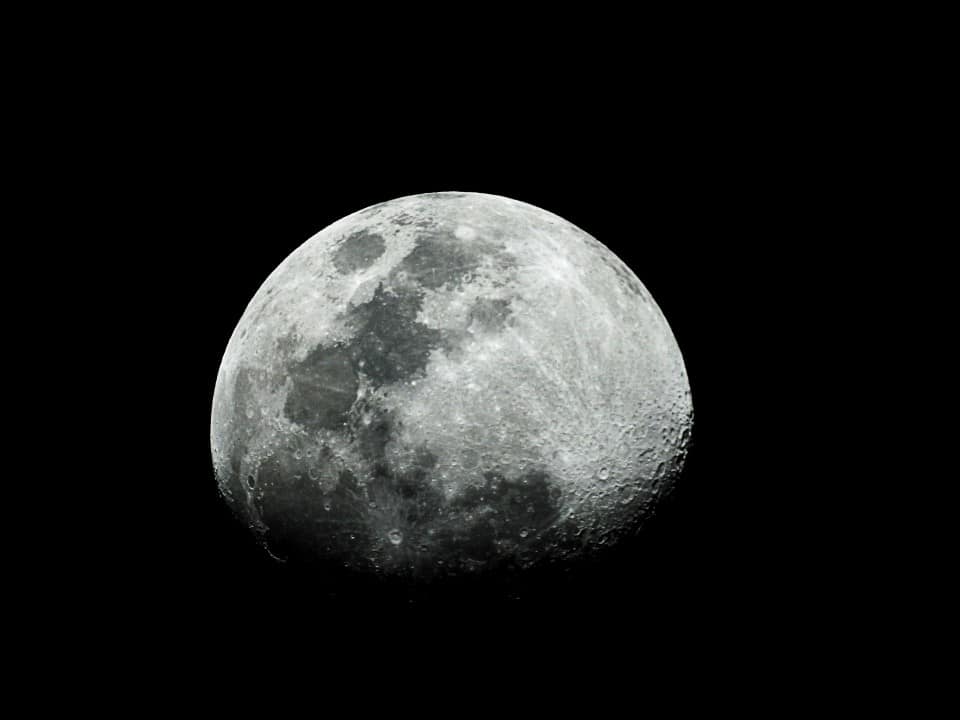
The natural satellite of Terra reaches a specific orbital stage when recording exactly sixty percent of its visible face illuminated by Sol. The astronomical phenomenon characterizes the waning gibbous phase, a moment of transition in which the bright portion undergoes a progressive reduction each night, altering the visual dynamics in the night sky.
The change in the star’s configuration establishes a highly favorable scenario for scientific observation. Institutos researchers use this window of opportunity to identify celestial bodies more easily, taking advantage of the reduction in light interference in the Earth’s atmosphere.
The distance from the full phase eliminates the intense glare that usually hinders image capture by large telescopes. The gradual dimming creates ideal conditions for tracking asteroids and collecting data fundamental to modern astronomy.
Geometric alignment and shadow advancement
The darkening of the lunar disk occurs due to the position established between Sol, Terra and Lua during the synodic cycle. The physical process extends until the complete renewal of the phases, which lasts on average twenty-nine and a half days, dictating the rhythm of terrestrial observations.
The terminator line, responsible for dividing day and night on the satellite’s surface, advances steadily over basalt plains and ancient craters. The continuous movement reveals unique topographic textures and provides a detailed field of study for high-resolution optical magnification equipment.
Atmospheric conditions and nighttime visibility
The current sixty percent illumination index indicates an imminent proximity to the last quarter phase, changing observation times. Orbital movement causes the celestial body to be born later and later, becoming visible predominantly during the early hours of the morning.
The inclination of the Earth’s axis and the position in the elliptical orbit determine the apparent height of the satellite during the monitoring period. Instrumentos measurements confirm that the rate of decrease in the illuminated area accelerates as perpendicular alignment approaches the star of the solar system.
The absence of direct lunar light in the early evening clears the atmospheric field of view, allowing the capture of photons from remote stellar sources. Profissionais who monitor deep space plan their image collection sessions for exactly these hours of deep darkness.
Spatial geometry and precision mechanics
The phenomenon of phases results exclusively from the three-dimensional geometric relationship between the solar system’s light source, the planet and its natural satellite, operating under absolute precision mechanics that govern celestial bodies. The celestial body has a synchronized rotation, which means that it rotates around its own axis at the same rate as it orbits Terra, permanently maintaining the same face facing terrestrial observers at any point on the globe. As it advances in its orbit at an average speed of three thousand six hundred kilometers per hour, the angle at which sunlight strikes this visible face changes continuously, generating the phases we observe from the ground and influencing the amount of light reflected into the atmosphere. Quando is in the waning gibbous stage, the star has already surpassed the position of opposition to Sol and is heading back towards the spatial region located between the star and the planet, changing the lighting dynamics. Sunlight hits the sphere obliquely from Earth’s perspective, illuminating more than half of the disk, but with an area of shadow that grows progressively with each planetary rotation. The mathematical accuracy of this orbital mechanics allows space agencies to calculate the exact illumination for any future date with virtually zero margins of error. Esse level of predictability makes it easier to schedule rocket launches, execute artificial satellite maneuvers, and calibrate interplanetary navigation instruments that rely on clear visual references to operate safely in the vacuum of space.
Integration of tracking technologies
The advancement of digital technology has transformed the way astronomical data is processed and distributed to the international scientific community. Softwares spatial modeling uses complex algorithms to determine the exact position of celestial bodies in the night sky with extreme precision.
Computer programs provide real-time updates on the lighting percentage and traffic times on the local meridian. Modern Observatórios integrate this modeling information into their automated tracking systems in a continuous and uninterrupted manner.
Technological integration allows the telescopes’ domes and primary mirrors to automatically adjust to compensate for the planet’s rotation. The mechanism ensures that the target remains centered in the field of view during long periods of photographic exposure.
The dissemination of accurate data optimizes the organization of observation campaigns and the scheduling of research at universities. Centros dedicated to the study of the universe depend on this synchronization to maximize the use of radio telescopes and equipment with high operational costs.
Technical protocols and sensor calibration
To optimize data collection during the sixty percent lighting period, research centers adopt rigorous technical protocols that guarantee the integrity of the captured images. Calibration of the image sensors is performed to deal with the extreme contrast between the illuminated area and the shadow of the lunar terminator, requiring fine adjustments to the capture equipment. The standardized procedures involve a series of steps that are fundamental to the success of ground-based astronomical observation missions, preventing the residual glow from overshadowing distant galaxies.
Technical teams perform specific configurations before each night monitoring session, ensuring that the telescopes operate at their maximum resolution capabilities. Thorough preparation of the machinery is essential to capture the depth of the winding valleys and mountain ranges that make up the rugged relief of the natural satellite. Entre the main actions adopted by the observatories to ensure the quality of the data collected, the following operational measures stand out:
– Ajuste of neutral density filters in refracting telescopes to avoid pixel saturation in high sensitivity cameras.
– Sincronização of the equatorial tracking engines with the star’s apparent displacement speed in the night sky.
– Previous Mapeamento of the craters positioned on the light dividing line for absolute focus calibration.
– Continuous Verificação of local atmospheric conditions to minimize optical distortions during spatial data capture.
Geological analysis and surface mapping
The detailed analysis of the shadows cast by the rugged terrain offers crucial information about the geological formation of the natural satellite. The grazing angle of sunlight during this specific phase highlights elevations and depressions that would go unnoticed under direct lighting, allowing planetary geology teams to update topographic maps and identify potential locations for future space exploration missions.
