
Astronomers are analyzing the possibility that intense non-gravitational braking in interstellar objects represents a technological signature. Astrophysicist Avi Loeb discusses how such a slowdown could reduce the positive kinetic energy of these bodies and allow them to become gravitationally bound to the Sol. Essa condition requires a non-gravitational acceleration that exceeds limits expected for natural processes such as ice sublimation.
Interstellar objects are identified by having positive energy relative to Sol, which means speeds greater than the escape velocities of Sistema Solar. Longe of Sol, this energy manifests as pure kinetic energy. As they approach, the local speed varies according to the conservation of energy under gravitational influence. Qualquer An object that exceeds the local escape velocity is classified as interstellar, with a value of 42.1 km/s calculated in the orbit of Terra.
- Objects with energy E > 0 travel faster than the solar escape velocity.
- The equation v² = U² + 2GM/r relates local speed, interstellar speed and distance to Sol.
- Non-gravitational accelerations change this dynamic differently than gravity.
Non-gravitational acceleration changes the trajectory of interstellar visitors
Non-gravitational acceleration, such as that caused by outgassing or the rocket effect, changes the energy of the object as it approaches. Quando Directed to brake the body, it reduces positive kinetic energy. If this reduction exceeds the initial positive energy value, the object may become gravitationally bound to Sol instead of escaping.
In the simple case of acceleration that varies as 1/r² and points against velocity, the condition for trapping involves A*r greater than half of U², where U is the initial interstellar velocity. Essa relationship compares to the gravitational acceleration g = GM/r². Para natural objects, the acceleration resulting from ice sublimation is limited to very small values close to Terra, typically A/g less than 0.0001.
This limitation arises because the release of gases occurs at thermal velocities hundreds of times lower than that of solar exhaust. Portanto, Natural icebergs cannot produce enough braking to drastically alter their escape trajectory.
Example of the 3I/ATLAS object illustrates limits of natural braking
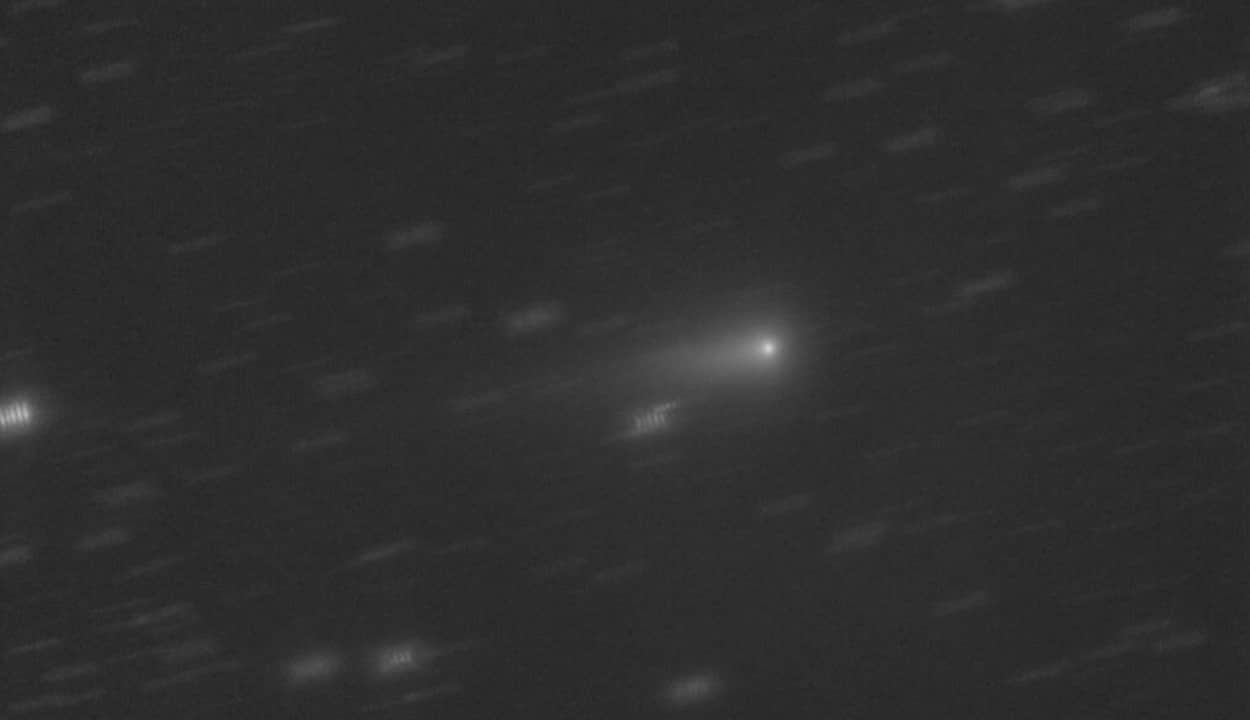
The interstellar object 3I/ATLAS entered Sistema Solar with an interstellar speed of 58 km/s. At its perihelic distance of 1.36 times the separation Terra-Sol, the local escape velocity was 36 km/s. Para for it to slow down enough and remain attached to the Sun, a non-gravitational acceleration with A/g greater than 2.6 would be necessary.
Measurements indicate that the actual non-gravitational acceleration observed in 3I/ATLAS is only about 0.0001 relative to the gravitational one. Essa Magnitude is insufficient to cause imprisonment. The same limit applies to any fragments released, as the condition does not depend on the mass of the body.
The 3I/ATLAS object did not exhibit any deceleration capable of keeping it at Sistema Solar. Sua trajectory remained hyperbolic, allowing exit after passage. Análises confirm that the measured acceleration remains compatible with conventional cometary processes, albeit at low levels.
Observatory Rubin prepares detection of new interstellar objects
Observatório Vera C. Rubin, operated jointly by the NSF and Estados Unidos’s Departamento, has released preliminary data that anticipate the potential discovery of dozens of new interstellar objects over the next decade. Essa Improved capability allows you to accurately monitor trajectory deviations and non-gravitational accelerations of these visitors.
If any future object slows down enough to become gravitationally bound to Sol, scientists will need to carefully evaluate the nature of that braking. Tal behavior would raise the classification on the scale proposed by Loeb for interstellar objects, approaching levels that require consideration of technological origin.
Condition details for technological signature in braking
Strong non-gravitational braking contrasts with known natural mechanisms. Acelerações measurements on Sistema Solar comets or on objects such as 1I/’Oumuamua and 3I/ATLAS remain orders of magnitude below that required for trapping in cases of high interstellar velocity. Isso reinforces the distinction between sublimation processes and possible artificial mechanisms.
Calculations show that, for 3I/ATLAS, the A/g factor required for permanence was greater than 2.6, while the observed value was around 0.0001. Essa discrepancy highlights that only an exceptionally intense non-gravitational force could alter the orbital fate significantly.
- Natural acceleration limited by thermal velocity of gases.
- Hypothetical technological braking capable of overcoming multiples of gravity.
- Independent application of putty to fragments or main body.
Kinetic energy analysis guides object classification
The object’s total energy evolves depending on the distance to Sol, but non-gravitational forces introduce additional terms that reduce the positive component. Quando this reduction exceeds the initial value, the net energy becomes negative and the body begins to orbit the Sol. Essa transition serves as a quantitative criterion to identify anomalous behavior.
Astronomers use equations such as E = -GM/r + (1/2)v² to model motion. The inclusion of acceleration A[r] allows simulating scenarios where braking acts as a brake, reducing the effective escape velocity. Observações future instruments like Observatório Rubin will help test these models in real time.
Precise measurements define current observational limits
Data collected from 3I/ATLAS, including analyzes of radial acceleration and lateral components, indicate values consistent with limited outgassing. The absence of intense braking confirms that the object follows Sistema Solar’s exit trajectory. Estudos complementary ground- and space-based telescopes refine these parameters without changing the main conclusion.
The classification scale for interstellar objects considers multiple indicators, including non-gravitational accelerations that exceed natural limits. Níveis Higher on the scale reserve space for anomalies that require additional investigation into possible artificial origins. Até At the moment, 3I/ATLAS does not reach these levels based on the observed braking.
Rubin Observatory Expands Search for Anomalies in Cosmic Visitors
Initial data from Observatório Rubin already contributes to the monitoring of distant bodies and objects in interstellar transit. The instrument’s sensitivity allows it to detect subtle deviations in the trajectory and photometric variations that complement dynamic analyses. Essa Future infrastructure will significantly increase the number of accurately characterized interstellar objects.
Scientists hope that the volume of data in the coming decades will reveal whether patterns of strong non-gravitational braking occur in other cases. Qualquer detection satisfying the A/g condition greater than the square of the ratio of interstellar to escape velocity would trigger detailed verification protocols.
The astronomical community maintains a focus on unbiased measurements to distinguish natural phenomena from possible technological signatures. The debate over non-gravitational accelerations in objects like 3I/ATLAS and predecessors continues to drive refinements in orbital and physical models.
