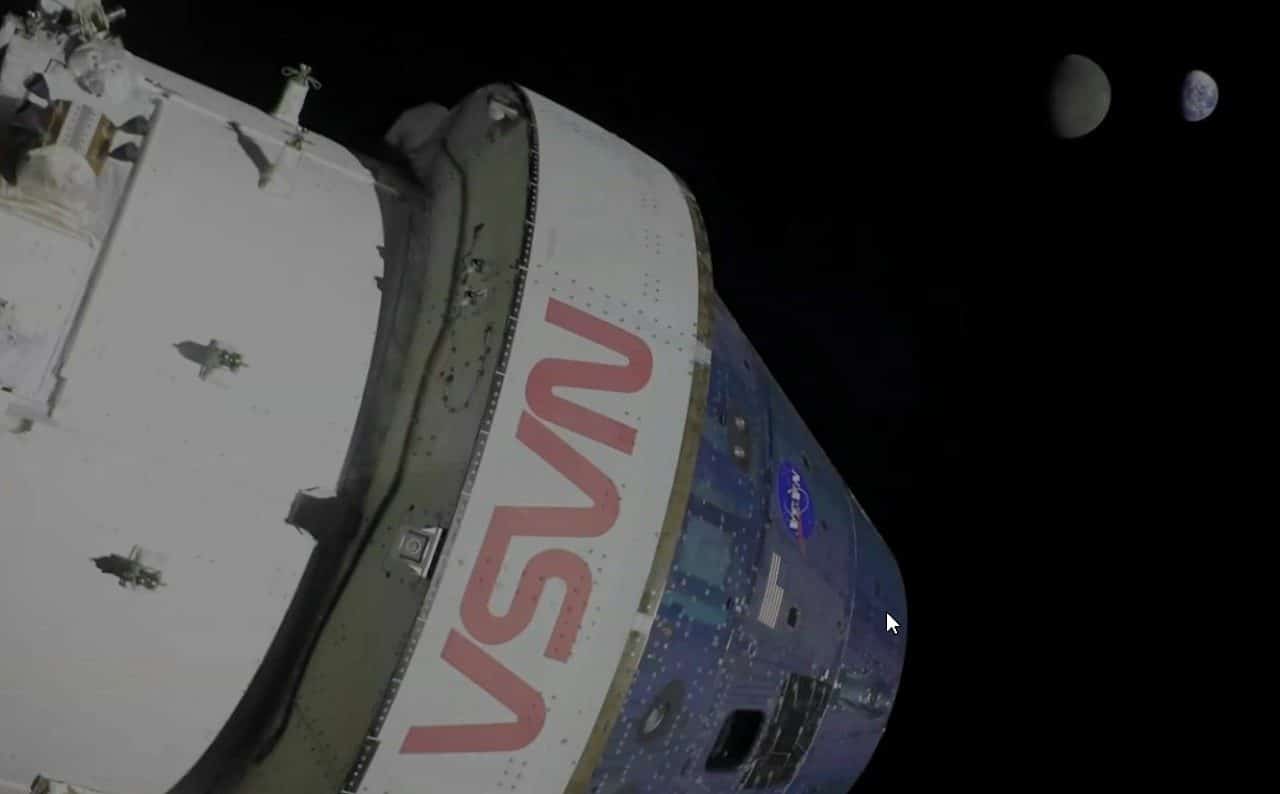
Capsule Orion from mission Artemis II, named Integrity, performs final maneuvers for re-entry into the Earth’s atmosphere this Friday. The four astronauts on board completed the first manned flight around Lua since the Apollo era. The journey included detailed observations of the far side of the natural satellite and transmission of high-resolution images of Terra and the lunar surface.
Commanded by Reid Wiseman, crew members Victor Glover, Christina Koch and Jeremy Hansen surpassed Apollo’s manned distance record 13. Durante lunar flyby, the team recorded newly named craters, including one named of Integrity in honor of the capsule itself and another called Carroll, in memory of the commander’s deceased wife.
High-speed data transmission marks the mission’s technological advancement
The mission transmitted up to 38 gigabytes of data per day via laser communication. Esse volume allowed the sending of clear images that show the geological history of Lua over 4.5 billion years. The records capture everything from the initial state of molten rock to the marks of accumulated impacts, including flashes of objects reaching the surface without atmospheric burning.
The astronauts maintained contact with Estação Espacial Internacional during part of the trip. Houve also a period of seven to eight hours on the hidden side of Lua, with a communications blackout of around 40 minutes, in which the crew performed trained tasks with precision.
Images from Terra highlight the planet’s fragility and inspire scientific reflection
Photographs of Terra seen from lunar orbit reinforce the perception of a unique and vulnerable planet shared by all humanity. Especialistas analyze these records to better understand the formation of Lua from an ancient collision with a body the size of Marte. The atmosphereless lunar surface preserves direct evidence of impacts, including from interstellar objects reaching the solar system.
Researchers monitor this data to study the composition and origin of materials coming from outside the solar system. The absence of a lunar atmosphere makes it easier to observe traces that would be erased in Terra.
Search for extraterrestrial intelligence gains momentum with advances in space exploration
Astrophysicist Avi Loeb, in recent interviews, associated the results of Artemis II with the question about possible cosmic neighbors. Ele highlighted that Via Láctea contains about 100 billion stars, with approximately 10% of those similar to Sol having planets the size of Terra in habitable zones. Condições chemicals similar to those of primitive Terra could have generated life in other places.
Loeb mentioned projects like Galileo Project, which uses ground-based observatories and expeditions to analyze interstellar materials. Ele advocated for greater transparency in government sensor data and the use of future telescopes to detect biosignatures such as oxygen in exoplanetary atmospheres.
Scientists advocate installing instruments on the hidden side of Lua
The lunar face facing away from Terra offers an environment free from terrestrial radioelectric interference. Especialistas propose placing radio telescopes and optical interferometers at this location to expand the search for signs of artificial or natural intelligence. Mission Artemis II demonstrated the capability of real-time operations even with limited communication windows.
These instruments could complement studies of interstellar impacts preserved in Lua. Lunar exploration continues to provide data that fuel debates about the origin and distribution of life in the universe.
Crew prepares for controlled reentry and splashdown at Pacífico
Capsule Orion adjusts its trajectory to enter the Earth’s atmosphere at an altitude of approximately 400,000 feet. The heat shield is designed to withstand extreme temperatures during deceleration. Equipes rescue personnel await landing on the coast of Califórnia to recover the astronauts and begin medical evaluations.
NASA followed every step with daily briefings. The success of Artemis II paves the way for future missions, including Artemis III, which plans to return humans to the lunar surface.
Mission details reinforce international cooperation and American innovation
The participation of Canadian astronaut Jeremy Hansen symbolizes collaboration between space agencies. The crew performed manual and automatic maneuvers that tested Orion systems in a deep space environment. Imagens and collected data are already beginning to be analyzed by scientific teams on the ground.
The flight tested communications between vehicles in orbit and ground control centers. Preliminary Resultados indicate better performance than previous missions in transmitting information volume.
- Capsule Integrity completed lunar flyby without major incident.
- Laser transmission surpassed capabilities of missions Apollo.
- Observations included nuances of color on the lunar surface.
- Splashdown scheduled for Oceano Pacífico next to San Diego.
- Recovery will involve helicopters and support ship from Marinha.
Technological advances open new frontiers for astronomical research
The ability to transmit large volumes of data in real time transforms the monitoring of celestial bodies. Cientistas plan to expand the use of lunar instruments to study both local geology and interstellar phenomena. Esses efforts contribute to understanding whether conditions similar to Terra have emerged in other cosmic environments.
The mission also highlighted the importance of protecting the shared planet, clearly visible in images sent back from lunar orbit. Dados collected continue to be processed for future scientific publications.
The Artemis II fulfilled the main objectives of systems testing and observation collection. The crew’s safe return marks another step in preparing for sustainable lunar exploration and investigating possibilities beyond the solar system.
